
…Commends FG, Ministry of Petroleum Resources, and NUPRC for conducting an automated, market-driven process under PIA.
…Says awarding blocks is only the catalyst converting exploration licenses into daily producing volumes.
-Felix Douglas
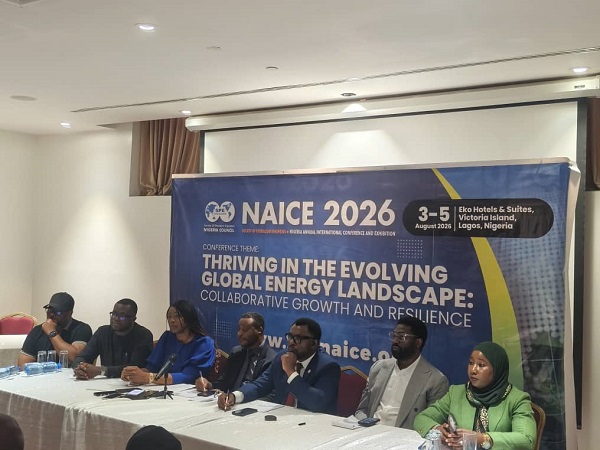
The Society of Petroleum Engineers (SPE) Nigeria Council officially flags off activities for the 49th Nigeria Annual International Conference and Exhibition (NAICE 2026), taking place from August 3rd to 5th, 2026, at the Expo Centre, Eko Hotel & Suites, Victoria Island, Lagos.
Speaking at a Press Conference, Chairman, SPE Nigeria Council, Engr. Francis Nwaochei, made it known that this year’s theme, “Thriving in the Evolving Global Energy Landscape: Collaborative Growth and Resilience,” directly reflects the structural realities facing the sector.
Globally, investment flows, technology adoption, geopolitics, and decarbonization strategies are shifting rapidly. Energy security and environmental sustainability can no longer be treated as distinct agendas—they must advance in tandem.
According to Engr. Nwaochei, for Africa, resilience cannot be a passive defense against market volatility; it must be an active, competitive strategy. The continent faces the dual imperative of eliminating energy poverty and accelerating industrial growth while managing environmental expectations. These goals cannot be achieved in silos. True resilience requires an integrated ecosystem where regulators, operators, service providers, technology developers, and financial institutions align to drive down unit operating costs, de-risk investments, and unlock capital.
“As a neutral, non-political technical body, SPE Nigeria Council provides the definitive platform to convert these strategic imperatives into execution.”
SPE Nigeria Council commends the Federal Government, the Ministry of Petroleum Resources, and the NUPRC for conducting an automated, market-driven process under the Petroleum Industry Act (PIA).
The SPE Chairman told journalists that NAICE 2026 will serve as the first major industry platform where the operational and commercial execution of these newly awarded assets will be decoded.
Awarding blocks is only the catalyst; converting exploration licenses into daily producing volumes requires rapid technology deployment, reservoir precision, and disciplined capital mobilization. This directly supports Nigeria’s national target of achieving 3 million barrels per day (bpd) by 2030.
“Concurrently, the ongoing portfolio rebalancing by International Oil Companies (IOCs) toward deepwater assets has placed indigenous independent operators at the center of domestic onshore and shallow-water production which is now accounting for roughly 60% of national supply. Indigenous companies must demonstrate both operational excellence and financial bankability as they assume asset stewardship, manage decommissioning liabilities, and drive field optimization.”
In the downstream, the scaling of world-scale private refineries alongside modular facilities is turning Nigeria into a regional refining hub. Sustainable energy security requires commercial harmony: enforcing Domestic Crude Supply Obligations (DCSO) under the PIA while preserving market-based returns and contract sanctity for upstream producers, Engr. Nwaochei added.
The SPE Chairman explained that expanding gas commercialization and maximizing condensate volumes which fall outside OPEC crude limits—provide immediate fiscal runway.
“To fund these capital-intensive projects amid Western commercial bank pullbacks under ESG mandates, Africa is structuring its own financial solutions. The operationalization of the African Energy Bank (AEB) in Abuja, by September this year hopefully, alongside regional syndicates and private equity, provides a critical framework to secure energy sovereignty and capital access.”
On infrastructure security, the SPE Chairman noted that technical solutions—such as digital twin monitoring, fiber-optic pipeline surveillance, and automated metering—are essential technical safeguards. However, technology must operate alongside the Host Community Development Trusts established under the PIA to ensure lasting security across production corridors.
SPE Nigeria Council maintains that Africa requires a pragmatic, just, and balanced energy transition. Hydrocarbons will remain vital to driving African industrialization, manufacturing, and grid stability for decades.
Concurrently, carbon competitiveness is now a commercial imperative. With international markets enforcing carbon border penalties, reducing emission intensity—by eliminating routine gas flaring, curbing fugitive methane, and electrifying remote assets—is essential to keep Nigerian crude competitive globally. Natural gas remains our vital transition fuel to power domestic growth and stabilize renewable energy integration.
The SPE event will highlights program of NAICE 2026 and offers a comprehensive outcome. It is also expected that about 15,000 participants will grace the event within and outside the shores of the country.
Comment here