
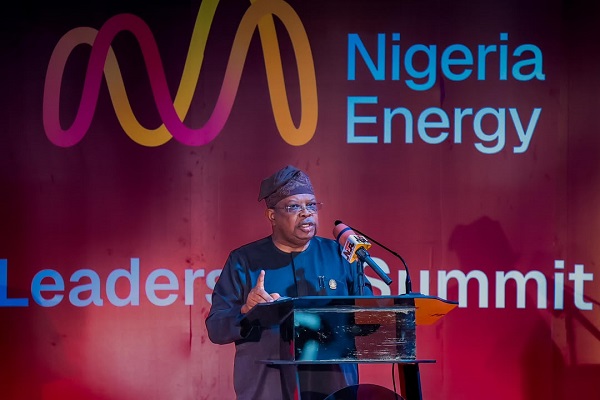
Joseph Tegbe, Minister of Power
…Minister unveils phased reform plan, seven-million-meter rollout and measures to address ₦3.3trn sector debt
-Felix Douglas
Nigeria is targeting 70 gigawatts (GW) of electricity generation capacity by 2030 as the Federal Government intensifies efforts to stabilise the national grid, improve sector liquidity, optimise existing infrastructure and attract fresh investments into the power sector.
The Minister of Power, Joseph Tegbe, disclosed this while outlining the government’s reform agenda at Nigeria Energy Summit in Lagos, where he identified three priority energy corridors: Lagos–Ogun, Enugu–Onitsha–Port Harcourt, and Abuja–Kaduna–Kano.
According to the minister, the strategy is designed to address critical bottlenecks across the electricity value chain while concentrating interventions in areas where improved power supply could deliver significant economic benefits.
Tegbe explained that the government’s approach recognises that increasing installed generation capacity alone would not resolve Nigeria’s electricity challenges without adequate transmission infrastructure, efficient distribution networks, effective metering and a financially sustainable electricity market.
“High innovation requires more than just installed capacity. It demands a system capable of converting available energy into reliable service,” he said.
Three-phase reform programme
The minister outlined a three-phase implementation plan to stabilise and transform the power sector.
The first phase, which began in June 2026 and is scheduled to run until February 2027, focuses on stabilisation. The second phase, scheduled for March 2027 through 2028, will concentrate on scaling up interventions, while the third phase, beginning in 2028, will focus on transformation.
He said the implementation process would be guided by defined milestones and measurable service outcomes.
As part of the initial measures, the ministry has commenced technical audits of Nigeria’s power infrastructure to identify critical weaknesses and determine where investments would deliver the greatest impact.
Tegbe added that the exercise, which had been underway for about four weeks at the time of his address, was intended to prevent the misallocation of resources by providing a clear assessment of existing infrastructure and the interventions required across generation, transmission and distribution.
“We don’t want to throw money at the wrong things,” he said, explaining that the findings would guide the prioritisation of investments and infrastructure upgrades.
Lagos–Ogun corridor takes centre stage
The minister identified the Lagos–Ogun corridor as a major priority, citing its concentration of commercial and industrial activities and its substantial electricity demand.
He said the corridor accounts for approximately 50 per cent of Nigeria’s electricity demand, making it a strategic starting point for interventions intended to improve power supply and support economic growth.
The government is also prioritising the Enugu–Onitsha–Port Harcourt corridor, which connects industrial, energy and trading centres across the South-East and South-South, as well as the Abuja–Kaduna–Kano corridor, which links manufacturing, agriculture, commerce and a large consumer market in northern Nigeria.
Tegbe was of the view that the three corridors will serve as proof-of-concept areas for a broader national programme.
He stressed that the initiative was not intended to override state-level electricity market reforms but to align federal, state and private-sector investments.
The minister disclosed that he had held discussions with the Lagos State Government and key electricity sector stakeholders, including the Transmission Company of Nigeria (TCN) and the Nigerian Independent System Operator (NISO), on a strategy to improve electricity supply across the Lagos corridor.
He added that the government would work with state governments, regulators and private operators to ensure that infrastructure development and electricity market initiatives complemented one another.
The minister also highlighted the need for additional substations in Lagos to meet growing demand from commercial developments, data centres and expanding industrial clusters.
He said the corridor-based approach would enable the government to concentrate resources in areas where improvements in electricity supply could generate measurable economic benefits before extending successful interventions to other parts of the country.
Seven million meters planned in three years
On sector liquidity and financial sustainability, the minister disclosed that the government was pursuing measures to reduce technical and commercial losses while improving electricity revenue collection.
He identified the Presidential Metering Initiative (PMI), the Distribution Sector Recovery Programme (DSRP) and the Meter Acquisition Fund (MAF) as key instruments supporting the effort.
The government, he said, plans to deploy seven million electricity meters nationwide over the next three years.
He noted that effective metering was essential to ensuring that electricity generated and delivered to consumers translated into revenue for operators across the value chain.
According to him, inadequate metering, estimated billing and weak collection systems have contributed to persistent financial difficulties in the electricity market.
The minister also disclosed plans to expand local technical capacity, saying 5,000 young Nigerians had been trained for meter installation and repairs, with a longer-term target of training 50,000 young people.
He said the programme would strengthen local content, create employment opportunities and improve the maintenance of metering infrastructure.
Beyond procurement and installation, he added, the government would focus on consumer enumeration, reliable data, functional billing systems and sustained meter maintenance.
He also noted that the growing use of solar and hybrid electricity systems alongside grid supply made it necessary to improve technical expertise and adapt metering technology to changing consumer needs.
Government addresses ₦3.3trn sector debt
The minister put the accumulated debt in the electricity sector at approximately ₦3.3 trillion, disclosing that the government had paid down ₦1.23 trillion.
He said the administration was working to resolve legacy obligations while preventing the accumulation of new liabilities.
Potential measures under consideration include structured settlements, payment assurance mechanisms and legally permissible net-off arrangements for eligible obligations.
The government is also seeking to reduce revenue leakages and improve the commercial arrangements underpinning electricity generation, transmission and distribution.
The minister explained that without stronger revenue collection and sustainable payment arrangements, operators would struggle to maintain infrastructure, invest in new capacity and deliver reliable electricity.
Government targets stranded power, promotes bilateral contracts
The minister identified asset optimisation as another pillar of the reform programme, saying the government intended to establish stronger commercial and operational links between available electricity capacity and identifiable demand centres.
He said the initiative would explore ways to utilise idle or stranded generation capacity through existing transmission lines, reconductoring of infrastructure and independent transmission projects.
The objective, he explained, is to ensure that available electricity reaches industrial and commercial consumers who need it, rather than remaining stranded because of infrastructure or market constraints.
The government is also encouraging bilateral electricity contracts between generation and distribution companies where commercial conditions permit.
The minister said such arrangements could improve the utilisation of available capacity, strengthen commercial relationships and reduce the accumulation of unpaid obligations.
He further signalled plans to strengthen the operations and financial structures of key public-sector institutions, including TCN, NISO and the Nigerian Bulk Electricity Trading Plc (NBET).
Tegbe submitted that the government was exploring asset management and financing arrangements that could support credible investment while protecting public interests.
Grid expansion and renewable energy investments
Looking beyond immediate stabilisation measures, the minister reaffirmed the government’s ambition to increase Nigeria’s electricity generation capacity to 70GW by 2030.
He acknowledged the gap between the target and the country’s current electricity supply challenges but argued that long-term planning was necessary to accommodate future demand from industry, technology, data centres and population growth.
The government’s medium- to long-term plans include an expanded East-West Grid programme intended to improve connectivity across major economic corridors and strengthen the resilience of the national transmission network.
The minister also highlighted the potential of small hydropower projects, saying the ministry was developing a policy framework to support their development.
He disclosed that 21 dams had been identified along the Sokoto–Badagry corridor for possible development and said the President had directed that their potential be assessed to determine how they could support hydropower generation.
He added that major projects, including the Mambilla hydropower project, would require sound legal, environmental, technical and commercial frameworks to support implementation.
According to him, smaller hydropower facilities could also support agricultural corridors, agro-processing centres and communities.
The minister said these initiatives would help diversify Nigeria’s energy mix while supporting the country’s broader economic development objectives.
Tinubu’s reforms and electricity market decentralisation
The minister attributed the government’s reform direction to President Bola Ahmed Tinubu’s administration, highlighting the Electricity Act 2023 as a major legislative development that expanded opportunities for states and private-sector participation in electricity markets.
He explained that the law enabled states to establish and regulate electricity markets within their jurisdictions, subject to the applicable legal and regulatory framework, while maintaining the need for coordination across the wider power system.
According to him, the decentralisation of electricity markets would allow state governments to develop solutions suited to their specific needs and attract investments beyond the traditional federal electricity structure.
He cited Lagos as an example of the need for cooperation between state and federal authorities to align infrastructure development, electricity supply and market reforms.
The minister also referenced government-backed interventions aimed at addressing outstanding obligations to generating companies and improving the delivery of electricity infrastructure.
He said collaboration among federal and state governments, regulators, investors and electricity operators would be essential to implementing the reform agenda.
Reliable electricity as a driver of economic growth
The minister stressed that the ultimate objective of the reforms was not simply to increase electricity generation but to improve productivity, industrialisation and living standards.
He said reliable electricity would enable manufacturers to plan production more confidently, help farmers and agro-processors preserve the value of their harvests, and allow technology companies to expand without relying entirely on costly private power infrastructure.
He also emphasised the importance of developing local technical skills and creating employment opportunities for young Nigerians through the expansion and maintenance of electricity infrastructure.
“The destination is a productive and prosperous nation. Electricity is just a foundation to build productivity, to build prosperity, and industrialise Nigeria,” he said.
The minister acknowledged that the challenges facing the sector could not be resolved overnight but maintained that a phased approach, focused investments and stronger coordination among stakeholders would help improve electricity supply.
He urged industry participants and government officials to use the discussions to develop practical solutions capable of translating Nigeria’s energy resources and infrastructure investments into reliable power for households, businesses and industries.
Comment here