
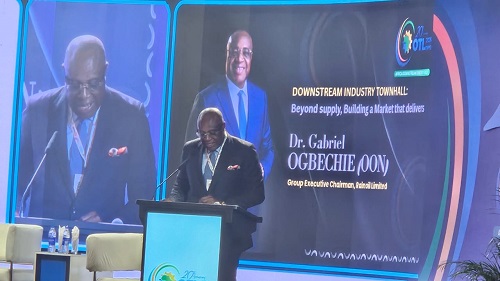
Dr Gabriel Ogbechie
Group Executive Chairman of Rainoil Limited, Dr Gabriel Ogbechie has expressed that Nigeria’s downstream industry has moved from product availability concerns towards a market where customer choice, supply economics and execution increasingly determine who wins
He also listed five priorities for marketers to win the customer in Nigeria’s evolving downstream petroleum market.
Ogbechie stated this in his presentation titled “Winning the Customer in Nigeria’s Evolving Downstream Petroleum Market” at the 20th anniversary edition of the OTL Africa Downstream Energy Week in Lagos with the theme “Secure Energy, Shared Prosperity;;
Providing context of the transition, he said Nigeria’s four state refineries with 445,000 barrels per day capacity operated at just 7% average utilisation in 2020, but following subsidy removal in May 2023, Dangote commenced refining in 2024.
According to him, the market has moved from import dependence to domestic refining, and from net importer to net exporter, he said.
According to the presentation, by Q2 2026, refined product exports reached approximately 55 million litres per day while imports fell below 20 million litres per day.
Also, Refined product export earnings reached US$3.94 billion, up 148% year-on-year, with Dangote supplying 71% of domestic PMS receipts in August 2026.
He noted that the industry has also moved from availability to affordability constraints, with PMS (petrol) remaining Nigeria’s dominant tracked fuel, accounting for 72% of combined fuel consumption, while PMS daily consumption declined from 60.2 million litres per day in January 2026 to 41.5 million litres per day in August 2026.
On how to win, Ogbechie listed three levers: Customer Service, Accurate Measurement, and Automation.Customer Service – Competing on Value, Not Just Price:In a buyer-led market, customer experience becomes a source of margin protection and loyalty, he said, citing NACS 2025 Report that 55.9% of downstream industry respondents cite seamless customer experience as a key challenge.
He listed three winning areas:Speed and reliability: Transparent pricing, operationally reliable pumps, minimal downtime, dependable opening hours and reduced stock-outs.Convenience and choice: Cashless payment, fuel cards, loyalty rewards, digital receipts and relevant non-fuel offerings such as lubricants and convenience retail.
Consistency across the network: Common service standards, empowered attendants, prompt complaint resolution and dealer incentives aligned with customer satisfaction.
“Move the discussion beyond courtesy at the pump. Customers may come for the price, but they return for reliability, convenience and trust,” he said.
Rainoil examples cited include policy on zero product stock-outs in all retail outlets, station look and feel across network, annual customer satisfaction survey and Customer Service Week celebration.
On Accurate Measurement – The Foundation of Trust:”Every litre must be right — for the customer, the marketer and the integrity of the market,” Ogbechie said.
He noted that 59% of downstream industry respondents reported fuel variance above 1% of sales (NACS 2025 Report).
He called for investment in verified dispensing equipment, regular calibration, stock reconciliation, documented custody transfer and controls that flag unusual losses, noting that digital records make measurement discrepancies traceable and actionable.”Regulators, in turn, should provide clear standards, risk-based inspection and consistent enforcement across the market. Every litre is a promise. Measurement integrity is how the industry keeps that promise,” he said.
He noted that Rainoil examples include routine tank calibration and maintenance and daily sales and stock reconciliation, Automation – From Manual Operations to Intelligent Networks:”Automation turns service standards and measurement controls into repeatable performance at scale. Automation should not merely digitise yesterday’s processes; it should redesign how the industry serves customers and protects value,” he said.
He listed six automation priorities :Automate forecourt operations; bring technology to the pumps and replace forecourt officers Eliminate transit losses; use technology to eliminate truck shortages Automated inventory and wet-stock management: Automatic tank gauging and real-time stock visibility.
Intelligent logistics and replenishment: GPS-enabled delivery tracking and electronic proof of delivery.Digital customer experience: Customer relationship management and targeted offers.AI-supported demand forecasting and pricing analysis, subject to reliable data and human oversight.
Rainoil examples: Installed Forecourt Controllers (FCC) and use of E-pump for real time sales monitoring and price setting, and use of fleet management system for logistics monitoring and control.
On integrating the three pillars, Ogbechie said customer service establishes a clear service commitment, accurate measurement ensures that the delivered quantity is verified and reconciled, and automation predicts replenishment needs, tracks delivery and generates exceptions when something goes wrong.
On Regulation, he said, ‘’’we should set clear rules, protect consumers and enforce compliance, while allowing efficient operators the freedom to innovate, invest and compete.”The competitive advantage will not necessarily go to the marketer with the most stations, the most expensive technology or the lowest advertised price. It will go to those that combine scale with disciplined execution, customer understanding and cost efficiency,” he said.
Ogbechie said the industry has moved beyond availability concerns to a buyer-led market where customer choice and execution determine winners.
He listed five priorities:which are Make customer service a leadership KPI, Institutionalize measurement integrity, Automate high-value processes first, Manage the economics of every location and Demand measurable returns, baseline, targets and accountable owners
“The future of downstream marketing is not just about moving more litres. It is about creating more value from every litre,” he said.
He noted that the competitive advantage will not go to the marketer with the most stations, the most expensive technology or the lowest advertised price, but to those that combine scale with disciplined execution, customer understanding and cost efficiency.
Comment here