
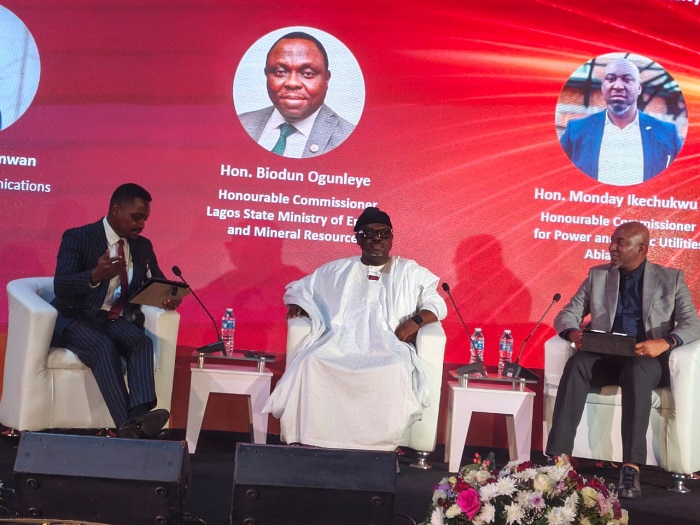
…Abia targets power expansion across 17 LGAs as Lagos advances embedded generation and gas infrastructure
-Felix Douglas
Abia and Lagos states have highlighted their efforts to develop independent electricity markets, strengthen power infrastructure and attract private-sector investment under Nigeria’s Electricity Act 2023.
The states outlined their strategies at a panel discussion on building functional electricity markets, where commissioners responsible for power and energy resources stressed the importance of state-level regulation, investor confidence, collaboration and the efficient use of local resources.
These conversations were made at the ongoing Nigeria Energy Summit in Lagos.
The discussion focused on how states could leverage the expanded powers provided by the Electricity Act 2023 to accelerate electricity generation, improve distribution and deliver more reliable power to households, businesses and industries.
Speaking on Abia State’s approach, the state’s Commissioner for Power and Public Utilities, Monday Ikpechukwu, described the electricity sector reforms as transformative, noting that states now have greater opportunities to develop solutions suited to their individual economic needs.
He said the administration was prioritising practical, incremental interventions to optimise available resources and address electricity challenges rather than attempting to solve every problem at once.
According to him, Abia has begun expanding electricity access in phases, with an initial focus on nine of its 17 local government areas.
He explained that the state was also exploring electricity clusters to serve communities, businesses and industrial facilities that could not be adequately supplied through the national grid.
The commissioner said renewable energy would play an important role in powering these clusters, particularly in locations where extending conventional grid infrastructure might be difficult or uneconomical.
He, however, stressed that state-level electricity reforms would require sustained collaboration with the Federal Government and other stakeholders, particularly in ensuring reliable gas supply for power generation.
Ikpechukwu noted that without dependable gas supplies, states could struggle to achieve the consistent electricity required to improve manufacturing, boost productivity and create jobs.
He urged states that had yet to establish their electricity laws and regulatory frameworks to learn from early movers, including Abia, Lagos and Enugu, rather than start from scratch.
“Any state that has established a good framework can serve as a model for others. You do not need to reinvent the wheel,” he said.
He also encouraged states to build electricity markets around their respective competitive advantages, explaining that Abia’s strengths lie in its people, enterprise and commercial activities.
Lagos establishes institutional framework
On its part, Lagos State said it had established key institutions and policy structures to support the development of a sustainable electricity market and create an enabling environment for private investors.
The state’s Commissioner for Energy and Mineral Resources, Abiodun Ogunleye, said the government had moved beyond legislation and policy formulation to focus on implementation, infrastructure development and investment mobilisation.
He explained that the state had established institutional arrangements for electricity regulation and market coordination, including mechanisms to monitor generation and distribution and provide greater confidence for investors across the electricity value chain.
According to the Commissioner, Lagos is pursuing a seven-point agenda to expand generation capacity, improve electricity supply and strengthen the market.
A major component of the strategy is the development of energy hubs, where investors can establish generation facilities, with the state offering land to encourage projects capable of generating at least 100 megawatts.
He said the government was working with gas suppliers, transmission stakeholders and other industry participants to support the initiative.
The commissioner also highlighted the Lagos Gas Initiative, which seeks to improve gas availability, support pipeline development and expand gas-processing capacity within the state.
He said the initiative was intended to improve access to gas for power plants and strengthen the reliability of electricity generation in Lagos.
Ogunleye added that the state was working towards a more transparent electricity market in which stakeholders could better track the contributions of producers and other participants across the value chain.
He said investor confidence remained critical to unlocking additional generation capacity, particularly from businesses and industries with excess electricity that could potentially be supplied to other consumers.
States urged to leverage local advantages
Both commissioners called on state governments to take advantage of the Electricity Act 2023 by establishing clear legal and regulatory frameworks that encourage private-sector participation.
They also emphasised that states should tailor their electricity strategies to their economic realities instead of adopting a uniform approach.
While Abia is leveraging its enterprise base and developing electricity clusters, the Lagos strategy places considerable emphasis on embedded generation, gas infrastructure and market coordination.
The panel also examined opportunities for cooperation between states, particularly in addressing shared electricity infrastructure and investment challenges.
Participants stressed that the Federal Government would continue to play an important role in supporting the emerging state electricity markets, while state governments should create conditions that allow private capital to drive expansion.
2028 outlook
Looking ahead to 2028, the commissioners expressed optimism that ongoing reforms could produce more decentralised electricity markets, greater private investment and improved power supply if institutional arrangements and infrastructure development progressed as planned.
The Abia commissioner said the state was working with New Era EDC and private investors to mobilise resources for electricity infrastructure to serve the remaining local government areas.
He called for sustained implementation of the Federal Government’s electricity reform initiatives and continued cooperation among industry stakeholders.
For Lagos, the commissioner said the state was targeting additional embedded generation capacity, including the development of smaller power assets that could improve electricity availability and reliability over the next 24 months.
He noted that the success of these plans would depend on establishing the necessary market structures, securing investment decisions and creating confidence that investors could recover their capital.
The discussion underscored the growing importance of state governments in Nigeria’s electricity reforms, with participants pointing to effective regulation, local solutions and private-sector investment as essential to building more reliable electricity markets.
Comment here