
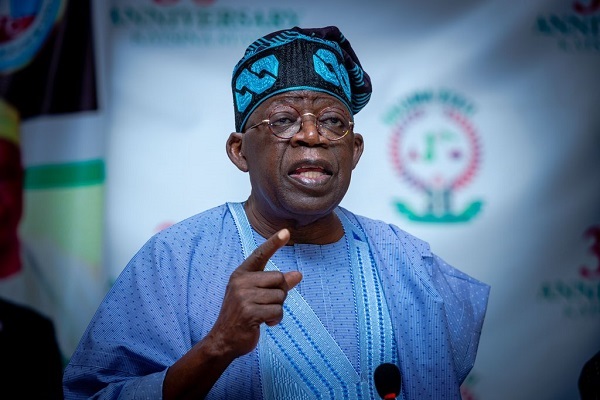
President Bola Tinubu
-Felix Douglas
President Bola Ahmed Tinubu has said Nigeria is positioning itself to become a major energy hub in Africa, driven by increased domestic refining, rising crude oil production, gas development and private-sector investment.
Tinubu stated this in an address delivered on his behalf by the Permanent Secretary of the Federal Ministry of Petroleum Resources at the 20th anniversary edition of the OTL Africa Downstream Energy Week in Lagos on October 26, 2026.
The President said Nigeria was transitioning from an economy historically characterised by petroleum product import dependence and infrastructure constraints to one increasingly driven by domestic refining, private investment, market efficiency and regional competitiveness.
He attributed the ongoing transformation to reforms under the Petroleum Industry Act, which he said were designed to establish a transparent, commercially viable and investment-friendly petroleum industry capable of delivering greater value to Nigerians.
According to him, Nigeria produced an average of approximately 1.50 million barrels per day of crude oil in October 2026, rising to 1.82 million barrels per day when condensates were included.
He said the country had maintained compliance with its Organisation of the Petroleum Exporting Countries quota for the fourth consecutive month, describing the development as evidence of the benefits of regulatory predictability, operational efficiency and investor confidence.
Tinubu, however, stressed that increasing production alone would not deliver the full economic benefits of Nigeria’s petroleum resources, noting that greater emphasis must be placed on domestic processing and value addition.
“For too long, Nigeria exported crude oil and imported a substantial proportion of the petroleum products required to power its economy,” he said, adding that the government’s objective was to build an integrated energy economy in which crude oil and gas generate greater domestic value through refining, petrochemicals, gas processing, manufacturing and other energy-intensive industries.
Dangote Refinery, Domestic Refining
The President identified the emergence of large-scale private refining capacity as a turning point for Nigeria’s petroleum industry, stating that the Dangote Refinery had reached its nameplate capacity of 650,000 barrels per day.
He said the development had strengthened Nigeria’s prospects of becoming a net exporter of refined petroleum products while creating opportunities to supply regional markets.
Tinubu also reaffirmed the government’s commitment to rehabilitating and repositioning existing state-owned refineries through technical assessments, stronger partnerships and improved operational discipline.
He said the goal was to ensure that Nigeria refined more of its crude oil locally, created additional domestic value and became a reliable energy supplier to other African countries.
Gas development to drive industrialisation
On natural gas, Tinubu said Nigeria’s proven reserves of more than 215 trillion cubic feet represented a significant opportunity to expand industrialisation, electricity generation and energy security.
He said the recently unveiled Gas Master Plan 2026 had set targets of increasing national gas production to 10 billion standard cubic feet per day by 2027 and 12 billion standard cubic feet per day by 2030, alongside efforts to mobilise investment across the gas value chain.
According to him, gas development would support electricity generation, compressed natural gas and liquefied petroleum gas utilisation, liquefied natural gas exports, petrochemicals and other gas-based industries.
He described natural gas as both an engine of industrialisation and a bridge towards a cleaner and more secure energy future.
“Our commitment is therefore not simply to produce hydrocarbons. It is to create an ecosystem in which hydrocarbons catalyse industrialisation, jobs, investment, technology and prosperity,” he said.
The President also reported improvements in domestic crude oil supply to local refineries during the second quarter of 2026, attributing the progress to stronger implementation of the Domestic Crude Supply Obligation and improved collaboration between producers and refiners.
Tinubu woos investors
Tinubu called on investors to take advantage of opportunities in Nigeria’s petroleum industry, citing the 2026 licensing round, which offers 40 oil and gas blocks across onshore, shallow-water and deep-water terrains.
He said the licensing round demonstrated the government’s commitment to attracting technically competent, financially capable and committed investors to develop the country’s petroleum resources.
The President also urged industry operators to increase investment in local content, technology, infrastructure, human capital, environmental responsibility and host-community development.
He maintained that the industry’s future should be measured not only by the extraction of natural resources but also by its contribution to domestic economic development.
“The era of extracting value without building value is changing,” he said.
Tinubu further emphasised Nigeria’s strategic position in Africa’s energy landscape, noting that its resource base, domestic market and entrepreneurial capacity could support its emergence as a continental energy hub.
He said the country intended to strengthen regional energy security through refined petroleum products, natural gas, LNG, petrochemicals and other energy solutions.
Congratulating OTL Africa on its 20th anniversary, the President commended the organisation for sustaining a platform that brings government officials, investors, regulators, operators and other stakeholders together to discuss the future of the energy industry.
He urged participants to develop practical solutions and lasting partnerships that would help transform Nigeria’s petroleum resources into economic value and strengthen Africa’s energy security.
Comment here