
-Felix Douglas
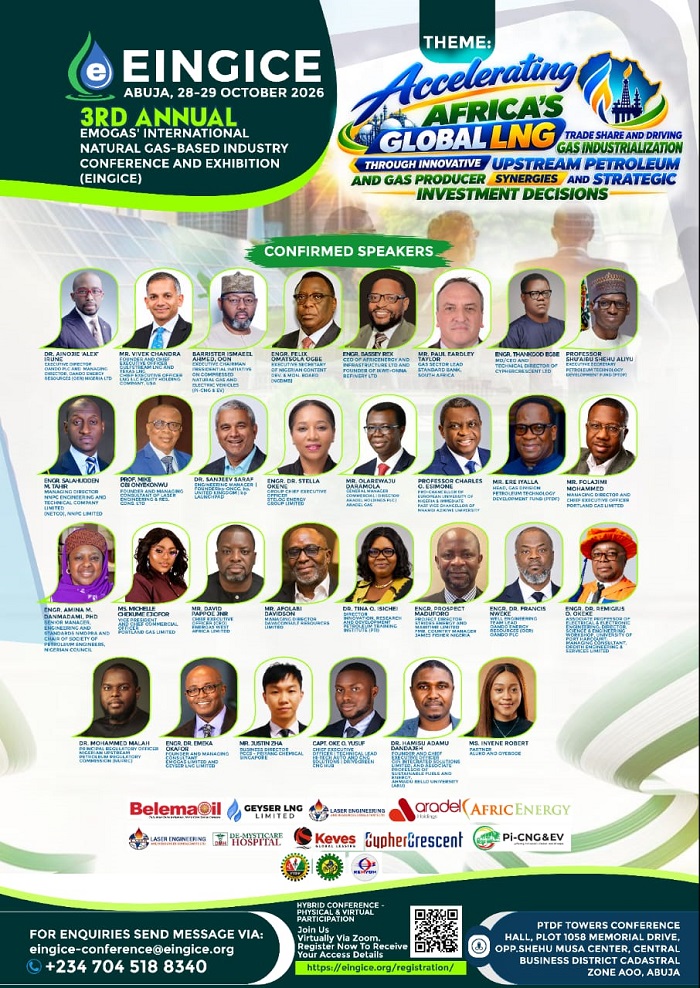
Dr. Emeka Okafor, Convener Emogas International Natural Gas-Based Industry Conference and Exhibition (EINGICE 2026); Founder and Managing Consultant, Emogas Limited, delivered his opening address in Abuja, calling on African governments and industry leaders to transform the continent’s natural gas resources into industrial growth, technological advancement and suitable economic prosperity.
Africa must move beyond the extraction and export of natural gas to harness its resources for industrialisation, technological advancement and economic prosperity, the Convener of the Emogas International Natural Gas-Based Industry Conference and Exhibition (EINGICE), has said.
Speaking under the theme, “Africa Must Turn Its Gas Wealth into the Industrial Power, Technological Strength and Economic Prosperity of Its People,” Dr. Okafor said Africa must prioritise the transformation of its natural gas resources into productive industries, indigenous technological capabilities and sustainable economic opportunities.
He stressed that the continent must move from resource possession to resource transformation, from potential to production, and from policy discussions to tangible investments and measurable results.
According to him, despite Africa’s substantial natural gas reserves, the economic benefits of developing these resources remain unevenly realised, largely due to infrastructure constraints, inadequate investment, regulatory uncertainties and limited industrial capacity.
The Emogas helmsman noted that natural gas could support electricity generation, fertiliser production, petrochemicals, industrial heating, gas-based manufacturing and modern energy infrastructure, while Liquefied Natural Gas (LNG), Compressed Natural Gas (CNG) and Liquefied Petroleum Gas (LPG) offer opportunities for domestic and international markets.
However, he emphasised that the availability of gas alone would not industrialise African economies without adequate infrastructure, investment and commercially viable projects.
“Gas industrialisation happens when resources are connected to infrastructure, infrastructure is supported by investment, investment creates productive enterprises, and productive enterprises generate jobs, value and opportunity,” he said.
Dr. Okafor called for increased investment in pipelines, processing facilities, LNG infrastructure, storage systems, distribution networks and industrial hubs to connect gas resources with markets and stimulate economic activities.
He also urged African governments to establish stable, transparent and predictable regulatory frameworks that encourage long-term investment while protecting the public interest.
Other priorities, he said, include strengthening collaboration among governments, national oil companies, indigenous producers, international operators, financial institutions and technology providers, as well as investing in technical education, research institutions and entrepreneurial development.
Addressing African political leaders, Dr. Okafor urged governments to make gas development a strategic instrument of national and regional economic transformation rather than merely a source of short-term revenue.
He further advocated regional cooperation through interconnected gas markets, shared infrastructure and industrial hubs that would enable gas-producing countries to supply feedstock to fertiliser plants, petrochemical facilities, manufacturing clusters and power systems across the continent.
On Africa’s participation in the global LNG market, Dr. Okafor pointed out that the continent must develop projects capable of competing internationally in terms of cost, reliability, financing, execution and long-term commercial value.
He explained that expanding Africa’s share of global LNG trade would require stronger coordination among upstream producers, gas companies, processing facilities, transportation operators, liquefaction plants, shipping companies and international buyers.
He identified infrastructure constraints, project delays, regulatory uncertainty and avoidable inefficiencies as some of the barriers that must be addressed to improve the competitiveness of African LNG projects.
He stressed that international LNG exports should complement, rather than undermine, domestic industrial development, noting that sound planning and commercially viable infrastructure could support both objectives.
The conference featured a keynote address on global LNG competitiveness by Dr. Ainojie Alex Irune, Executive Director of Oando PLC and Managing Director of Oando Energy Resources Nigeria Limited.
Dr. Okafor also highlighted the growing importance of artificial intelligence (AI) and digital technologies in transforming Africa’s energy industry.
He said AI-powered solutions could improve asset management, predict equipment failures, optimise gas-processing operations, reduce downtime and strengthen investment decisions.
He urged African governments, investors and energy companies to create opportunities for indigenous technology firms, young engineers and entrepreneurs to develop and commercialise solutions for the continent’s energy challenges.
He cited opportunities in digital monitoring of CNG infrastructure, industrial automation, emissions monitoring, predictive maintenance and intelligent energy management.
According to him, Africa must not remain a consumer of technologies developed elsewhere but should create an enabling environment for local innovators to develop, own and commercialise technologies that address the continent’s needs.
He identified access to funding, mentorship, research partnerships, supportive policies and market opportunities as essential to translating technological ideas into viable businesses.
Dr. Okafor further challenged industry leaders to make the conference a platform for concrete business decisions and partnerships rather than limiting its outcomes to speeches and networking.
He called on producers, investors, policymakers, technology companies and academic institutions to use the gathering to develop bankable projects, resolve investment barriers, strengthen research partnerships and identify commercially viable innovations.
He also emphasised the need to deepen local content development beyond contractual compliance, describing it as a pathway to building competitive African companies, transferring technical knowledge, developing indigenous expertise and retaining more economic value within the continent.
He maintained that Africa needs indigenous businesses capable of engineering, financing, building, operating and maintaining world-class energy infrastructure.
The Emogas Consultant said the success of the continent’s gas industry should ultimately be measured not only by production and export volumes but also by the industries established, businesses empowered, technologies developed and opportunities created for future generations.
He urged young professionals to prepare for leadership roles in the evolving energy industry, stressing that Africa’s industrial and technological future would depend on their intelligence, creativity, integrity and capacity to innovate.
Concluding, he called for collective leadership, strategic discipline and sustained collaboration to transform Africa’s natural gas resources into lasting economic and social value.
He declared the third EINGICE 2026, officially open, expressing hope that the two-day gathering would generate practical ideas, investment opportunities and partnerships capable of advancing Africa’s gas industry and industrial development.
The conference was organised by Emogas Limited in collaboration with the Gas and Energy Development Council.
Comment here