
- Ruto: We have market, capital, expertise, why would we fail?
- Dangote opens businesses to African ownership, targets $100bn revenue
- Kenya regulator reports strong appetite for refinery IPO
Africa’s leading industrialist, Aliko Dangote, is taking his continental industrialisation drive deeper into East Africa, declaring that the continent must mobilise its own capital, build at global scale and increasingly own the businesses transforming its economy.
Dangote, who disclosed plans to invest an additional $50 billion across Africa after committing more than $25 billion to existing businesses, said the next phase of the Group’s expansion would combine massive industrial investment with a deliberate opening of its businesses to African ownership through the capital markets. The declaration came in Nairobi on the eve of the groundbreaking of the Dangote East Africa Petroleum Refinery & Petrochemicals, scheduled for today, September 30, in Lamu, Kenya, a project Kenyan officials said emerged from high level discussions about ending Africa’s historic role as an exporter of raw materials and importer of finished products.
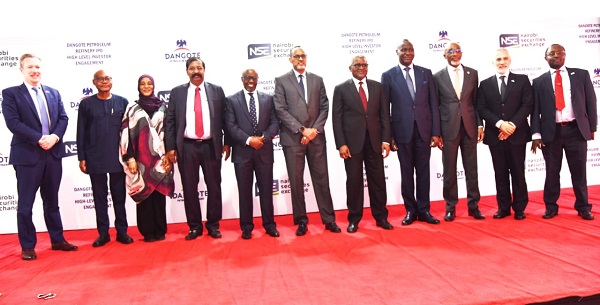
Speaking during a fireside chat with Chief Executive Officer of the Nairobi Securities Exchange, Frank Mwiti, at the “Dangote Petroleum Refinery IPO High Level Investor Engagement” organised by the NSE, Dangote said Africa could no longer afford “baby steps” if it intended to compete globally.
“We have already invested more than $25 billion, but right now, we’re going ahead to invest an additional $50 billion,” Dangote said. “We want to create and generate wealth for Africans, to make sure that we defend our markets. And the only way to defend the market is not to do baby steps. It’s better we do big scale.”
The scale of that ambition will move into sharper focus today when the groundbreaking takes place in Lamu, opening a new chapter in Dangote’s drive to replicate in East Africa the industrial ecosystem created around the 700,000 barrels per day Dangote Petroleum Refinery in Lagos.
The groundbreaking will proceed against the backdrop of a legal challenge over portions of the proposed project land in Lamu. The Malindi Environment and Land Court has ordered that the status quo be maintained on the disputed land until October 14 following a petition by 133 residents asserting rights over the property, although the court did not stop Wednesday’s groundbreaking ceremony.
Dangote, who said he learnt of the development from a media report shortly after arriving in Kenya, appeared unfazed by the legal challenge, describing such disputes as part of the realities of executing major projects. Drawing on the Group’s experience in Senegal, where one of its investments also faced litigation that eventually reached the Supreme Court.
President Williams Ruto’s chief economic advisor, David Ndii, disclosed that the Lamu project grew out of discussions among African policymakers, financiers and business leaders on how to deploy the continent’s natural resources for industrialisation rather than extraction. According to Ndii, those discussions identified petroleum refining as one of the strategic opportunities for East Africa and led to engagement with Dangote, President William Ruto, Uganda’s President Yoweri Museveni and other regional leaders.
He said a closed-door meeting in April examined an addressable East African market for finished petroleum products estimated at about 20 million metric tonnes annually, potentially rising to 30 million tonnes. At the conclusion of the discussions, Ndii recalled, Ruto distilled the proposition into three questions: Was there a market for the products? Was African capital available to finance the investment? And was there an entrepreneur with proven capacity to execute a refinery of that scale? With the answers in the affirmative, the Kenyan President asked: “Why would we fail?” Ndii said the answer in the room was equally emphatic: “We cannot fail.”
He traced the intellectual roots of the project to an earlier Nairobi meeting convened by President and Chief Executive of Africa Finance Corporation, Samaila Zubairu, which challenged African leaders to reconsider an economic model under which infrastructure readily attracts international financing when designed to evacuate raw materials, but struggles to secure capital when intended to process those resources locally.
Quoting a phrase from Zubairu that he said had stayed with him, Ndii declared: “We export our minerals FOB and import inflation CIF.” He said the Lamu project represented an attempt to reverse that equation.
The East African expansion is also being tied to a broader push by Dangote to change who owns Africa’s biggest businesses. Dangote told investors that the ongoing public offer of Dangote Petroleum Refinery was not primarily driven by a need to raise cash but by a desire to democratise wealth and allow ordinary Africans to participate in the prosperity created by the continent’s industrialisation.
“It’s not because we need the money. No. It’s because we want to share this prosperity with everybody,” he said. “The real purpose is for us to democratise wealth making.” He disclosed that the Group was prepared to progressively release more equity in its businesses as investor demand grows.
Dangote went further, declaring that all the Group’s operating businesses would eventually be opened increasingly to public ownership. “I’ve said that all the companies that we operate from today, eventually all of them will be owned by the people,” he said. The industrialist disclosed that a new shipping business being developed by the Group would eventually be taken to the capital market, while its expanding fertiliser operations would also be opened to public participation. “Let people own it,” he said.
Dangote said the Group’s ambition was to create millions of African shareholders who would benefit not only from dividends but also from capital appreciation as the underlying businesses grow. He also declared that when the Lamu refinery matures for public ownership, it should be listed in Kenya rather than automatically taken to the Nigerian market. “If tomorrow we are going to have the refinery here in Lamu to be listed, we don’t have to list it in Nigeria. We shouldn’t list it in Nigeria. We should list it here,” he said.
The proposal reinforced calls at the engagement for deeper integration of African capital markets to enable savings generated in one part of the continent to finance productive assets elsewhere. Chairman of Kenya’s Capital Markets Authority, Ugas Mohammed, disclosed that Kenyan investors had already demonstrated significant appetite for the Dangote Petroleum Refinery IPO, with the regulator receiving enquiries daily since the offer opened on September 14. “One question” had been recurring consistently, Mohammed said: “How can we participate?”
He said the interest demonstrated growing demand among Kenyan and East African investors for opportunities beyond their domestic markets and strengthened the case for mechanisms allowing investors to access securities issued elsewhere on the continent. “A new frontier of Africa’s economic sovereignty is beginning,” the CMA Chairman declared.
Mohammed said African regulators needed to develop deeper, more efficient, transparent and interconnected markets capable of mobilising long term capital for infrastructure, energy, manufacturing and other productive sectors. He disclosed that Kenya’s CMA, Nigeria’s Securities and Exchange Commission and other African regulators had signed a Memorandum of Understanding aimed at creating mechanisms to facilitate greater cross border investment and trading.
NSE Chairman Tom Muluwa described the refinery offer and Dangote’s wider industrial expansion as evidence that Africa could move from the margins of the global economy to competing at scale. “Africa’s time to lead the world has come,” Muluwa declared.
He said the continent had lost too much time and could no longer afford incremental responses to challenges requiring investments of global scale. “We agree with you that we cannot continue taking baby steps. We must go big and help solve the world’s challenges,” he said.
Muluwa said Africa had the resources to play a much larger role in global energy and food security, pointing to Dangote’s refinery and fertiliser investments as examples of the scale required. “We must industrialise Africa,” he said, adding: “We cannot continue exporting jobs and importing poverty.”
Mwiti framed the Nairobi engagement around what he described as a defining question for the continent: “Can Africans finance Africa? And can Africans own the great businesses that are transforming our continent?” He said Africa had for decades exported capital and savings while watching some of its greatest investment opportunities from the sidelines.
The Dangote Petroleum Refinery IPO, he said, offered an opportunity to rewrite that story. “The conversation is changing from what Mr Dangote has built to what Africans can own together,” Mwiti said.
Dangote said the ownership push formed part of a much bigger ambition to build African companies capable of competing with the world’s largest corporations. Under the Group’s Vision 2030, he said, Dangote is targeting more than $100 billion in annual revenue.
“We want to make sure that, for the first time, an African company will actually be out there with over $100 billion of revenue,” he said. “This thing is possible.”
He said the Group was also undertaking a major expansion of its fertiliser operations, with an ambition to reach about 12 million tonnes of capacity and become the world’s biggest fertiliser producers. Dangote argued that Africa’s development would remain constrained unless African capital increasingly financed African enterprise.
“People like us should allow our money to remain in our continent to develop our continent,” he said.
He urged governments to strengthen African financial institutions, citing AFC’s financing of Dangote projects as evidence that institutions with a deep understanding of the continent could move more decisively on transformative investments. The industrialist also challenged Africa’s emerging entrepreneurs to think beyond the limitations historically imposed on the continent.
Recalling that he started in 1978 as a domestic trader selling about four trucks of cement, Dangote told entrepreneurs in the room that his own success should not be regarded as the ceiling of African ambition. “You can become bigger than Dangote,” he said.
Ndii said that shift in mindset could ultimately prove as important as the physical infrastructure now rising across the continent.
Thanking Dangote for making Africans “think big” and see the possibility of competing at global scale, the presidential adviser said the industrialist’s place in the continent’s economic history could extend beyond the factories he built. “When that history is written,” Ndii said, “I think Mr Dangote will occupy a special place in terms of opening up Africa and opening up our minds to see possibilities, not limits.”
Today (September 30), that philosophy will move from the conference room in Nairobi to the construction site in Lamu.
Comment here