
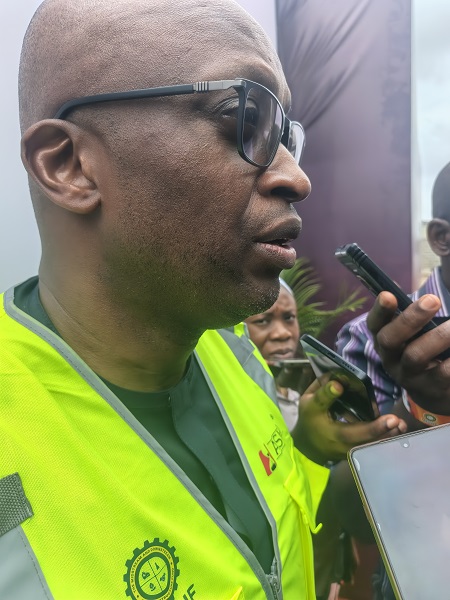
Speaking to journalists at the completion ceremony of Asiko Energy Holdings Limited, LPG and Propane Terminal in Lagos, Managing Director, Felix Ekundayo, applauded the Midstream Downstream Gas Infrastructure Fund (MDGIF) for its support and how it ensured that the dream of the gas company came to fruition.
Excerpts:
For the first phase of this laudable project, we are very grateful to the Minister of State Petroleum Resources (Gas), Honorable Ekperikpe Ekpo, who championed it in the first instance.
At the inception during ground breaking, the Minister supported Asiko. We’re also grateful to MDGIF led by Wale Adama, who was a supporting funding partner. The significance of the project is that it allows Asiko to receive gas from NLNG and other Nigerian producers to bring the gas that was previously isolated and exported.
Asiko can bring gas into the country and distribute it. The company already has a distribution chain in hinterland and will be fed by its own infrastructure which has been displayed.
The gas company is proud to have achieved this feat. Looking forward to the next phase where it will be able to bring LNG into country.
Given the abundant gas resources in this nation, will you say the country has maximized gas resources that it has and how much have you spent in this first phase?
I won’t go into numbers, but I will answer the question this way: No, I do not think that Nigeria has maximized the use of its own resources. I say that for every dollar of gas that we flare, we have to replace it with $30 to $40, right?
The prudent thing to do is to use gas to displace other fuels, so that our economy can grow and people can be prosperous.
What we are doing here today is the mechanical completion. There’s a stage called mechanical completion and the next stage after this is instrument and electrical. Instrument and electrical is where we put in all the wires, valves and emergency systems are tested. We’re going to complete those within the next few weeks and we’re looking forward to receiving the first ship cargo in November.
In your remarks, you mentioned that you’re going to LPG and considering the fact that there’s a faster adoption rate for CNG. Are there plans for you to go into CNG?
People often get confused. I focus on the way I tell people, is this the last two letters tell you what the gas is. The first letter tells you how it’s transported. Natural gas is natural, whether it’s C, which is compressed natural gas, or L liquefied natural gas, it’s the same. So, we are into natural gas and LPG as well.
We started off with LPG and move up the chain to natural gas. We will do CNG. In fact, we have two operations, two locations that we’re going to be putting CNG facilities. The next stage is that we are going to do LNG. So, we are in all forms of gas. We’re not discriminating.
Do you think of scaling up this type of project in other places in the country?
But we are in more than one place. This is not just where we are. We have operations in Kano. We have operations in Abuja. We have operations in Edo State and a few other satellite locations, and now we’re going into the Port Harcourt area, our River State, should I say?
To what extent would you see the midstream infrastructure fund as supported this initiative?
For the MDGIF, you can see their logo everywhere. It is a partner we are happy to collaborate with and they’ve helped catalyze the completion of this particular phase of the project and also to initiate and catalyze the next phase of the project.
The price of LPG is rising. What do you say about this development?
I would say that part of the reason we built this facility is that it can bring in vast and larger variety of LPG. Today, we bring in material from NLNG which is right.
Comment here