
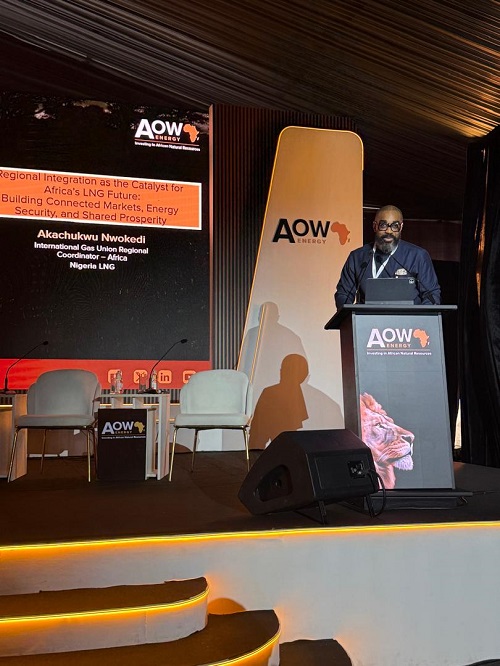
Mr. Akachukwu Nwokedi
Africa’s ability to derive lasting economic value from its vast natural gas resources will depend less on the size of its reserves and more on the continent’s capacity to integrate markets, infrastructure, policies and investment, the International Gas Union (IGU) Regional Coordinator for Africa, Akachukwu Adeyinka Nwokedi, has said.
Nwokedi made the submission while delivering a keynote address at Africa Oil Week (AOW:Energy) 2026, held in Accra, Ghana, from 1–3 September under the theme, “Investing in African Natural Resources.”
Speaking on “Regional Integration as the Catalyst for Africa’s LNG Future,” Nwokedi said Africa stands at a critical point in its energy development, with significant gas resources on the one hand and persistent energy access, infrastructure and industrialisation challenges on the other.
According to him, the continent’s next phase of gas development must move beyond a narrow focus on production and exports towards building an integrated African gas economy capable of connecting resources to markets, supply to demand and energy to industrial development.
“Africa’s LNG future will not be secured by reserves alone. It will be secured through connectivity, credibility and execution. Resources create opportunity; integration creates value,” Nwokedi said.
He noted that while individual African countries developing their gas resources in isolation could increase LNG production and exports, such an approach would not necessarily resolve the continent’s significant energy deficit or maximise the wider economic benefits of its gas resources.
Nwokedi called for greater cooperation among African countries in cross-border gas infrastructure, demand aggregation, market development, policy alignment, investment mobilisation and the sharing of strategic infrastructure.
He argued that regional integration could enable African countries to develop larger and more reliable markets, improve investment confidence, reduce infrastructure duplication and create the scale required to support commercially viable gas projects.
“By connecting markets, aggregating demand, sharing infrastructure and aligning policies, LNG can become more than an export commodity. It can become a platform for energy security, industrial competitiveness and shared prosperity across Africa,” he said.
The IGU Africa Coordinator stressed that the continent’s gas conversation must therefore extend beyond export terminals to the productive sectors and communities that require reliable and affordable energy.
“Africa’s next LNG chapter should not be written only at its export terminals. It must also be written in the homes, factories, farms and businesses powered by African gas,” he added.
The keynote formed part of discussions at AOW:Energy 2026 focused on unlocking Africa’s natural resource potential through stronger investment, partnerships and policy coordination. The event brought together governments, investors, energy companies, policymakers and other stakeholders from across Africa and the global energy industry.
Nwokedi reaffirmed the IGU’s commitment to supporting dialogue and collaboration around policies and strategies that can accelerate the responsible development and utilisation of natural gas across Africa.
Comment here