
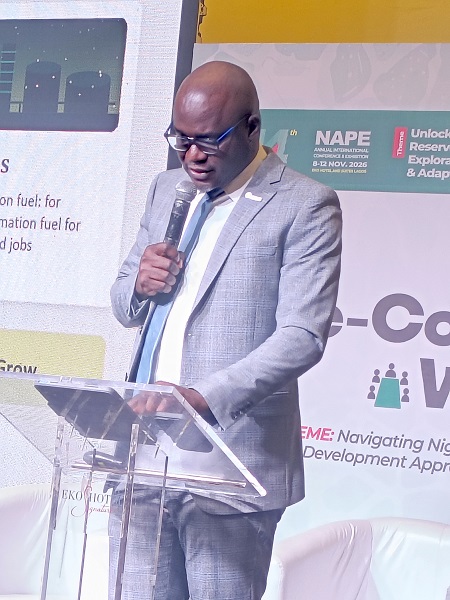
Dr. John Bosco Uche, Vice President Exploration of RAE
…Exploration, development and production must operate as an integrated value chain to ensure Nigeria meets its current energy requirements.
…First 100 days of assuming operatorship of assets Renaissance added approximately 100,000 barrels of oil to Nigeria’s production.
-Felix Douglas
Renaissance Africa Energy Company Limited (RAE) has unveiled plans to increase its oil production to 500,000 barrels per day by 2030, alongside expanding gas supply as part of efforts to strengthen Nigeria’s energy security and accelerate industrial development.
The company also plans to grow its production portfolio to one million barrels of oil equivalent per day by 2030, supported by additional gas production and investments in exploration, development and infrastructure-led opportunities.
The Managing Director and Chief Executive Officer of RAE, Engr. Tony Attah, disclosed this in a keynote address delivered on his behalf by the company’s Vice President, Exploration, Dr. John Bosco Uche, at a pre-conference workshop organised by the Nigerian Association of Petroleum Explorationists (NAPE).
The workshop, themed “Navigating Nigeria’s Upstream Future: Exploration and Development Approaches vs. Energy Security Demand,” examined strategies for increasing petroleum reserves, accelerating project delivery and meeting the country’s growing energy needs.
Attah said Nigeria’s energy security depended not merely on its abundant oil and gas resources but on its ability to convert those resources into reliable energy supply, industrial growth, employment and improved living standards.
The Renaissance helmsman noted that despite the country’s substantial hydrocarbon resources, millions of Nigerians still lacked reliable access to energy, stressing that the real measure of energy security was the extent to which resources powered homes, industries, hospitals and schools.
According to him, exploration, development and production must operate as an integrated value chain to ensure that Nigeria meets its current energy requirements while sustaining supply for future generations.
“Exploration creates options. Development transforms options into projects. Production converts projects into energy, and energy security exists only when all these three operate as an integrated value chain,” he said.
The Renaissance CEO emphasised the need for continuous investment in exploration to replenish reserves, warning that failure to discover new resources would undermine future production and threaten long-term energy security.
He explained that every barrel produced today depended on discoveries and investments made in previous years, making reserve replacement essential to sustaining Nigeria’s petroleum industry.
Attah also stressed the importance of accelerating the journey from discovery to first production, arguing that the speed of project delivery had become as important as the volume of resources available.
“Energy security is not only about volume; it is about velocity,” he said, adding that discoveries that take decades to reach production could fail to address the immediate energy needs of a growing economy.
He identified infrastructure-led exploration as a key strategy for shortening project timelines and improving the commercial value of discoveries, noting that Renaissance had adopted the approach as a central pillar of its near-term strategy.
According to him, leveraging existing infrastructure, data and technical knowledge could help unlock additional value from mature assets while reducing the time and cost required to bring resources to market.
The company’s strategy, he said, was anchored on three principles: safely receiving inherited assets, stabilising operations and growing production.
Attah disclosed that within its first 100 days of assuming operatorship of the assets in March 2025, Renaissance added approximately 100,000 barrels of oil to its portfolio and Nigeria’s production.
He added that the company had sustained gas exports while increasing domestic gas supply, with further expansion planned to support the country’s industrialisation and energy needs.
On the role of natural gas, Attah described the resource as a major driver of Nigeria’s economic transformation, noting its potential to strengthen manufacturing, improve industrial competitiveness, create jobs and stimulate economic growth.
“Gas is not merely a transition fuel for Nigeria; it is our transformation fuel,” he said.
He maintained that Nigeria could achieve greater economic benefits by deploying its gas resources to support industrial development and expand access to reliable energy.
The Renaissance CEO further highlighted the importance of indigenous capabilities, technology and human capital development in building a sustainable upstream industry.
He said the growing participation of indigenous operators represented not just a transfer of assets but also a transfer of responsibility for developing the country’s resources and creating long-term value.
Attah also identified artificial intelligence, digital technologies and advanced software as tools for improving exploration decisions, maturing prospects and enhancing operational performance.
He said Renaissance had tested several digital solutions and planned to deploy additional technologies to improve the identification and development of exploration opportunities.
On workforce development, he announced that the company planned to recruit more than 100 young graduates by November 2026 to strengthen its workforce and contribute to building local technical capacity.
He added that sustainable development required the industry to balance environmental responsibility with the need to provide affordable and reliable energy for economic progress.
Attah urged industry stakeholders to focus on execution, investment and collaboration, stressing that Nigeria’s petroleum wealth would deliver lasting benefits only when resources were continuously discovered, developed and produced at a pace that matched the country’s energy demand.
He concluded that effective leadership with a clear vision and disciplined project execution would be essential to converting the country’s oil and gas potential into energy security, industrialisation and shared prosperity.
Comment here