
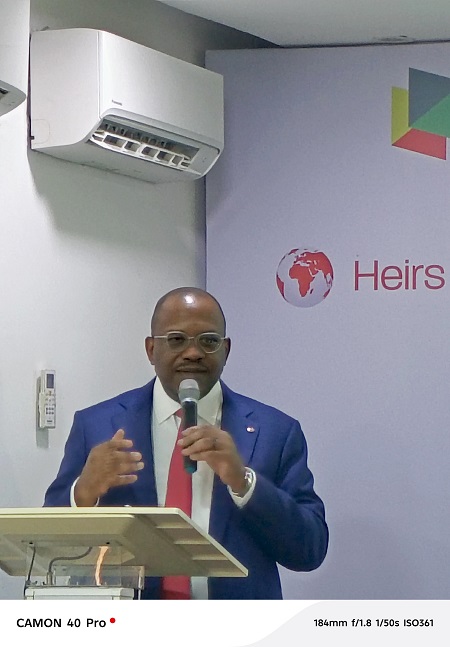
Mr. Osayande Igiehon, MD/CEO Heirs Energies
…Dr Egbogah was a Petroleum Engineer and strategist, a nation-builder who understood that natural resources derived beneath the ground is to improve the lives of the people above it.
…Heirs Energies gas production has peaked at approximately 135 million scf per day from less than 50 million scf and serves Nigeria’s domestic market, enables about 450 megawatts of electricity generation.
-Felix Douglas
The Managing Director and Chief Executive Officer (CEO) of Heirs Energies, Osayande Igiehon spoke during his Keynote Address at the 15th Emmanuel Egbogah Foundation Lecture Series (EEFLS), at Emerald Energy Institute, University of Port Harcourt that Nigeria’s greatest petroleum challenge is not a lack of resources. It is the persistent gap between resources the country possesses and value it creates from them.
Nigeria has produced oil for over six decades. The country holds some of Africa’s largest hydrocarbon reserves. Yet production remains below its potential, electricity is unreliable, industries are constrained and many communities still struggle to see the benefit of the resources produced around them, the Heirs Energies CEO lamented.
The theme of EEFLS was “The Expanding Role of Upstream Independents in Nigeria: Implications for Petroleum Value Creation and Public Value”
Igiehon was represented by Fidelis Akpoghiran, SVP, Business Transformation & Innovation at Heirs Energies.
The Heirs Energies CEO said that few developments have reshaped Nigeria’s petroleum landscape as profoundly as the emergence of indigenous upstream operators. What began as a policy aspiration to promote local participation has evolved into one of the most important structural transformations in the history of the country’s oil and gas industry.
Igiehon cautioned the oil industry operators that as they celebrate the rise of indigenous upstream operators, they must resist the temptation to declare victory too early.
An asset can change ownership in a day but capability cannot.
A Nigerian name on a licence does not automatically create Nigerian value. If an asset changes hands but production declines, infrastructure deteriorates and investment disappears, it means the names on the shareholder register have changed without changing the national outcome.
Igiehon said Dr Emmanuel Egbogah left a befitting legacy.
Dr Egbogah was not merely a Petroleum Engineer and strategist. He was a nation-builder who understood that natural resources derive their true value not from their existence beneath the ground, but from their ability to improve the lives of the people above it.
He understood that technical excellence carries a public responsibility. Petroleum engineering was not simply about bringing hydrocarbons to the surface. It was about what those resources made possible above the ground.
The Heirs Energies helmsman submitted that the question of public value is not theoretical.
“When we assumed operatorship of OML 17 in 2021, production was below 27,000 barrels per day. We inherited a mature brownfield asset and soon faced unprecedented crude theft and the shutdown of a critical evacuation route.”
“We focused on what we could control: restoring wells, rehabilitating the aged facilities, strengthening asset integrity and improving visibility across the production system.”
Continuing, Igiehon disclosed that Heirs Energies developed the concept of Brownfield Excellence in which the company safely extracted maximum value from existing assets that were otherwise considered of little or no value.
“Through more than 100 well interventions and disciplined brownfield investment, we increased production to over 55,000 barrels per day.”
He spoke on gas production, that it has peaked at approximately 135 million standard cubic feet per day, from less than 50 million standard cubic feet per day. All of that gas serves Nigeria’s domestic market and enables about 450 megawatts of electricity generation.
Surprisingly, this feat was achieved with a 100% Nigerian workforce and the company also reached 10 million Lost Time Injury-free man-hours in March 2026.
Igiehon believed that indigenous ownership must be matched by disciplined execution. Mature assets are not necessarily exhausted assets. A shut-in well may still contain value. An ageing facility may still have productive life. A declining field may still become a platform for growth.
But ownership alone will not unlock that value. It requires engineering discipline, targeted investment and accountability for outcomes.
Going forward, the Heirs Energies boss said Nigeria’s ambition to increase production towards three million barrels per day by 2030, will depend significantly on how effectively independent operators manage the assets already under their control.
When Heirs Energies acquired OML 17, investors backed its plans. After acquisition, the company had to prove that those plans could survive operational reality.
According to Igiehon, indigenous operators must attract investment because they are transparent, disciplined and well run. Government and regulators must also provide the policy stability, timely approvals and commercially realistic environment that enable responsible investment.
Petroleum development must create visible public value.
He reiterated Federal Government through NNPC Limited projection and ambition of growing Nigeria’s crude oil production to approximately 3 million barrels per day by 2030.
This is not merely an industry target, it is a national economic objective because higher production base would strengthen government revenues, improve foreign exchange earnings, support economic growth, enhance energy security, and provide additional resources for national development.
When gas leaves OML 17 and becomes electricity for a hospital, power for a factory or energy for a small business, petroleum development becomes meaningful to ordinary Nigerians.
Gas production cannot be separated from transportation, power generation and payment discipline. Operators must treat the gas value chain as one connected commercial system.
Igiehon was of the view that when operating footprint of international oil companies shrinks, indigenous operators must become the new training grounds for Nigerian energy professionals. The sustainability of the industry depends on both reserve replacement and talent replacement, a twin requirement for success.
“At Heirs Energies, our experience has strengthened our belief in what Nigerian companies can achieve. Ownership creates the opportunity.”
Capability converts that opportunity into performance and purpose converts performance into public value.
The responsibility before Nigeria’s upstream independents is to transform assets into productive enterprises, gas into power and industry, Nigerian talent into global capability, and the country’s natural resources into lasting prosperity.
Dr Emmanuel Egbogah believed in the ability of Nigerians to shape the future of this industry.
Comment here