
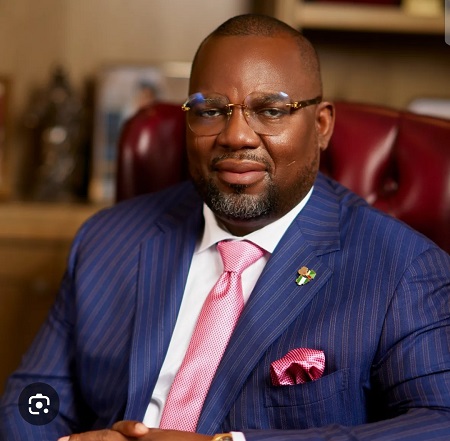
Julius Rone
By Olaoye Samuel
In July 2026, renowned businessman and “King of Gas”, Julius Dediare Rone OFR, gave Nigeria’s quest to become a major global exporter of liquefied natural gas a significant boost when his UTM FLNG Limited signed a 15-year gas supply agreement expected to unlock financing for the country’s first indigenous floating LNG facility. The landmark Wet Gas Sale and Purchase Agreement, signed during the 2026 NOG Energy Week in Abuja, commits the NNPC/Seplat Energy Producing Nigeria Unlimited Joint Venture to supply 200 million standard cubic feet of gas per day to the UTM FLNG project over a 15-year period.
It would be recalled that in December 2023, UTM Offshore, NNPC Limited and the Delta State Government signed a shareholder agreement to jointly develop the project. UTM FLNG Limited, the special-purpose vehicle established for the project, is owned by UTM Offshore, which holds a 72 per cent stake, NNPC Limited with 20 per cent and the Delta State Government with 8 per cent.
The significance of the recent agreement is worth far more than the attention it is currently receiving. For a project estimated at about $3 billion, a dependable long-term source of feed gas is one of the conditions financiers and prospective buyers need before committing their money. With that hurdle substantially addressed, UTM is targeting a final investment decision in the fourth quarter of 2026.
The actualisation of this project will mark a significant moment in Nigeria’s gas industry. The facility, to be located at the Yoho field in Oil Mining Lease 104, approximately 60 to 90 kilometres off the coast of Akwa Ibom, is designed to produce about 1.8 million tonnes of LNG annually. Unlike a conventional land-based LNG plant, the floating facility will process the gas offshore, reducing the need for the extensive onshore infrastructure associated with traditional liquefaction projects.
But for Rone, the illustrious GMD/CEO of UTM Offshore Group, the project is not just another gas development. It is the outcome of years spent building a socially responsible business, taking risks and steadily moving into bigger and more ambitious areas of Nigeria’s energy industry. More significantly, it signals his vision to lead a Pan-African gas expansion capable of driving industrial and economic growth across the continent.
As he disclosed in a recent interview: “Our current FLNG project is the first of several that we want to pursue in Nigeria and elsewhere in Africa. We want to lead Africa’s gas sector as an indigenous Nigerian company, using local talent and proven technologies, and eventually grow in generation through investments in floating power barges that can convert offshore gas into electricity for nearby industries.”
Solid educational and career foundations
Born into the family of Chief S. S. Rone, the Obazuaye of Warri Kingdom in Delta State, Julius Rone’s educational background reflects an early interest in and aptitude for business management. He is an alumnus of Obafemi Awolowo University, Ile-Ife, and the University of Calabar, where he obtained an advanced diploma and a postgraduate diploma in business administration respectively. His early career was spent within the country’s public sector. He worked with the Oil Mineral Producing Areas Development Commission (OMPADEC) between 1995 and 2000, before moving to the Niger Delta Development Commission (NDDC), where he served from 2000 to 2008.
Those years placed him close to the machinery of government and, importantly, to the complex relationship between the oil-producing communities of the Niger Delta and the institutions created to address their development needs. His transition into private business began in 2008, and by 2012 he had led the incorporation of UTM Offshore as a privately held Nigerian company with active interests across the Nigerian and international markets.
In its early years, UTM operated primarily in the downstream sector and marine support. It established a strong foothold providing premium marine logistics, subsea engineering, equipment leasing, and specialised vessels, such as platform supply vessels and anchor handling tugs, to global oil majors operating in Nigerian waters.
As the company matured, Rone expanded the business vertically and horizontally to capture more of the energy value chain, officially structuring it into the UTM Group of Companies. The conglomerate grew to include its current specialised subsidiaries: UTM Dredging Limited, UTM Engineering and Construction Limited, UTM Logistics and Marine Services Limited, UTM Energy Limited, and UTM Properties Limited. The group also participated significantly in the Direct Sales and Direct Purchase (DSDP) of Nigerian crude oil, further strengthening its financial capacity and industry leverage.
Ultimately, it was Rone’s decision to move beyond providing services to the oil and gas industry, and to participate directly in the commercialisation of Nigeria’s gas resources, that changed the scale of his ambition.
The floating LNG vision
The idea behind UTM’s FLNG project is a formidable one, the kind that only a bold and far-sighted mind like Rone’s could conceive. Fundamentally, the project is an attempt to solve the longstanding problem of turning Nigeria’s offshore gas resources into commercially valuable products without waiting for the extensive onshore infrastructure required by a conventional LNG plant. The King of Gas is therefore not merely building “Nigeria’s first FLNG” but attempting to move from participating in the oil and gas industry as a services provider to owning and developing an asset that directly monetises Nigeria’s gas resources.
Nigeria has large gas resources, but bringing them into production has often been constrained by infrastructure, investment and the economics of developing offshore fields. By placing the processing and liquefaction facility offshore, UTM aims to bring the plant closer to the gas, convert it into LNG for export, LPG for the domestic market and condensate, and thereby monetise a resource that might otherwise remain underdeveloped or be flared. UTM describes the facility as a newly built vessel equipped with gas pre-treatment, LNG production, storage and offloading systems.
As one might expect of such a massive and historic project, it has gone through several iterations in its projected capacity and cost. Earlier plans envisaged a 1.2 million-tonnes-per-annum facility processing about 176 million standard cubic feet of gas daily. In 2024, when UTM received its Licence to Construct, the project was described as a 2.8 million-tonnes-per-annum facility, with NMDPRA stating that it would process 324 million standard cubic feet of gas per day. The latest project description associated with the 2026 gas supply agreement puts the LNG production capacity at about 1.8 million tonnes annually.
These changes show just how the project has evolved through successive stages of engineering, regulatory approval, financing and commercial negotiations. They also explain why figures previously reported for its capacity and cost do not always match the latest descriptions.
Earlier this year, Rone announced that construction would begin within the year. The announcement came as he received the Investor of the Year award at the Sun Newspaper Awards. Five months later, the gas-supply agreement has given that ambition a firmer commercial foundation.
Master of strategy and doggedness
What makes Rone’s story particularly interesting is not simply the size of his vision but the patience and foresight required to pursue a project of this nature in an industry where the time frame between an announcement and actual production can stretch across years. The FLNG project has gone through changes in its design, capacity and projected cost, as well as delays associated with the commercial and regulatory requirements of a major energy development. Yet Rone has continued to present it as a central part of UTM’s long-term strategy.
That characteristic persistence has solidified his reputation within the country’s oil and gas industry. He has increasingly been described as a leading indigenous investor in gas, while the ongoing FLNG facility has placed him among the Nigerian entrepreneurs attempting to take a larger share of the value chain rather than remain on the margins as service providers.
That distinction is critical because while Nigeria has long attracted foreign capital into its oil and gas industry, indigenous participation has often been concentrated in contracting, services and smaller upstream ventures. Building a liquefaction facility capable of processing hundreds of millions of cubic feet of gas daily requires a different level of financial commitment, technical partnerships, risk-taking and institutional coordination.
Rone’s conviction is that Nigerian capital and entrepreneurship can play a much larger role in that part of the industry. In a June 2026 interview, he argued that changing global energy-security priorities were creating fresh opportunities for African gas producers, but stressed that governments still needed to create bankable frameworks capable of converting resources into actual production.
That statement says as much about Rone’s business philosophy as it does about the Nigerian gas industry. He is not presenting the resource itself as the solution. The real challenge, in his view, is building the commercial structure that allows the resource to become an economic asset. The July gas agreement is an important part of that structure. By securing a 15-year supply of feed gas, UTM has addressed one of the fundamental requirements for a large-scale LNG development and moved its groundbreaking project closer to the point where plans, financing and engineering can translate into construction and, eventually, production.
Olaoye Samuel writes from Lagos (07033179360)
Comment here