
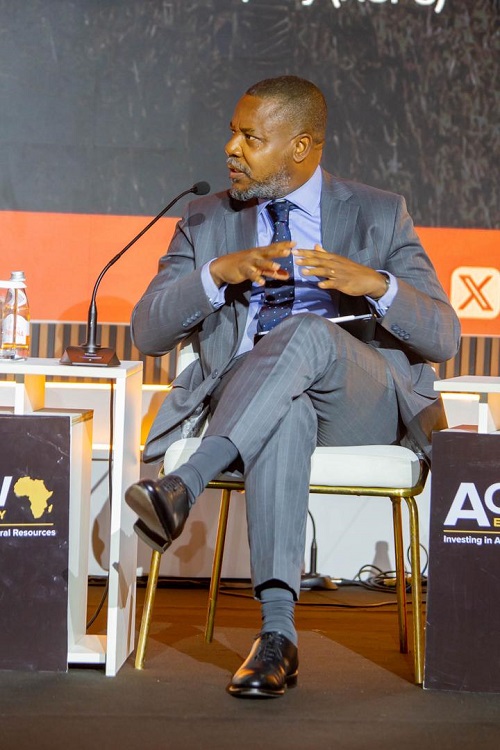
Mr. Ralph Gbobo, Managing Director, Shell Gas Nigeria
…Advocates for Industrialisation and Sustainable Economic Prosperity.
…The real opportunity for Africa is ensuring gas infrastructure is capable of supporting future energy transition.
–Felix Douglas
“The key question is not Africa’s readiness for hydrogen, biomethane and CCS, but whether they are the continent’s most pressing energy priorities.”
Africa’s immediate challenge remains energy access and industrialization.
Over 600 million Africans still lack access to electricity, and many industries continue to face energy reliability challenges. For most African countries, the priority today is building the gas infrastructure needed to support economic growth, industrialization and energy security.”
These were the words of Ralph Gbobo, Managing Director of Shell Nigeria Gas (SNG) at the Africa Oil Week (AOW) Conference in Accra.
Continuing, Gbobo made it known that the infrastructure built today should be transition ready.
“That does not mean ignoring the future. As we invest in pipelines, processing facilities and distribution networks, we should design them with flexibility in mind so they can eventually accommodate lower-carbon molecules such as biomethane, hydrogen blends and carbon management solutions that are commercially viable.”
The SNG MD said readiness differs significantly by technology and biomethane can leverage existing gas infrastructure.
He said hydrogen will require more extensive infrastructure adaptation while carbon capture will depend heavily on policy support, commercial incentives and suitable storage facilities.
Gbobo pointed out that apart from being ready to have the infrastructure and regulatory frameworks, commercial ecosystems are needed for large-scale deployment.
According to Gbobo, Africa is probably below one-quarter ready at present. However, that is the wrong scorecard. The real opportunity is ensuring the gas infrastructures that are being built today is capable of supporting tomorrow’s energy transition.
Gbobo advised Africa to avoid the mistake of trying to replicate the energy transition pathways of other regions.
“Our transition must be anchored in Africa’s realities: expanding energy access, enabling industrialization, and building infrastructure that can evolve over time to support lower-carbon energy solutions.”
Stranded Gas across Africa
Gbobo acknowledged that there are some stranded gas with key challenges and strategy to mitigate them.
For instance, when gas is stranded, the resources remain untapped. It will affect jobs, investments, industrial growth and economic value it could have generated.
Firstly, stranded gas represents a significant economic opportunity cost.
The government loses potential revenues, industries remain dependent on more expensive fuels and opportunities for employment and local value creation are constrained.
For example, gas that could support power generation, fertilizer production, petrochemicals or manufacturing remains unused and in some cases is flared with negative impact to the environment.
Secondly, the challenge demands viability not resource availability.
Gbobo urged industry operators to develop the gas value chain as an integrated system, connecting gas fields to processing facilities, transmission pipelines, distribution networks and viable demand centers.
The SNG MD added that:
“When you talk about economic impact from stranded gas, it means it can no longer add value.
This will impact government revenues, employment that would have been created and existing industries will be forced to continue using expensive liquid fuel.
The implication will be that cost of production of goods and services remain high.
Primarily gas is for power, but it affects other parts of the economy.”
Speaking further Gbobo added that “the economic impact of having stranded gas to any nation is not just that the gas is stranded, it also means that value is stranded (so everything that would have been gotten from the gas remains stranded starting from government revenue, employment, existing industries etc).”
Proximity of Gas
Viability of demand can mean sufficiency or proximity of gas fields.
However, Gbobo also outlined practical solutions to accelerate readiness for hydrogen, biomethane, and CCS:
- Create demand sufficiency through industrial clusters – aggregating several manufacturers creates sufficient demand to support investment while improving the competitiveness of those industries.
- Proximity through location of industrial clusters around the gas field, reliable gas infrastructure or an anchor customer.
- Where the market and demand centers already exist away from the supply sources, what is required is a bold initiative to build the midstream backbone to connect gas-rich locations to neighboring markets with unmet demand– e,g the Escravos-Lagos Pipeline System(ELPS) and Ajaokuta-Kaduna-Kano(AKK) in Nigeria; WAGP in West Africa.
The SNG MD added that addressing issues of stranded gas requires an integrated approach.
In his words: “we must connect gas supply to processing, transmission and distribution infrastructure, while aggregating credible demand around industrial clusters and anchor customers. These projects must also be commercially bankable, with transparent regulatory frameworks, stable policies, and clear pathways to investment.”
Ultimately, the objective is not simply to produce more gas, but to build the midstream backbone that converts Africa’s gas resources into energy security, industrialization and sustainable economic prosperity.
“We need to start having industrial clusters, bringing factories and manufacturers to one location to create more viable demand. If you have something like what you call industrial clusters, that you bring, factories and manufacturers in one location to have enough demand to make that investment more viable’’.
The government needs to be bold to create initiatives like the ELPS (located in the eastern part of the country) to provide gas to businesses in the western part.”
Gbobo revealed that in Nigeria alone, over the last few years there have been a few policy incentives aimed at stimulating investment in the energy market.
According to him, most of the incentives provide either some form of tax relief or gap funding that derisks these projects. Examples of some of the practical fiscal and funding-relations interventions put in place within the Nigerian context include the following:
- The Midstream and Downstream Gas Infrastructure Fund (MDGIF), a fund established under the Petroleum Industry Act (PIA) to support the development of Nigeria’s midstream and downstream gas infrastructure. MDGIF provides equity investments that de-risk strategic gas infrastructure projects, thereby facilitating the attraction of private capital.
- Tax Credits for Non-Associated Gas (NAG) Greenfield Development which is aimed at encouraging the development of stranded non-associated gas resources as a way of ensuring sustainable gas supply within Nigeria.
- Midstream Capital and Gas Utilization Investment Allowance, an additional tax deduction for CAPEX incurred on eligible plants and equipment for qualifying midstream projects, thereby improving the project economics for qualifying projects.
- Deep Offshore Oil and Gas Projects Incentives which are production-based tax credits to help stimulate the development of new deep-water projects.
- Zero import duty on qualifying gas equipment reduces the landed cost of imported machinery and infrastructure.
- VAT relief for feedgas and CNG helps to reduce the cost of gas to users encouraging them to convert to gas.
In his words:
“You are siting a compression facility next to the gas field, compress the gas, and transport it to where the demand centers are. When that is done people will gradually move away from liquid fuel to gas and they will start building ecosystem that will make future investment to be viable.
There should be more targeted incentives to increase investments because private entities cannot do investments alone.”
Gbobo was of the view that across Africa, similar fiscal and financing incentives exist, but they are country-specific and not applied uniformly across the continent.
He emphasized that policy incentives can be powerful, but the most effective incentive is one that reduces risk, improves project economics and gives investors’ confidence that the rules will remain stable.
Incentives and Regulatory Framework
On the role of gas in Africa’s energy future, Gbobo emphasized three key priorities:
First, fiscal incentives must improve project viability. These could include targeted tax relief, accelerated capital allowances, duty exemptions and viability-gap funding for infrastructure serving new or remote markets. For example, temporary support for a pipeline into an emerging industrial corridor can help establish demand that later become commercially sustainable.
Second, regulatory certainty is critical. Investors need transparent tariffs, predictable licensing, open-access rules and protection against arbitrary changes. For example, a clearly regulated pipeline system that allows multiple suppliers and customers to use shared infrastructure can increase asset utilization rates and reduce unit costs.
Third, policy must address demand and payment risk. Governments can support credible anchor customers, payment-security mechanisms and public-private partnerships. For example, aggregating demand from power plants, fertilizer producers and manufacturers within an industrial cluster can provide the predictable throughput needed to finance infrastructure. Regional trade agreements can similarly connect gas-rich countries to underserved neighboring markets. Preferential tariffs, transit frameworks and support for shared infrastructure are among the incentives proposed for expanding intra-African gas trade.
Gbobo submitted that good policy should not permanently subsidize uneconomic infrastructure. It should remove the barriers that prevent viable projects from taking off and give private capital the confidence to connect Africa’s gas resources to the people, industries and regions that need them most.
Shell Nigeria Gas Limited (SNG) was established in 1998 as a wholly owned Shell company. The company operates across eastern and western Nigeria, serving customers in Abia, Rivers, and Ogun States, with ongoing expansion into Bayelsa State and other locations. SNG delivers natural gas through a distribution network spanning approximately 150 kilometres of pipeline infrastructure.
Comment here