
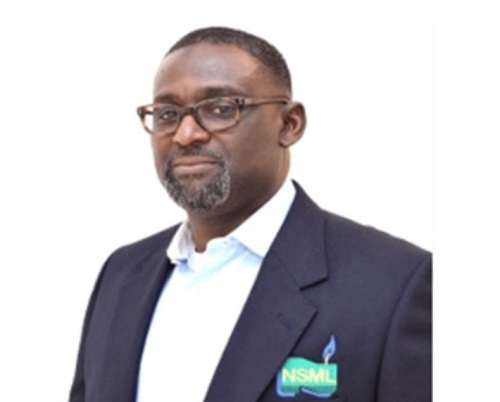
Mr. Abdulkadir Ahmed, Managing Director of NSML
…Develops globally competitive maritime professionals.
…Africa aspiring seafarers face limited access to quality training.
…NSML has consistently pursued a Nigerianisation agenda by developing local maritime manpower.
-Felix Douglas
Speaking at the Maritime Training Institute, organised by the Association of Maritime Journalist of Nigeria (AMJON), Managing Director of NSML, Abdulkadir Ahmed, explained that global maritime industry is highly regulated, technology-driven, and dependent on a skilled workforce capable of operating under international standards.
The NSML MD was represented by Dr. Effiong Ekanem-Attah, Manager, Maritime Centre of Excellence (MCOE).
Ahmed disclosed that international shipping continues to evolve through digitalisation, decarbonisation, automation, and enhanced safety requirements.
He said demand for competent maritime professionals is increasing globally.
Despite Africa’s strategic maritime position and extensive coastline, the continent has struggled to produce enough internationally certified seafarers and maritime professionals. Many aspiring seafarers face barriers such as limited access to quality training, inadequate simulator facilities, accreditation challenges, and a lack of practical sea-time opportunities.
“Against this backdrop, the NSML MCOE emerged as a strategic response to these systemic challenges. Established as a one-stop maritime research, consultancy, and training institution on Bonny Island, Nigeria, the MCOE was designed to provide world-class maritime expertise and develop globally competitive maritime professionals for Nigeria, West Africa, and beyond.”
The Maritime Manpower Challenge in Africa
According to Ahmed, maritime manpower deficit in Africa has traditionally been characterised by several interrelated factors:
There is insufficient access to internationally accredited maritime training institutions, limited exposure to modern maritime technologies and simulators.
Also, there is a shortage of quality sea-time opportunities for cadets, gaps between classroom learning and operational realities, dependence on foreign expertise for specialised maritime operations, and limited pathways for continuous professional development.
Ahmed said these challenges have hindered the ability of African maritime professionals to compete effectively in the global maritime labour market.
Consequently, many shipping companies operating in and out of Africa have relied heavily on expatriate personnel for critical technical and operational roles.
The NSML MD was of the view that addressing these gaps requires more than conventional training. It demands a comprehensive ecosystem that integrates education, certification, practical exposure, mentorship, technology, research, and industry partnerships. The NSML MCOE has distinguished itself by adopting exactly such a holistic approach.
NSML MCOE as a Positive Disruptor
The NSML MD pointed out that positive disruption occurs when innovative solutions challenge traditional limitations and create new opportunities for growth and advancement.
The MCOE exemplifies this concept through its multidimensional contributions to maritime manpower development.
Unlike conventional training centres that focus primarily on classroom delivery, the MCOE combines Maritime training, simulator-based learning, sea-time development, professional certification support, maritime research, consultancy services and industry collaboration, Ahmed explained.
This integrated model has elevated maritime manpower development from a fragmented process into a structured talent pipeline capable of producing internationally competitive professionals, supporting our operations at NSML and providing a model that can be replicated suitably.
International Accreditation and Global Standards
Ahmed stated further that one of the most significant disruptions introduced by the MCOE is its achievement of internationally recognised accreditations.
The centre holds accreditation from DNV under:
- ISO 9001:2015 Quality Management System
- DNV-ST-0029 Maritime Simulator Centre
- DNV-ST-0029 Maritime Training Centre
According to the NSML helmsman, these accreditations position the MCOE among a select group of maritime institutions capable of delivering training that meets globally accepted standards.
“For African maritime professionals, this means access to world-class qualifications without the traditional necessity of travelling abroad for specialist training. This democratization of access to quality certification represents a major step forward in maritime human capital development.”
Leveraging Advanced Maritime Technology
He said modern shipping operations increasingly depend on sophisticated technologies. Recognising this reality, the MCOE invested in state-of-the-art maritime training infrastructure, including advanced bridge simulators, engine room simulators, and Dynamic Positioning (DP) systems.
These facilities enable maritime professionals to simulate real-life operational scenarios, practice emergency response procedures, develop navigational competencies, build confidence in complex vessel operations and enhance decision-making capabilities in risk-sensitive environments.
Ahmed opined that the use of advanced simulation technology narrows the gap between theoretical learning and practical application; ensuring trainees acquire competencies directly relevant to real-world maritime operations.
Bridging the Sea-Time Gap, Locally
One of the most persistent bottlenecks in maritime manpower development is access to sea-time experience required for professional certification.
The MCOE’s flagship Seafarers Continuous Development Programme (SCDP) directly addresses this challenge. Through strategic partnerships with organisations including NIMASA and the Maritime Academy of Nigeria, Oron, the programme supports cadets on their journey toward obtaining Certificates of Competency (CoC).
According to Ahmed it created structured pathways from classroom learning to vessel deployment, the MCOE has significantly strengthened Nigeria’s and Africa’s maritime talent pipeline.
Furthermore, NSML has consistently pursued a Nigerianisation agenda by developing local maritime manpower capable of performing to international standards. As of August 2026, NSML employs over 700 seafarers and remains the largest employer of qualified Nigerian seafarers.
Its targeted goal of maintaining significant Nigerian participation in managed vessel operations demonstrates how manpower development can create both economic and strategic national value.
Maritime Research and Consultancy
Ahmed further explained that the distinguishing feature of the MCOE is its role beyond training; the centre provides maritime research, intelligence, and consultancy services across various maritime projects, including shipbuilding supervision, commercial project evaluation, dry docking supervision, vessel lifecycle support and Crew & vessel management advisory services
Through these activities, the MCOE functions as a knowledge hub where training is continually informed by industry realities and emerging maritime trends. This strengthens the relevance and quality of workforce development efforts.
Regional Impact and Africa’s Maritime Future
The significance of the MCOE extends beyond Nigeria.
As one of the few institutions in West Africa with its breadth of international accreditations and advanced training infrastructure, the centre is attracting attention as a regional hub for maritime excellence.
“Its model demonstrates how African institutions can deliver globally benchmarked maritime training to develop indigenous expertise and retain training investments within Africa, while building sustainable maritime workforce pipelines.”
Future Outlook
For the future, Ahmed made it known that the MCOE’s influence is expected to expand further through planned facility development and service enhancement initiatives. Supported by the Nigerian Content Development and Monitoring Board (NCDMB), the centre has begun steps toward an expansion project aimed at increasing capacity, introducing additional courses, and broadening service offerings, so as to ensure that most, if not all international maritime certifications are obtainable in country.
The NSML MCOE represents one of the most significant interventions in Africa’s maritime manpower development landscape. Through international accreditation, advanced simulation technology, structured cadet development programmes, sea-time opportunities, consultancy services, and a commitment to indigenous capacity building, the centre has introduced a model that effectively addresses longstanding deficiencies in maritime human capital development.
In his words:
“Its success demonstrates that sustainable maritime capacity development requires more than training institutions alone. It demands an integrated ecosystem that combines technology, practical exposure, mentorship, certification, research, and industry collaboration. By delivering this holistic approach, the NSML MCOE has become a positive disruptor and a benchmark for maritime workforce development in Africa.
As Africa seeks to strengthen its position within the global maritime economy, institutions such as the NSML MCOE will play a critical role in shaping the next generation of maritime professionals and ensuring the continent contributes meaningfully to the future of global shipping.”
Comment here