
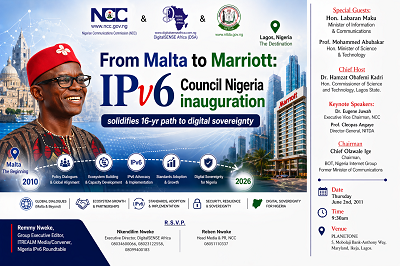
The formal inauguration of the IPv6 Council Nigeria by the Nigerian Communications Commission (NCC) at the Marriott Hotel, Ikeja GRA, today, Thursday, April 23, 2026, marks the historic fulfillment of a 16-year advocacy journey.
This national milestone is the direct result of persistent digital diplomacy initiated in 2010 by Ogbuefi Chinenyeze Remmy Nweke and foundational industry mobilization launched in 2011. This journey began during his tenure as Senior ICT Reporter and Head of the ICT Desk at Champion Newspapers Limited, while he was a candidate for the MA programme in Contemporary Diplomacy at the University of Malta.
Speaking at the Lagos inauguration, Ogbuefi Nweke, currently the Group Executive Editor of ITREALMS Media and Lead Consulting Strategist at DigitalSENSE Africa (DSA), noted that the Council’s roots are deeply anchored in his 2010 outreach from the University of Malta to the Global IPv6 Forum.
“In June 2010, following high-level engagements at the University of Malta/DiploFoundation, we facilitated the critical first link between Global IPv6 Forum Chair, Latif Ladid, and Nigeria’s technical community,” Nweke stated. “Seeing the NCC formalize this structure today with Muhammed Rudman at the helm is a victory for institutional memory and policy consistency in Nigeria”.
Historical Record of the Communication and Advocacy Committee (CAC)
The CAC was not a recent creation but a core pillar of the IPv6 Council Nigeria from its early formalization stages.
- Initial Leadership and Mandate: The committee was established with Remmy Nweke as the pioneer chairman. His leadership was intended to leverage 16 years of advocacy that began with the 2010 University of Malta/DiploFoundation diplomatic link.
- Committee Composition: Under Nweke’s chairmanship, the original committee included notable ICT professionals: Bayero Agabi, Chike Onwuegbuchi, Nahimah Nurudeen, and Martin Ekpeke.
- Strategic Objectives: The CAC was mandated to drive awareness, advocacy, and strategic communication to ensure Nigerian ISPs, telcos, and institutions transitioned from exhausted IPv4 addresses to the 21st-century IPv6 standard.
- Proven Track Record: Under Nweke’s leadership, the committee was active in stakeholder visits, hosting technical webinars, and collaborating with global experts to advance the “Join the Players” vision first established at the 2011 Roundtable.
The Historical Roadmap: “IPv6: Join the Players”
The Council’s trajectory was established on June 2, 2011, during the first-ever Nigeria IPv6 Roundtable held at Planet One, Maryland, Lagos. Organized by DigitalSENSE Africa (DSA) in collaboration with the NCC and the National Information Technology Development Agency (NITDA), the assembly was themed “IPv6: Join the Players”.
That foundational event was presided over by the late Chief Olawale Ige, MFR, former Minister of Communications and then-Chairman of the Board of Trustees for the Nigeria Internet Group (NIG). Key highlights from that era include:
- Initial Advocacy: The 2011 Roundtable served as the first national commemoration of World IPv6 Day in Nigeria.
- Strategic Alignment: The event featured pivotal contributions from Mr. Sunday Folayan, who presented on behalf of the NITDA IPv6 Committee, via a staff representative and Mr. Muhammed Rudman (CEO of Internet Exchange Point of Nigeria), then representing the NiRA Executive Board.
- Call for Action: The resulting 2011 Communiqué urged the Federal Government to establish a national Task Force to ensure Ministries, Departments, and Agencies (MDAs) prepared for IPv6 migration to avoid the risk of digital obsolescence and potential international blacklisting.
Formal Institutionalization (2026)
The 2026 formal inauguration was performed by the Executive Vice Chairman of the NCC, Dr. Aminu Maida, alongside a distinguished delegation of NCC Commissioners and Directors. This transition from a volunteer-led advocacy movement to a formal national body positions Nigeria to lead the African continent in next-generation internet infrastructure.
With this mandate, the IPv6 Council Nigeria is now empowered to drive the adoption of the latest internet protocol, ensuring that Nigeria’s digital economy remains secure, scalable, and globally competitive.
Comment here