
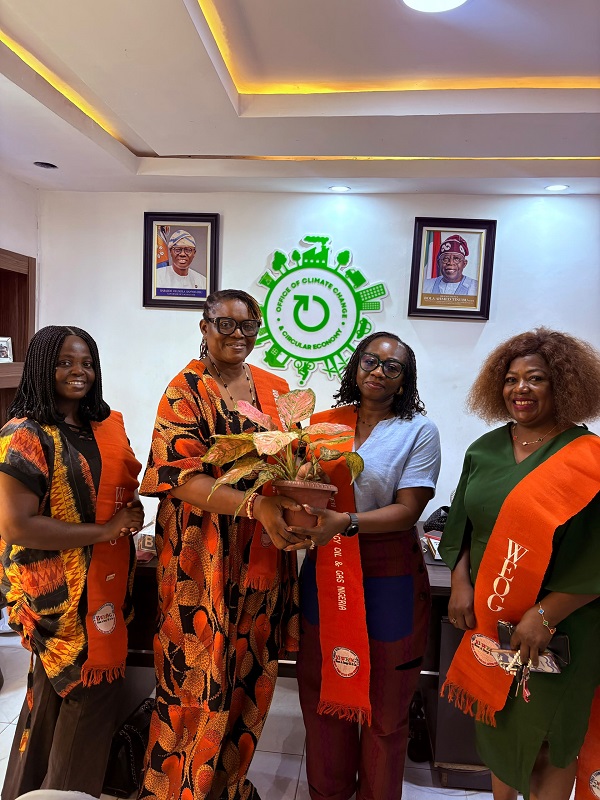
In the middle Mrs. Titi Oshodi, flanked by Mrs Toyin Yusuff, National VP (Services), WEOG, Dr. Chizoba Anyika National VP (Sectors) and on the extreme right Mrs Tolulope Akinnubi Sector Secretary, Future Energy, Renewables and Climate Action Committee (FERCA).
…WEOG Advocates Data, Climate Education, Bankable Green Projects and Inclusive Energy Transition
As part of its preparations for World Decarbonization Day (WDD) 2026, the Women in Energy, Oil and Gas (WEOG) paid a courtesy visit to Mrs. Titi Oshodi, Special Adviser to the Lagos State Governor on Climate Change and Circular Economy and a Distinguished Speaker at WDD 2026.
The visit took place at the Ministry of Economic Planning and Budget, Alausa Secretariat, Ikeja, Lagos, and provided an opportunity for WEOG leadership to engage with the Lagos State Government on opportunities for stronger collaboration on climate action, sustainability, circular economy and the transition to a low-carbon economy.
The delegation was led by Mrs. Toyin Yusuff, National Vice President (Services), WEOG, and Dr. Chizoba Christiana Anyika, National Vice President (Sectors), WEOG.
Also joining the delegation was Mrs. Tolulope Akinnubi, Sector Secretary, Future Energy, Renewables and Climate Action Committee (FERCA), WEOG, who participated in the visit to lend her support to the association’s climate-action and decarbonization agenda.
Her participation further underscored WEOG’s commitment to strengthening its engagement around future energy, renewable energy development and climate action, while creating stronger linkages between policy, innovation, investment and sustainable development.
Climate Change Requires Data, Education and Economic Action
Speaking during the courtesy call, Mrs. Titi Oshodi described climate change as a serious threat to the global economy, stressing that climate action must go beyond awareness to include data development, family and community education, innovation, entrepreneurship and sustainable financing.
She emphasized the importance of building reliable and accessible climate data to support evidence-based decision-making, noting that better data would enable governments, businesses and investors to understand climate risks and develop appropriate solutions.
Oshodi also advocated stronger climate education beginning at the family and community levels, stressing the importance of equipping people with the knowledge to understand climate change and respond meaningfully to its impacts.
She noted that climate action should also be viewed through the lens of economic opportunity, encouraging the development of innovative and entrepreneurial solutions that can be structured into bankable projects capable of attracting financial support.
She stressed the need for appropriate incentives and enabling policies to encourage investment in sustainable businesses and climate solutions, while urging financial institutions to support viable green innovations with appropriate financing.
Oshodi identified the energy sector as a major contributor to greenhouse-gas emissions, reinforcing the need for accelerated and practical action to reduce emissions while sustaining economic development.
She further noted that the Lagos State Climate Adaptation and Resilience Plan (LCARP) estimates the economic impact of climate inaction at between $22 billion and $29 billion, representing approximately 11 times the state’s 2022 annual budget.
She expressed the Lagos State Government’s openness to exploring strategic partnerships with WEOG in advancing climate education, sustainability, innovation, circular economy initiatives and climate action.
WEOG Calls for Balanced Energy Transition
In her remarks, Mrs. Toyin Yusuff, National Vice President (Services), WEOG, explained that WEOG serves as the anchor point for World Decarbonization Day, providing a platform for sustained stakeholder engagement on decarbonization.
She called on governments, institutions, businesses and other stakeholders to partner with WEOG to educate the public and major actors across the energy ecosystem, stressing that continuous advocacy and education are essential to bridging the gap between climate awareness and climate action.
Yusuff also emphasized the need for a balanced and realistic conversation around the energy transition, cautioning against the demonization of fossil fuels.
She noted that while Nigeria must accelerate the transition towards cleaner energy, fossil fuels remain significant to the country’s economy and energy security. She therefore advocated an inclusive, practical and just energy transition that recognizes Nigeria’s economic realities while promoting investments in renewable energy, cleaner technologies, energy efficiency and emissions reduction.
According to her, the goal should be to manage the transition responsibly through collaboration, innovation, technology, investment and education, ensuring that communities, workers and businesses are not left behind.
Turning Climate Challenges into Economic Opportunities
Also speaking, Dr. Chizoba Christiana Anyika, National Vice President (Sectors), WEOG, reaffirmed the association’s readiness to collaborate with government, the private sector, financial institutions, development partners and other stakeholders on decarbonization, climate-change education and advocacy.
Dr. Anyika noted that climate change and its impacts should not be viewed exclusively as bad news, stressing that the transition also presents significant opportunities for job creation, entrepreneurship, innovation and revenue generation.
She emphasized that when climate challenges are properly documented through data, translated into knowledge and matched with appropriate financing and entrepreneurial support, they can become catalysts for new businesses and sustainable livelihoods.
She highlighted opportunities for women, young people, entrepreneurs and innovators to participate in emerging green sectors, including renewable energy, circular economy, waste management and energy efficiency.
Building Strategic Partnerships for WDD 2026
The courtesy visit reinforced WEOG’s commitment to building strategic partnerships with government and other stakeholders ahead of World Decarbonization Day 2026.
The engagement highlighted a common understanding that effective climate action requires more than policies—it requires data, education, incentives, innovation, bankable projects, financing and sustained collaboration.
With the theme, “Accelerating Decarbonization Through Collaboration, Innovation and Sustainable Climate Action,” WDD 2026 will provide a platform for stakeholders to explore practical pathways for achieving a cleaner, resilient and sustainable future while unlocking the economic opportunities presented by the energy transition.
World Decarbonization Day 2026 holds on 3 September 2026.
Comment here