
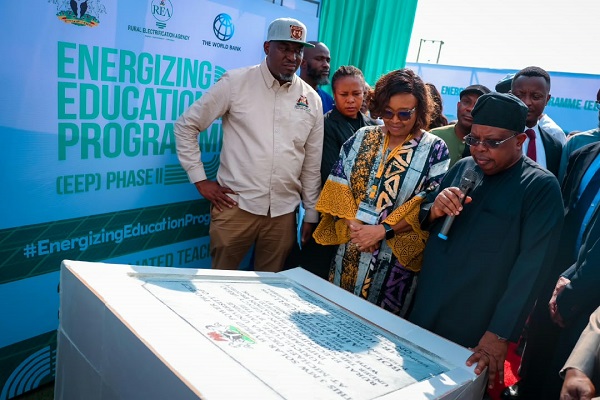
The Minister of Power, Joseph Tegbe has commissioned a 3.0MW solar hybrid project at Michael Okpara University, Umudike, Abia State.
The project was commissioned under the Energizing Education Programme (EEP) Phase II, funded by the World Bank and implemented by the Rural Electrification Agency (REA), which serves seven Nigerian universities and two teaching hospitals across the six geopolitical zones of Nigeria.
Delivering a keynote address, the Minister of Power, Joseph Tegbe, harped on President Bola Ahmed Tinubu’s administration’s commitment to transforming electricity from a persistent constraint on economic growth into a dependable enabler of national prosperity.
He noted the premium President Bola Ahmed Tinubu places on education and his unwavering determination to ensure that every young Nigerian has the opportunity to learn with dignity and fulfill their potential.
He further explained that the federal government’s approach combines stronger grid infrastructure with renewable and distributed energy systems suited to different communities and institutions.
“Universities, healthcare facilities, and productive centres require solutions that respond to their actual needs,” he said.
The Abia State Governor, represented by the Commissioner for Power, Hon. Ikechukwu Monday, stated that the EEP is excellent in conception and dynamic in relevance.
He thanked the federal government for its commitment to electrification across Abia State and other states in the country.
“The project holds benefits for lecturers, students, and everyone interested in scientific research,” he said.
The Governor praised the federal government for its determined commitment to the execution of the institution’s energy matrix in supporting the nation’s effort in tackling the age-long issue of energy adequacy.
Also speaking, the Managing Director of the Rural Electrification Agency (REA), Dr. Abba Aliyu, said, “Today, we are commissioning a 3MW solar hybrid power plant, complemented by 2.2MWh of battery energy storage, rehabilitated distribution infrastructure, streetlights, and a renewable energy training centre. But beyond these impressive engineering numbers, we are commissioning an infrastructure of possibilities, the possibility of uninterrupted research, advanced agricultural innovation, extended learning hours, and the emergence of a new generation of entrepreneurs.”
“Globally, the countries that dominate agricultural production are not necessarily those with the largest agricultural land. They are those that have successfully combined agriculture with energy, technology, research, and innovation. Nigeria must deliberately pursue this pathway. Under the leadership of His Excellency, President Bola Ahmed Tinubu and the strategic guidance of the Honourable Minister of Power, we are witnessing a fundamental transformation in the scale, ambition, and economic impact of decentralised electrification in Nigeria.”
“Through the Energizing Education Programme alone, we have delivered energy infrastructure across 22 federal universities and three affiliated teaching hospitals, with over 100MW of installed capacity, positively impacting more than 600,000 students and 50,000 academic and non-academic staff. Under Phase II of the programme, supported by the World Bank, we have also provided practical renewable energy training to 140 female students in science, technology, engineering, and mathematics.”
“However, what we are doing here today is only one component of a much bigger national transformation. Through the completed Nigeria Electrification Project, we delivered 198 mini-grids and facilitated the deployment of approximately 1.4 million solar home systems across Nigeria. Building on that success, we are implementing the $750 million World Bank-supported Distributed Access through Renewable Energy Scale-up programme (DARES), targeting electricity access for 17.5 million Nigerians, with approximately 1,350 mini-grids envisaged under the programme.”
“Our ambition is not just to be a consumer, but to position Nigeria as a manufacturer and exporter of solar technology. I envision a future where some of the renewable energy tech deployed on this project is produced in Abia State. A powered university must produce graduates and also produce solutions,” he said.
In his remarks, the Head of the Nigeria Electrification Project, Femi Akinyelure, stated that Nigeria is now a benchmark in energy access and is ensuring that the capacity being built is exported.
He noted that the democratisation of power ensures prosperity reaches all Nigerians.
In her welcome remarks, the Vice-Chancellor of the University, Prof. Ursula Ngozi Akanwa, thanked the federal government for the intervention, noting that reliable electricity is indispensable to effectively discharging the mandate of the university, which is rooted in agricultural development, scientific research, innovation, and the delivery of practical solutions to national challenges.
“Our laboratories, workshops, research facilities, and practical training programmes depend on a stable power supply to operate optimally. More importantly, the future of agriculture increasingly depends on electricity, as technology, data-driven systems, and innovation continue to transform food production, processing, preservation, and value addition,” she said.
She emphasized that the project addresses an important infrastructure need while creating better conditions for the university to advance its academic and research priorities.
Prof. Akanwa further pledged the university’s commitment to ensuring that the facility is properly managed and that electricity is used responsibly.
Comment here