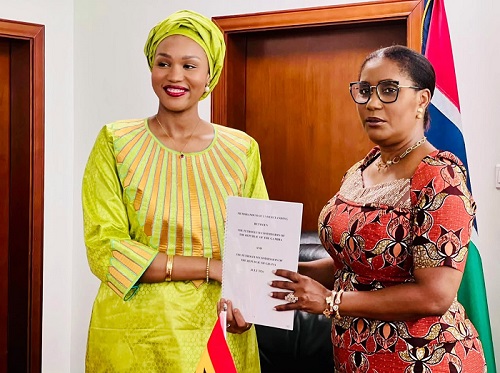
The Petroleum Commission of The Gambia and the Petroleum Commission of Ghana have signed a Memorandum of Understanding (MoU) establishing a formal framework for cooperation in the regulation and management of the upstream petroleum sector.
The MoU was signed by the Director General of the Petroleum Commission of The Gambia, Engr. Cany Jobe, and the Acting Chief Executive Officer of the Petroleum Commission of Ghana, Ms. Emeafa Hardcastle, following a three-day institutional visit by a high-level Ghanaian delegation.
During the visit, the Ghanaian delegation paid courtesy calls on the Minister of Petroleum, Energy and Mines, Hon. Nani Juwara, and on the Gambia National Petroleum Corporation (GNPC). The Minister warmly welcomed the delegation and conveyed his collegial regards to his Ghanaian counterpart, Hon. John Abdulai Jinapor, Minister for Energy and Green Transition of the Republic of Ghana, reaffirming the longstanding relationship between the two countries and the Government of The Gambia’s commitment to strengthening cooperation among their petroleum institutions.
The Memorandum of Understanding establishes a framework for cooperation across a broad range of areas, including upstream petroleum regulation, local content and local participation, petroleum data management, legal and regulatory frameworks, compliance monitoring and enforcement, institutional strengthening, and human capacity development. It also provides for staff exchanges, training, study visits, internships, secondments, technical assistance and the joint organisation of programmes of mutual interest.
During the technical engagement, the two institutions exchanged experiences on regulatory governance, institutional development, upstream licensing and licence management, local content implementation, public procurement, institutional financing, stakeholder engagement, human resource development and collaboration with Parliament and other oversight institutions.
Speaking at the signing ceremony, Director General of the Petroleum Commission of The Gambia, Engr. Cany Jobe, described the agreement as a practical partnership founded on institution building and shared learning.
“A country may discover petroleum, but without capable institutions, clear rules, technical discipline, public trust and responsible oversight, the opportunity can easily be weakened.”
She emphasised that while petroleum discoveries depend on geology, science and investment, it is strong institutions that ultimately determine whether those discoveries translate into sustainable national benefit. She explained that this is precisely why the partnership with the Petroleum Commission of Ghana is so significant. By creating a structured framework for technical cooperation, staff exchanges and institutional learning, the MoU enables The Gambia to draw on Ghana’s decades of regulatory and operational experience as it continues to build a transparent, accountable and technically competent petroleum regulator capable of managing future petroleum development in the national interest.
Engr. Jobe further noted that Ghana’s petroleum journey offers valuable lessons for frontier petroleum jurisdictions such as The Gambia. While expressing optimism about The Gambia’s petroleum potential, she observed that Ghana’s exploration history, spanning more than a century before its world-class Jubilee discovery placed it on the map as a petroleum producer, illustrates the patience, persistence and institutional preparedness required to achieve long-term success in petroleum exploration.
Acting Chief Executive Officer of the Petroleum Commission of Ghana, Ms. Emeafa Hardcastle, described the signing as “far more than a formal act” and “a landmark moment and a powerful symbol of our mutual commitment to a brighter future.”
She noted that the agreement comes at a time when African petroleum-producing and frontier countries face common challenges, including increasing competition for investment and the realities of the global energy transition. She stressed that collaboration among African regulators has therefore become increasingly important, enabling institutions to leverage their complementary strengths, deepen technical cooperation and pursue mutual development.
Emphasising that implementation would determine the success of the partnership, Ms. Hardcastle remarked that “our most important task begins: turning the commitments in our MoU into meaningful, on-the-ground results,” expressing confidence that the partnership would strengthen not only the two institutions but also the enduring friendship between the peoples of Ghana and The Gambia.
Representing the Minister of Petroleum, Energy and Mines, Hon. Nani Juwara, the Permanent Secretary at the Ministry, Abdoulie Jallow, reaffirmed the Ministry’s full support for the partnership, describing the MoU as a reflection of Pan-African cooperation and the shared belief that African countries can accelerate their development by learning from one another. He encouraged both institutions to translate the agreement into concrete programmes, measurable outcomes and lasting impacts for the benefit of future generations.
Under the MoU, the two Commissions will establish a Joint Steering and Oversight Committee to guide implementation, develop annual work programmes and coordinate technical cooperation through specialised sub-committees.
The Petroleum Commission of The Gambia expresses its sincere appreciation to the Petroleum Commission of Ghana for its visit, friendship and continued partnership, and to the Ministry of Petroleum, Energy and Mines under the leadership of Hon. Nani Juwara, the Commission’s Board, Management and Staff, and all stakeholders whose support contributed to the success of the visit.
The partnership reaffirms the shared belief of both Commissions that Africa’s greatest opportunity lies not only in its natural resources, but also in the strength of its institutions and its willingness to learn from one another.
Comment here