
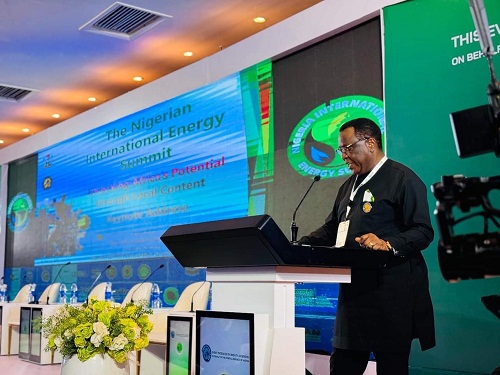
Engr. Felix Omatsola Ogbe, Executive Secretary NCDMB
…Significant efforts have been made to restore confidence in Nigeria’s energy sector, attract investment, improve competitiveness, unlock dormant opportunities, under current administration.
-Felix Douglas
Delivering his Welcome Address at the recent Nigerian Oil and Gas Midstream and Downstream Stakeholders Summit, the Executive Secretary (ES) of Nigerian Content Development and Monitoring Board (NCDMB), Engr. Felix Omatsola Ogbe, pointed out that the Summit reflects NCDMB shared commitment to advancing Nigerian Content, promoting industrial growth, strengthening investments, creating sustainable jobs, and building a stronger, resilient energy sector for Nigeria.
The ES stated that the summit took place at a strategic period in the evolution of Nigeria’s oil and gas industry.
He stated thus: “Across the country, we are witnessing renewed optimism, stronger investor confidence, strategic reforms, policy clarity, and deliberate efforts aimed at repositioning the Nigerian economy for sustainable growth and development.”
Ogbe made it known that under Nigeria’s current administration, significant efforts have been made to restore confidence in Nigeria’s energy sector, attract investment, improve competitiveness, unlock dormant opportunities, and create an environment where businesses can thrive.
Reforms in the sector are yielding positive outcomes across the energy value chain and positioning Nigeria as one of the most attractive destinations for oil and gas investments on the African continent.
The NCDMB helmsman revealed that the Board was established pursuant to the Nigerian Oil and Gas Industry Content Development (NOGICD) Act of 2010, with a clear mandate to deepen indigenous participation, build in-country capacity, create employment opportunities.
It is also to develop technical competence, promote technology transfer, and ensure that the enormous value generated from hydrocarbon resources translates into real economic benefits for Nigerians.
NCDMB’s journey in Nigerian Content development has been progressive and deliberate across the entire oil and gas value chain.
In the upstream sector, the Board has collectively recorded significant milestones in exploration, production, drilling services, fabrication, engineering, marine operations, project management, and indigenous asset ownership.
“As of today, Nigerian companies are not just participants but major contributors to some of the most complex upstream projects in the industry, delivering quality value with competence and professionalism.”
The midstream sector is witnessing tremendous opportunities in gas gathering, gas processing, compression, transportation, storage infrastructure, pipelines, LPG and CNG distribution, and related industrial infrastructure.
Nigeria continues to deepen its gas-based industrialization agenda as the midstream sector presents enormous opportunities for investment, technology deployment, local manufacturing, and capacity development.
Ogbe stated further that on the downstream sector, the industry continues to see growing opportunities in refining, product distribution, retail operations, depot infrastructure, lubricants, petrochemical products, logistics, supply chain optimization, and domestic energy accessibility. This segment remains one of the strongest drivers of employment creation, SME participation, local enterprise development, and direct economic impact on Nigerians.
However the Board’s vision is not limited to one segment of the industry. Its vision is to ensure that Nigerian Content is fully embedded across the upstream, midstream, and downstream sectors, creating an integrated ecosystem where Nigerian businesses, professionals and Nigerian communities can prosper sustainably.
According to Ogbe, for many years, Nigeria was largely known as a producer and exporter of crude oil while depending heavily on imported refined petroleum products and industrial feedstock. But at present, that narrative is changing significantly.
One of the most notable achievements is the emergence of world-class refining infrastructure within country, particularly the Dangote Refinery, which stands as one of the largest single-train refineries in the world and a major symbol of Nigeria’s industrial ambition, resilience, and capacity for self-sufficiency.
The ES harped on large-scale refining investments. There is also progress in the development of modular refineries across different parts of the country, creating opportunities for indigenous participation, technology transfer, local manufacturing, employment generation, and improved domestic supply security.
He mentioned major progress in gas commercialization, LPG penetration, Compressed Natural Gas (CNG) deployment, petrochemical expansion, fertilizer production, and associated industrial developments that are creating value beyond crude oil exports.
Stressing further, the ES said projects such as NLNG Train 7, ongoing gas infrastructure expansion programmes, domestic gas utilization initiatives, the Federal Government’s Presidential Initiative on CNG, and several indigenous processing and infrastructure projects are clear evidence that Nigeria is not only producing energy resources, but increasingly processing, adding value, industrializing, and exporting finished and semi-finished energy products to regional and international markets.
However, as NCDMB continues to deepen Nigerian Content, it has become increasingly clear that the next major frontier for sustainable economic growth, industrial expansion, employment generation, and national competitiveness lie significantly within the midstream and downstream sectors of the oil and gas industry.
The ES pointed that the Board fully understands its responsibility under the law to drive compliance which is its central mandate and remains non-negotiable .
Comment here