
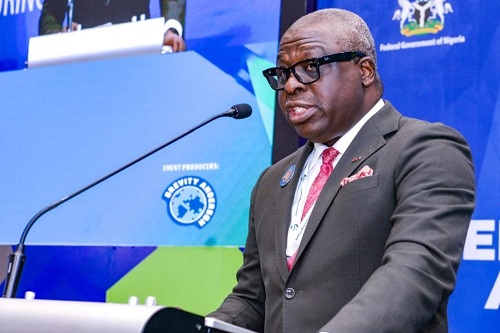
Adegbite Falade, IPPG Chairman
Nigeria must stop celebrating barrels and start building value, indigenous producers said Tuesday at the opening of the 25th NOG Energy Week in Abuja.
IPPG Chairman, Adegbite Falade,speaking on behalf of the Independent Petroleum Producers Group, said the industry has turned a corner on output and investment, but warned that without urgent reforms, Nigeria will keep missing out when the next global energy shock hits.
The Chairman commended President Bola Ahmed Tinubu for reforms aimed at cutting contracting cycles and improving fiscal terms. As a result, he said:
Output recovered from below 1 million barrels per day a few years ago to an average of 1.6 million bpd between January and May 2026, with May output exceeding Nigeria’s OPEC quota for the first time in nearly a year.
Over $8 billion in upstream FIDs secured since 2023, including Shell’s $5 billion Bonga North, $2 billion HI Field gas project, and TotalEnergies’ Ubeta.
28 field development plans worth $18.2 billion approved in 2025 alone, unlocking 1.4 billion barrels of oil and 5.4 trillion cubic feet of gas.
Also, Nigeria’s share of Africa’s upstream FIDs has jumped from about 4 percent a decade ago to nearly 40 percent in the last two years, the Chairman said.
Drawing lessons from the Russia-Ukraine crisis in 2022 and the US-Iran and Middle East conflict earlier this year, the IPPG Chairman said Nigeria held leverage with the world’s 10th largest gas reserves but could not scale fast enough due to capacity constraints and delayed FIDs.
“Let’s borrow a leaf from Dangote Refinery by prioritising upfront investment in potent capacity,” he said.
“We must see infrastructure not just as an economic asset, but as a strategic national shield.”
This year’s theme, “Forging Africa’s Strategic Energy Growth Through Global Collaboration,” he added, is about building readiness today to seize tomorrow’s opportunity.
He made four urgent calls which are, to convert resources into prosperity, IPPG asked government and industry to act on:
Fiscal harmonization.
The industry faces over 270 separate fees, taxes and levies.
The Chairman urged a comprehensive harmonization to remove duplication and align costs with the incentive spirit of the Petroleum Industry Act.
He added that a wave of retirements and IOC divestments has created a competence gap. Operators must invest heavily in hiring and training Nigerian engineers, technicians and project managers, he said, calling it core to business survival.
On integrated value chain, he stressed that the future is not just upstream. Nigeria must link production to processing, transport and domestic use.
Gas, he said, must drive industrialization through gas-to-power, LPG, CNG, fertilizer and petrochemicals, while LNG and FLNG capacity is restored and expanded.
According to him, five years after the Act, it is time for an all-inclusive review to clarify ambiguities and codify presidential directives and executive orders that have worked.
“A country that produces crude but cannot refine at scale is exposed. A country that exports raw molecules but imports finished energy products has not captured the full value of its resources,” he said.
Looking ahead, the Chairman said what is needed now is alignment and execution: regulations that enable speed, competitive fiscal terms, security in operating areas, and upgraded crude and gas infrastructure for both export and domestic markets.
“Let this 25th NOG Energy Week mark the moment we move decisively from extraction to value creation, and choose competitiveness over complacency,” he concluded.
“The next chapter of Nigeria’s energy story will be written by those bold enough to invest, honest enough to reform, and united enough to act.”
Comment here