
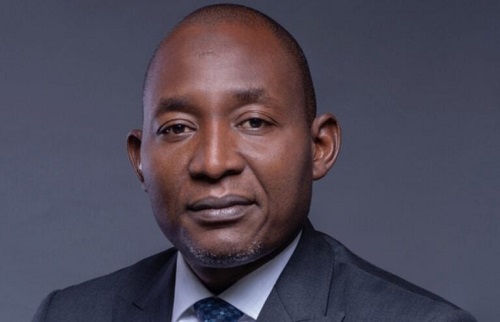
Rabiu Abdullahi Umar, Authority Chief Executiveof NMDPRA
…Nigeria has not experienced nationwide supply and distribution disruptions since reforms commenced in 2023.
-Felix Douglas
Nigeria is targeting between 30 and 45 days of national petroleum product stock sufficiency as part of efforts to strengthen energy security, attract new investments and protect the economy against global supply disruptions.
The Nigerian Midstream and Downstream Petroleum Regulatory Authority (NMDPRA) said the country’s current strategic petroleum stock sufficiency stands at approximately 17 to 19 days, leaving the nation vulnerable to external shocks, geopolitical tensions and disruptions in international energy markets.
Rabiu Abdullahi Umar, Authority Chief Executive (ACE) of NMDPRA disclosed this at the Business Intelligence (TBI) Africa Summit in Lagos.
Umar was represented by Engr. Victor Ojiakor, Deputy Director at NMDPRA.
The Authority Chief said Nigeria had recorded significant progress in domestic refining, with approximately three out of every four litres of petrol supplied to Nigerians in September 2026 refined locally.
According to him, domestic refining capacity has increased to about 682,000 barrels per day, enabling the country to meet a substantial portion of its domestic petroleum product requirements while creating opportunities for exports to other markets.
He attributed the progress to regulatory reforms and increased competition in the downstream petroleum market, noting that Nigeria had not experienced nationwide supply and distribution disruptions since the reforms commenced in 2023.
He also disclosed that increased competition had helped moderate petrol prices, with the average pump price standing at approximately N1,384 per litre, which he described as relatively competitive within the West African market.
The NMDPRA representative, however, warned that despite the improvements in domestic refining and supply, Nigeria’s strategic petroleum reserves remained inadequate to withstand prolonged international market disruptions.
He explained that the country’s current stock cover of about 19 days was below the desired threshold, stressing the need to build sufficient reserves to guarantee uninterrupted supply during periods of geopolitical instability.
Umar identified the ongoing tensions involving Iran and the United States, alongside other potential international disruptions, as reminders of the importance of maintaining adequate national energy reserves.
He said the Authority was working towards establishing a national strategic petroleum stock system through selected Nigerian National Petroleum Company Limited (NNPC) depots across different parts of the country.
According to him, the initiative is designed to ensure that petroleum products are strategically stored in different locations, allowing the government to respond effectively to supply emergencies and prevent any part of the country from being left without adequate fuel.
Beyond petroleum products, he identified the growing demand for liquefied petroleum gas (LPG) as another critical area requiring urgent investment, noting that domestic production remained insufficient to meet consumption requirements.
He stated further that Nigeria had enormous opportunities to expand LPG production, gas processing, extraction, storage and distribution infrastructure, particularly in underserved parts of the country.
$30bn investment needed by 2030
On investment requirements, Umar submitted that Nigeria’s midstream and downstream petroleum sector would require approximately $30 billion in new investments by 2030 to expand infrastructure, strengthen supply chains and support industrial development.
He noted that Nigeria possessed approximately 215 trillion cubic feet of proven natural gas reserves, the largest in Africa, but inadequate investment and infrastructure continued to limit the country’s ability to fully harness its resources.
The Authority Chief Executive believed that major constraints are not resource availability but insufficient gas processing facilities, storage infrastructure, pipelines and transportation networks.
He identified opportunities in gas processing and LPG extraction, storage facilities, pipeline development and logistics infrastructure as critical areas for prospective investors.
He also highlighted ongoing infrastructure projects, including the OB3 pipeline and associated compressor facilities, as well as the Ajaokuta-Kaduna-Kano (AKK) gas pipeline, which he said were progressing towards completion.
Umar disclosed that the Authority was strengthening its regulatory framework to improve investor confidence and accelerate project execution.
He cited the launch of the revised Gas Transportation Network Code and Project Nexus as important initiatives aimed at improving transparency, efficiency and regulatory processes.
The Authority was working towards a regulatory framework anchored on three principles: firmness in regulation, fairness in conduct and speed in execution.
According to him, some regulatory processes that previously took several months can now be completed within 24 to 48 hours, with the Authority working towards reducing certain approval timelines to minutes.
He added that operators could now access several regulatory services remotely without necessarily visiting the Authority’s offices or relying on personal connections.
Gas transition and cleaner energy
On sustainability, Umar described natural gas as Nigeria’s most practical transition fuel, stressing that the country must expand its utilisation to support affordable energy, cleaner transportation and industrial growth.
He said the Authority was working with other government institutions and private investors to expand compressed natural gas (CNG) infrastructure, particularly through smaller refuelling facilities capable of reaching consumers in underserved communities.
He disclosed that approximately 20 universities across Nigeria had benefited from CNG refuelling facilities, which are expected to support affordable transportation for students and surrounding communities.
He also highlighted plans to introduce ethanol blending into Nigeria’s petrol supply system, noting that the country currently had little or no ethanol blending in its domestic petrol consumption.
According to him, the initiative would be implemented through pilot programmes and collaboration with relevant stakeholders, including the NNPC, while leveraging locally available agricultural feedstock.
He said the development would help reduce emissions, conserve foreign exchange and create new markets for Nigerian farmers without displacing food production or encouraging deforestation.
Five-point regulatory commitment
Outlining the Authority’s priorities, Umar said it was committed to five major actions aimed at strengthening the country’s energy security and improving the investment climate.
These include building national resilience by increasing petroleum stock sufficiency to between 30 and 45 days; prioritising domestic energy supply; unlocking investments through efficient licensing and public-private partnerships; accelerating cleaner energy development through gas expansion and biofuel integration; and improving transparency through reliable market data.
Domestic energy resources must work for Nigerians first, pointing to the importance of domestic crude supply obligations, the naira-for-crude initiative and increased local refining to support households and industries.
There is need to strengthen partnerships with investors, financiers, operators, host communities, security agencies and development partners.
According to the Authority Chief, no regulator can independently secure the country’s energy future without sustained collaboration across the industry.
“Nigeria has shown that it can refine its own fuel and supply its own people. Our next task is to make that security deep enough, clean enough and bold enough to power a new era of industry and growth,” he said.
He urged stakeholders to support the development of a more resilient, sustainable and competitive midstream and downstream petroleum sector, adding that the country’s abundant energy resources must translate into industrialisation, employment and shared economic prosperity.
Comment here