
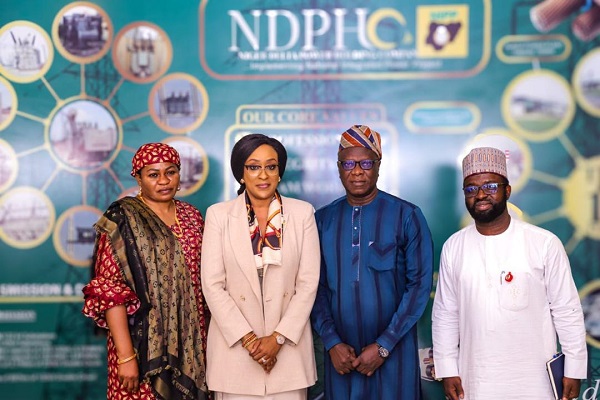
L-R: Executive Director Commercial Services, NEMSA, Engr. Maymunah Abubakar Audu Yusuf; Managing Director/CEO, Engr. Jennifer Adighije; Managing Director/Chief Executive Officer of NEMSA and Chief Electrical Inspector of the Federation, Engr. Olusegun Adesayo and Executive Director, NDPHC, the Executive Director (Generation) Engr. Kassim Abdulahi during the NEMSA’s management visit to NDPHC office in Abuja.
The Nigeria Electricity Management Services Agency (NEMSA) and the Niger Delta Power Holding Company (NDPHC) have reaffirmed their commitment to closer collaboration aimed at ensuring that materials, equipment, and engineering installations deployed across Nigeria’s electricity value chain comply with global standards and international best practices.
The renewed commitment was made during a courtesy visit by the Managing Director/Chief Executive Officer of NEMSA and Chief Electrical Inspector of the Federation, Engr. Olusegun Adesayo, to the Managing Director/CEO of NDPHC, Engr. Jennifer Adighije, at the company’s headquarters in Abuja.
Speaking during the meeting, Adighije stressed the urgent need for durable, safe, and standard-compliant infrastructure as Nigeria continues to grapple with persistent electricity challenges and a widening infrastructure deficit.
She described NDPHC as a strategic institution within the power sector because of its broad mandate covering electricity generation, transmission, and distribution. According to her, the company remains one of the largest public-sector investors in Nigeria’s power infrastructure, with major investments in transformers, substations, transmission lines, switchyards, and line bay extensions across the country.
Adighije noted that these installations are critical national assets that must meet stringent technical and safety standards to ensure efficiency, reliability, and long-term sustainability.
According to her, collaboration with NEMSA has become increasingly vital as the country intensifies efforts to modernize its electricity network and improve power supply to homes, industries, and businesses.
She explained that every new project introduced into the power sector must not only align with international best practices but must also be designed and executed to withstand the test of time.
“NEMSA’s regulatory oversight and inspection responsibilities are critical to ensuring quality assurance, operational safety, and technical compliance throughout the electricity industry,” she said.
The NDPHC boss further emphasized that the relationship between both institutions extends beyond routine regulation, noting that there are several operational intersections between NDPHC’s infrastructure development mandate and NEMSA’s enforcement and certification responsibilities.
She added that stronger institutional collaboration would help reduce technical failures, improve project delivery timelines, and promote greater efficiency across the electricity value chain.
In his remarks, Adesayo reiterated NEMSA’s commitment to enforcing technical standards and ensuring that electrical installations nationwide comply with established safety regulations.
He stated that the agency remains focused on safeguarding lives and property by preventing the deployment of substandard electrical materials and ensuring that all power projects meet approved engineering specifications before being energized.
Industry stakeholders at the engagement observed that stronger synergy between the two agencies could significantly enhance investor confidence in Nigeria’s electricity sector, especially at a time when the Federal Government is pursuing reforms aimed at attracting investment and improving sector performance.
The renewed partnership is also expected to support ongoing efforts to strengthen grid reliability, minimize system failures, and accelerate the delivery of stable and sustainable electricity supply across the country.
Analysts say the collaboration reflects a broader recognition within the sector that improved regulation, strict technical compliance, and coordinated infrastructure planning are essential to achieving long-term stability in Nigeria’s power industry.
Comment here