
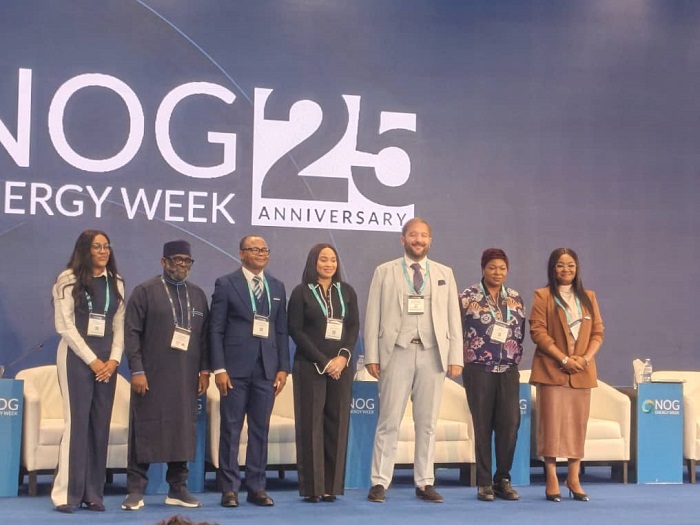
Moderator, Bassey Adie, fourth from left in a group photograph with other speakers at a panel session: From Ownership to Competence: The Role of Maritime Training and Capacity at the NOG Week in Abuja.
…The maritime industry can only thrive with operational excellence, competence and capacity building.
-Felix Douglas
Over the years, the industry conversations and approach has been focused on ownership, stakeholders have worked hard, implemented relevant policies to ensure there’s an increase in indigenous participation in acquiring maritime assets and ensuring that value created in the maritime sector predominantly remains in the hands of Nigerians.
Ownership was never meant to be the destination but a starting point. Whilst acquiring assets, investing in infrastructure and making several investments are critical. Ultimately, value assets do not solve challenges offshore. They do not innovate themselves or build competent and competitive industries.
Notwithstanding, people do and as the industry continues to evolve with digitization, automation, technological advancements with stricter maritime environmental regulations. More projects are being invented with operators demanding a higher standard for safety, operational excellence and technical expertise.
Competitiveness will be no longer about who owns what. It’s going to be about what is known, done, and how to deliver on operations offshore.
Precisely, at present, the conversations are about how to move from just speaking to ownership to building competence, and not only competence that is for the local industry, but that which drives global relevance.
These were the words of Bassey Adie, MD/CEO of Loyz Marine Services at the NOG Week Conference that was held in Abuja.
Adie moderated the strategic panel session with the theme: “From Ownership to Competence: The Role of Maritime Training and Capacity”
A panel of experts in the marine industry with lot of knowledge and experience spoke and gave their insights.
Abdul-kadir Ahmed, MD/CEO, NLNG Shipping and Marine Services Limited (NSML), expressed his views on owning maritime asset.
Ahmed said NSML is essentially a shipping maritime service and the purpose of the creation of the business was to have a company that provides opportunities for engineering and to participate in what the company does.
NSML is known for operating elite standard, LNG and LPG vessels, looking at the journey that has been set.
Ahmed said the company started with key element of how to implement different processes.
“Looking at shipping and marine services, there are standards. But some people believe that there is nothing like a global standard for shipping. The standards are global, and operators must adhere to the right systems.”
Ahmed disclosed that the target of NSML is that within 10 years, the level of seafarers in its vessel will be well trained personnel. It has zero tolerance for bullying and harassment of female gender.
The company also plans to unveil first female chief engineer this year.
The vision of ABC in Nigeria is how it can drive the role of indigenous capacity within Nigerian maritime domain.
Captain Nicolas Bernard, Regional and Business Director, MD/ABC, Maritime Ltd, was of the view that ABC vision is to inherit its 45years of experience in technology management that it has built within the group and various regions where it has worked.
It makes sure it enhances indigenous ship made by Nigerians to serve fleet trading offshore, commercial, domestically and regionally. The company next focus and stage of this revolution is operational sovereignty.
XPO Marine Limited is one indigenous company in Nigeria that has grown in time and space, Temidayo Dahunsi, Head Business Development & Strategy opined that from conception, the company started through commercial representation and international route.
The company was also encouraged as an indigenous concern by the Nigerian Content Development and Monitoring Board (NCDMB). Its focus was to build competence, industry knowledge with commercial perception.
Dahunsi said she strived to become an indigenous woman to motivate an offshore concern in order to build reputation and capacity.
She applauded the banks for being supportive to XPO but the company still needs more funds to finance its projects. Finance is key to the success of the industry.
In terms of regulator ensuring operational excellence and creating pathways for company and transferring competence to next generation, Silas Omomehin Ajimijaye, Ag Director, Planning, Research & Statistics of NCDMB, emphasized on specific quality and strategic initiatives required to ensure local content policy and sustainability.
The Board partners and collaborates with operators to solve issues.
NCDMB analyses existing gap, modifies it and train people. Some have been sent out of the country for training.
However, Ajimijaye said NCDMB is deploying advanced data analytics to solve problems in the sector.
The Board encourages operators to involve in various trainings to ensure that owners and management of vessels including the environment are maintained.
On the issue of female training in maritime sector, Ajimijaye said the Board has spent hundreds of dollars only for the women to decline the job after working for a short time. The women in maritime sector need a lot of counseling, advocacy and support.
He called for collaboration and urged operators to embark on training.
SIFAX Group is a diverse conglomerate with different footprints in logistics support. The company has huge maritime infrastructure.
Wunmi Eniola Jegede, Group Coordinating Director, SIFAX Group, pointed out that works have been done to close gaps that could enhance business. When goods are brought from the port, the company ensures they are well conveyed in whatever means of transportation being used by its hauling subsidiary.
The company also offers financial services and creates values at various levels to deliver goods.
Jegede explained further that the Group moved goods by badges through inland waterways to central location in Lagos to ease traffic hours for its clients.
In terms of employment, it has over 500 people working in its terminal and the goal is to make things easy for its customers.
SIFAX encouraged cross-function exposure, knowledge sharing where experts sensitize people and move employees across department.
Building competence and capacity are linked to training and development. Practical steps must be taken to build a maritime workforce for the industry since it has a global standard.
Speaking at the panel session, Koni Duniya, President & Founder, Female Seafarers Association of Nigeria (FESAN), said that asset ownership cannot be disconnected with training.
Duniya added that in UK if one applies for maritime training, admission cannot be given except there is guarantee of where the training can be applied practically. There must also be an undertaking that a company is behind the training to make the certification wholesome.
Unfortunately, in Nigeria, there are training institutions, but practical training is lacking, Duniya lamented.
The way forward in Nigeria is for industry, training institutions, government to work together so that young people and intending maritime institutions have asset with practical training.
Duniya disclosed that global average right for women is 2% but Nigeria has attained 4% making it above global level.
Nigeria has qualified females that have been trained to work at sea.
However, operators within the Nigerian offshore sector find it difficult to accommodate women. There is also the aspect of cultural behavioral of not allowing women to be on the vessel.
Some vessel owners don’t want female and jettisoned the idea of employment.
The issue of harassment and bullying are part of the challenges female faces in the sector.
In concluding the panel session, Adie made her remarks that:
“Ownership is not enough, and ownership and competence should not compete. They are complementary and whilst we are championing for ownership, let’s put that energy into championing for competence, capacity building and overall knowledge transfer.”
“This is the only way we are going to build a sustainable industry.”
It is not all about ownership but operational excellence, competence and capacity building.
Comment here