
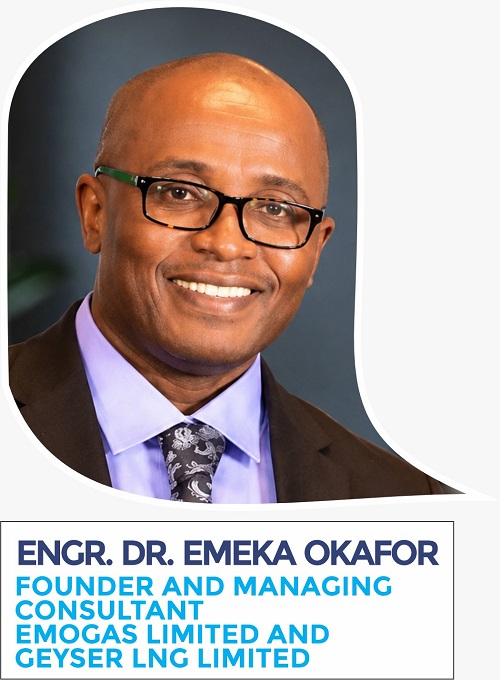
Dr. Emeka Okafor
3rd Emogas’ International Natural Gas-Based Industry Conference and Exhibition (EINGICE 2026)
Theme: Accelerating Africa’s Global LNG Trade Share and Driving Gas Industrialization through Innovative and Strategic Upstream Petroleum and Gas Producer Synergies and Investment Decisions.
Sub-theme: Strategies for Powering Africa’s Entrepreneurial Talent in the Energy Sector Through AI, AI-Powered Software, and Digital Solutions—with a Focus on Natural Gas, CNG, LNG, LPG and Green Technologies.
“Africa Must Turn Its Gas Wealth Into The Industrial Power, Technological Strength And Economic Prosperity Of Its People.”
This is a gathering about Africa’s future, the destiny of our economies, the opportunities available to our young people, and the responsibility of our generation to transform our continent’s enormous natural resource potential into enduring prosperity. To every distinguished speaker, sponsor, exhibitor, delegate, partner and participant who has made this gathering possible, I extend my sincere appreciation.
Your presence demonstrates a shared recognition that Africa’s energy future cannot be built by governments alone, industry alone, or technology alone. It must be built through purposeful collaboration.
What will Africa do with the extraordinary natural gas resources entrusted to this generation? Will we merely extract them, export them and celebrate the revenue? Or will we use them to power our industries, strengthen our economies, create millions of productive opportunities over time, develop indigenous technologies, empower our entrepreneurs and establish Africa as a formidable force in the global energy marketplace? That is the question before us at EINGICE 2026. And the answer must be bold, deliberate and unmistakable.
Africa must move from resource possession to resource transformation. From potential to production. From dialogue to investment. And from ambition to measurable results.
Our continent possesses substantial natural gas resources, yet the economic opportunities available through their development remain unevenly realised. Across Africa, businesses need dependable and competitively priced energy.
Manufacturers need reliable gas supply. Industries require modern infrastructure. Investors need predictable policies and commercially viable projects. Young Africans need opportunities to apply their knowledge, creativity and entrepreneurial ambition. Natural gas can help address these challenges.
It can support electricity generation, fertilizer production, petrochemicals, industrial heating, gas-based manufacturing and the development of modern energy infrastructure. Through LNG, it can connect African producers to international markets.
Through CNG and LPG, it can support a range of domestic fuel and transport applications. Through responsible deployment alongside renewable energy and other technologies, it can contribute to diversified energy systems. But natural gas does not industrialize an economy simply because it exists beneath the ground.
Gas industrialization happens when resources are connected to infrastructure, infrastructure is supported by investment, investment creates productive enterprises, and productive enterprises generate jobs, value and opportunity. That is the transformation Africa must pursue.
We must ask ourselves why a continent endowed with natural resources should continue to struggle to convert sufficient portions of that wealth into competitive manufacturing, strong industrial supply chains, technology ownership and broad-based prosperity.
The challenge is not simply geological. It is also commercial, institutional, technological and strategic. We must build the pipelines, processing facilities, LNG infrastructure, storage systems, distribution networks and industrial hubs that connect resources to markets.
We must improve project bankability, strengthen commercial partnerships, develop local expertise and create conditions in which serious investors can commit capital with confidence. Above all, we must ensure that the value created by our resources extends beyond the point of extraction.
Africa must not merely supply the world’s energy needs; Africa must also build industries, capabilities and competitive businesses around its own energy resources.
Distinguished government representatives, and policymakers across our beloved continent: Permit me, from this platform, to make a respectful but urgent appeal.
The future of Africa’s gas industry will be shaped not only by the resources we possess, but by the quality of the decisions we make today.
The decisions of governments determine whether investment moves from consideration to commitment. They influence whether projects are delayed or delivered, whether businesses can plan with confidence, whether infrastructure is developed efficiently, and whether African enterprises can compete effectively.
We therefore need a new level of strategic ambition in gas development and industrialization. First, we need stable, transparent and predictable regulatory frameworks that protect the public interest while encouraging responsible long-term investment. Second, we need to prioritize the infrastructure that connects gas resources to industries, power plants, export facilities and underserved markets.
Third, we need stronger collaboration among governments, national oil companies, indigenous producers, international operators, financial institutions and technology providers. Fourth, we must invest in the technical education, research institutions and entrepreneurial ecosystems that will enable African professionals to design, build, operate and maintain our own energy infrastructure. Fifth, we must establish clear performance expectations. Policies should be judged not only by their announcements, but by the investments mobilized, projects delivered, businesses developed, jobs created and measurable improvements in the lives of citizens. And finally, we must recognize that Africa is not a single market with identical circumstances. Every country must pursue strategies suited to its resources, infrastructure, financing capacity and development priorities, while strengthening regional cooperation and cross-border trade.
The strategic opportunity is enormous. Imagine African countries collaborating to develop regional gas corridors, interconnected markets, shared infrastructure and complementary industrial hubs. Imagine our gas-producing nations supplying the feedstock for fertiliser plants, petrochemical facilities, manufacturing clusters and power systems across the continent. Imagine African entrepreneurs designing the software, engineering systems and technological solutions that make these projects more efficient and competitive. Imagine a future in which the success of Africa’s gas industry is measured not only in export volumes and revenue, but also in the strength of our industries, the capabilities of our people and the opportunities available to our young population. This is the vision that deserves the commitment of our political and business leadership.
Our appeal to African governments is simple: make gas development a disciplined instrument of national and regional economic transformation—not merely a source of short-term revenue.
Distinguished industry leaders
Our main conference theme places global LNG competitiveness at the heart of our discussions. The international LNG market is competitive.
Capital is mobile, project costs matter, delivery schedules matter, and buyers require reliable supply under commercially credible arrangements.
Africa cannot expand its global LNG trade share through aspiration alone. We must develop projects that can compete on cost, reliability, execution, financing and long-term commercial value.
This requires upstream petroleum producers and gas companies to work together more strategically. It requires early alignment between resource development, processing capacity, transportation, liquefaction, shipping, marketing and off take.
It requires investors and operators to examine risks honestly, allocate capital prudently and pursue partnerships that improve project delivery.
It also requires governments and industry leaders to confront barriers that undermine competitiveness, including infrastructure constraints, project delays, uncertainty and avoidable inefficiencies.
Our keynote speaker on the main theme, Dr. Ainojie Alex Irune, Executive Director of Oando PLC and Managing Director of Oando Energy Resources Nigeria Limited, brings valuable industry leadership to this conversation.
Let us also remember that export competitiveness and domestic industrial development need not be opposing objectives. With sound planning and commercially viable infrastructure, Africa can pursue international LNG opportunities while strengthening the supply of gas to domestic industries.
There is another revolution taking place alongside the transformation of global energy markets: the revolution in artificial intelligence and digital technology. AI is changing how industries analyze information, manage complex assets, monitor performance, predict equipment failures, optimize operations and make investment decisions.
For Africa, this presents both a challenge and an extraordinary opportunity. We must not become merely consumers of technologies developed elsewhere. We must create the conditions for African innovators to develop, adapt, own and commercialize solutions that address our realities. Our sub-theme challenges us to consider how AI-powered software, digital solutions and green technologies can empower entrepreneurs across natural gas, CNG, LNG, LPG and related energy sectors.
Think about what this could mean. An African technology company developing software to reduce downtime in a gas-processing facility. A young engineering team using data analytics to improve maintenance and equipment reliability. An indigenous enterprise developing digital monitoring solutions for CNG infrastructure. A research institution working with industry to improve energy efficiency. An entrepreneur building a scalable business around industrial automation, emissions monitoring or intelligent energy management. These are not merely technological possibilities.
They represent potential businesses, skilled employment, intellectual property and opportunities to strengthen Africa’s industrial capabilities. However, innovation requires more than inspiration. It requires funding, mentorship, research partnerships, access to markets, supportive policies and a willingness by established companies to test and adopt promising solutions.
Do not ask only what AI can do for your organisation. Ask what opportunities your organisation can create for African innovators to build the technologies of our energy future.
Let us invest in our talent. Let us open doors for our entrepreneurs. Let us connect universities and technical institutions to real industry challenges. Let us create pathways for promising ideas to become viable enterprises. Africa’s young people must be participants in the energy revolution, not spectators watching it unfold elsewhere.
The greatest success of EINGICE 2026 will not be the number of people in this hall, but the quality of the decisions, partnerships and initiatives that emerge from it.
To the chief executives, investors, project developers, engineering professionals, regulators and technology leaders gathered here:
History will not judge our generation solely by the resources we discovered or the projects we announced. It will judge us by what we built, the opportunities we created and the lasting value we delivered.
We have a responsibility to think beyond institutional boundaries and immediate commercial interests.
We must develop partnerships that strengthen the entire value chain.
We must invest with discipline, innovate with purpose and execute with excellence.
We must also ensure that local content is more than a contractual requirement.
It should become a pathway to building competitive African companies, developing technical expertise, transferring knowledge and retaining a greater share of value within our economies.
Our continent needs businesses that can engineer, finance, build, operate and maintain world-class energy infrastructure.
It needs entrepreneurs who can turn emerging technologies into commercially sustainable solutions. It needs institutions that can provide credible regulation, quality research and skilled professionals.
And it needs leaders who understand that collaboration is not a sign of weakness, but a source of strategic strength.
Let us therefore make EINGICE 2026 a meeting point for serious business, constructive policy engagement, technological advancement and partnerships capable of delivering results.
When future generations look back at this period in Africa’s history, what will they say about us?
Will they say that we possessed enormous natural resources but failed to build enough industries around them?
Will they say that we watched technological revolutions transform other economies while our own innovators struggled for access to capital and markets?
Or will they say that this was the generation that made courageous decisions, built strategic partnerships, developed indigenous capabilities and used its resources to expand opportunity?
I believe we can choose the third path. We can build an Africa where natural gas supports competitive industries, where investment creates productive capacity, where technology empowers entrepreneurs, where research translates into commercial solutions and where economic progress creates meaningful opportunities for our people.
This vision will not be realized overnight
It will require patient investment, credible institutions, technical competence, responsible resource development and sustained cooperation.
But the work must begin with the decisions we make today.
The task before us is not the responsibility of one government, one company, one conference or one individual.
It is a shared responsibility. And that is why we are here.
As we commence the 3rd Emogas’ International Natural Gas-Based Industry Conference and Exhibition, I invite each of us to leave this gathering with a renewed sense of purpose.
To our governments: create the conditions for responsible investment, reliable infrastructure and competitive industries.
To our industry leaders: strengthen partnerships, pursue bankable projects and commit to operational excellence.
To our investors: recognize the opportunities available across Africa’s gas value chains and engage with commercial discipline and a long-term perspective.
To our technology companies and entrepreneurs: develop solutions that address real problems and create value for African markets.
To our academics and researchers: deepen collaboration with industry and help translate knowledge into innovation. And to our young professionals: prepare yourselves to lead.
The future of Africa’s energy industry will need your intelligence, integrity, creativity and courage. Let us make one commitment together: that Africa’s natural gas wealth will not be measured only by what lies beneath our soil, but by what we build above it.
Let it be measured by the industries we establish, the infrastructure we develop, the businesses we empower, the technologies we create and the opportunities we open for future generations.
Let us expand Africa’s participation in global LNG markets while building stronger domestic value chains. Let us harness artificial intelligence without neglecting human ingenuity.
Let us attract investment while strengthening indigenous capacity. And let us transform natural resources into enduring economic and social value.
Africa has the resources. Africa has the talent. Africa has the entrepreneurial spirit. What we must now demonstrate is the collective leadership, strategic discipline and determination to turn these advantages into results. Ladies and gentlemen, the time for ambition without execution has passed. The time for fragmented efforts has passed.
The time to connect our resources with investment, our industries with innovation, and our aspirations with action is now. On behalf of Emogas Limited and the Gas and Energy Development Council, I warmly welcome you to EINGICE 2026. May these two days generate ideas that lead to investment, conversations that produce partnerships, and decisions that advance Africa’s gas industry and industrial future?
May our deliberations be productive, our collaborations enduring, and our collective efforts beneficial to the people of Africa.
By Dr. Emeka Okafor, Convener, EINGICE 2026; Founder and Managing Consultant, Emogas Limited.
Comment here