
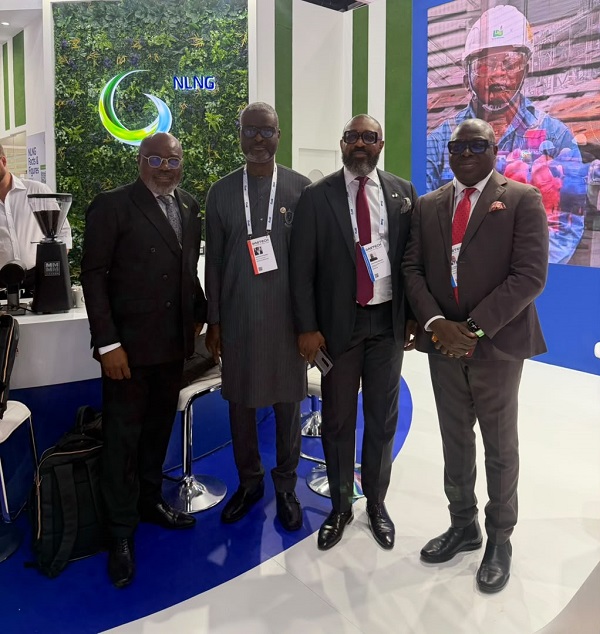
L-R: Kunle Odusola-Stevenson, CEO, Legend and Legacy Company and Conference Producer, Nigeria International Energy Summit (NIES); Olufisayo Duduyemi, Executive Vice President, Axxela Integrated Power and Vice President, Nigerian Gas Association (NGA); Akachukwu Nwokedi, General Counsel and Company Secretary, NLNG, and Africa Regional Coordinator, International Gas Union (IGU); and Adegbite Falade, Managing Director, Aradel Holdings Plc and Chairman, Independent Petroleum Producers Group (IPPG), at Gastech 2026 in Bangkok, Thailand.
By Kunle Odusola-Stevenson
Media Analyst & Public Relations Expert, writing from Bangkok
With an audience expected to exceed 50,000 and more than 800 exhibiting companies from across the global energy value chain, Gastech 2026 has made Bangkok a meeting point for the forces reshaping the energy economy: supply security, investment, infrastructure, technology and rapidly changing demand.
For Nigeria, however, the significance extends beyond participation. The conference has sharpened a fundamental question: how can the country translate its considerable gas endowment into industrial growth, competitive energy and investable opportunities?
Nigeria arrived in Bangkok with an increasingly clear proposition. Its gas resources can support global LNG markets, but their greater strategic value may lie in what they can enable at home—reliable electricity, fertiliser, petrochemicals, manufacturing and a deeper regional energy market.
That proposition was captured succinctly by H.E. Rt. Hon. Ekperikpe Ekpo, Nigeria’s Minister of State for Petroleum Resources (Gas), during the opening ministerial dialogue:
“Resource alone, without provision of infrastructure, technology, and financing cannot take us anywhere.”
The statement goes beyond policy. It identifies the central commercial challenge facing Nigeria’s gas economy: converting resource potential into projects capable of attracting long-term capital.
That means creating the conditions for pipelines, processing facilities, storage, gas-to-power, CNG, small-scale LNG and gas-based industries to operate as viable businesses rather than remain perpetual infrastructure aspirations.
It is also where the wider African conversation becomes relevant.
NJ Ayuk, Executive Chairman of the African Energy Chamber and convener of African Energy Week, argued in Bangkok for an African energy strategy centred on adding energy capacity rather than narrowing available options. His intervention highlighted the persistent gap between Africa’s resource wealth and its energy needs, stressing the importance of investment, infrastructure and market development in translating resources into economic value.
For Nigeria, that gap represents both a challenge and a sizeable commercial frontier.
The investment opportunity is no longer confined to upstream production. Midstream infrastructure, gas distribution, power generation and energy-intensive industries can create multiple revenue streams from the same underlying resource.
A pipeline generates transportation revenue. Processing creates a service business. Gas-fired power creates contracted electricity demand. Fertiliser and petrochemicals increase the value of the molecule before it reaches an export terminal.
That is the logic of building a gas economy rather than simply an export industry.
The proposition was given a distinctly commercial emphasis by Olalekan Ogunleye, Executive Vice President, Gas, Power & New Energy at NNPC Limited.
Describing Nigeria’s gas development and monetisation strategy as “a purely commercial play,” Ogunleye outlined ambitions to expand reserves and production, targeting 10 billion cubic feet per day by 2027 and 12 Bcf/d by 2030. He also emphasised that domestic utilisation and exports should advance together, while identifying security, competitive pricing and assured supply as critical to attracting investment.
That approach matters because investors assess energy opportunities differently from policymakers.
They ask whether customers will pay, whether contracts will hold, whether tariffs support returns, whether supply will be reliable and whether political and commercial risks have been properly allocated.
Nigeria’s next task is therefore to translate ambitious production targets into a pipeline of projects with identifiable customers, credible economics and a realistic route to financial close.
The presence of Adeleye Falade, Managing Director and Chief Executive Officer of Nigeria LNG Limited, offered a reminder that Nigeria has already demonstrated its ability to do this at global scale.
NLNG’s success rests on partnerships, infrastructure, technical cometence, disciplined execution and dependable international markets. The strategic opportunity now is to extend that experience into the wider gas value chain while enabling Nigerian companies to capture greater engineering, technology, manufacturing and services value.
The conversation in Bangkok also exposed a broader tension in global energy policy.
Rt. Hon. Tony Blair, former Prime Minister of Great Britain and Northern Ireland and Executive Chairman of the Tony Blair Institute for Global Change, argued that energy security is integral to national independence and economic prosperity. He rejected a binary choice between fossil fuels and clean energy, advocating a balanced approach in which transitional energy supports the journey towards a lower-carbon system.
For Africa, the argument is particularly relevant.
A continent still facing significant electricity deficits cannot separate climate ambition from development economics. Energy must be reliable enough to power industry, affordable enough to support consumers and increasingly cleaner as technology and investment permit.
Gas can occupy an important part of that equation.
For investors, this creates an interesting convergence. Energy security supports demand; industrialisation creates customers; infrastructure creates long-duration assets; and global LNG markets provide an additional outlet for production.
The financing challenge, however, remains decisive.
Development finance institutions, commercial banks, private equity, infrastructure funds, sovereign investors and African institutions such as the African Energy Bank can help structure projects capable of attracting international capital. The objective should not simply be to finance individual assets, but to create commercially connected gas corridors and industrial ecosystems.
Gastech’s scale demonstrates the size of the global capital pool available to the energy industry. The organisers say the 2025 edition facilitated approximately $60 billion in commercial agreements and investments.
The question for Nigeria is how much of that capital can be channelled into projects that transform domestic resources into productive capacity.
The answer will depend on credibility.
Nigeria must move from selling the story of gas abundance to presenting a portfolio of investable projects.
That means bankable offtake, transparent commercial terms, reliable infrastructure, appropriate risk allocation and predictable regulation.
The prize extends well beyond export revenue.
It is a stronger electricity system. More competitive industry. New manufacturing capacity. Regional energy trade. Higher-value gas utilisation. More sophisticated Nigerian companies. And, ultimately, a broader domestic capital market capable of participating in the energy transformation.
That is the more consequential message from Bangkok.
Gastech 2026 has shown that the world still needs reliable energy. Nigeria’s challenge is to ensure that meeting that demand also accelerates its own economic transformation.
The country has the resource.
The opportunity now is to build the commercial architecture that makes it investable—and the industrial ecosystem that makes it transformative.
Nigeria’s gas future should not be measured only by how much gas it produces, but by how much economic value that gas enables.
Comment here