
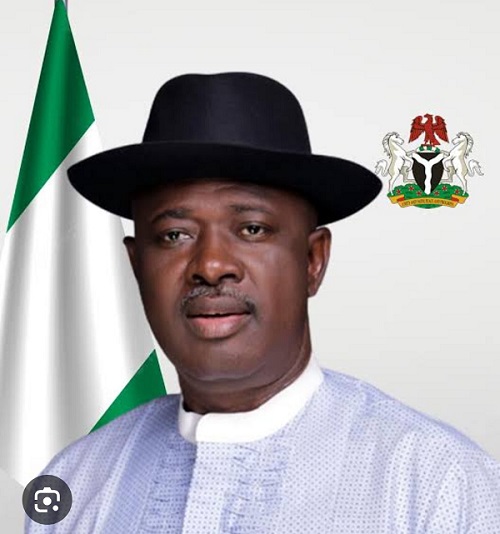
Dr. Heineken Lokpobiri, Minister of State for Petroleum Resources (Oil)
By Olaoye Samuel
When Senator (Dr.) Heineken Lokpobiri assumed office as Minister of State for Petroleum Resources (Oil) in August 2023, Nigeria’s petroleum industry was weighed down by declining crude output, widespread oil theft, investor anxiety and deep uncertainty about the future of the sector. Production had fallen to levels that alarmed both government officials and international observers, while the global energy transition debate was beginning to place additional pressure on hydrocarbon-dependent economies such as Nigeria.
It was within that atmosphere of doubt and urgency that Lokpobiri emerged and delivered what would become the defining statement of his tenure. He told journalists and industry officials shortly after being sworn in: “I’ve got more energy and I’ve come to utilise that energy to revamp the petroleum sector. I am here with one agenda, which is to increase oil production.”
The declaration was undoubtedly direct, unapologetic and ambitious. And in a country accustomed to grand official promises, many initially received it with caution. Yet for Lokpobiri, the statement was not mere rhetoric but a clear articulation of purpose. Nearly three years later, with Nigeria’s crude production rising from about one million barrels per day in 2023 to approximately 1.8 million barrels per day by early 2025, the minister’s early words now read less like optimism and more like a blueprint.
At a time when Nigeria’s petroleum industry stands between renewal and regression, Senator Lokpobiri has become one of the most consequential figures forging its direction. Admirers see him as a pragmatic reformer determined to restore confidence in the sector. Critics view him as a fierce defender of difficult policies whose long-term social consequences remain contested. Either way, his tenure has altered the national conversation around oil, investment, deregulation and energy sovereignty.
Formidable Foundations
To fully understand Dr. Lokpobiri’s approach to petroleum governance, one may need to first understand where he comes from – not merely in the biographical sense, but in the deeper sense of intellectual and political formation. He was born on 3 March 1967 in Bayelsa State, one of the youngest and most oil-rich states in the Niger Delta federation.
That region – a vast, ecologically intricate network of creeks, mangroves, wetlands and riverine communities – has supplied the vast majority of Nigeria’s petroleum wealth for more than six decades, while simultaneously bearing a disproportionate share of the environmental degradation, social disruption and governance failures that have accompanied extraction. Growing up in that environment inevitably redefines one’s relationship with oil, not as an abstraction of national revenue, but as an intimate and often painful reality of communal life.
Lokpobiri’s academic background further portrays unusual breadth for a man who would eventually oversee one of Africa’s largest petroleum industries. He studied Law at Rivers State University of Science and Technology, grounding himself in the procedural and constitutional frameworks that govern resource extraction and state authority. He then pursued advanced study abroad, earning a doctorate in Environmental Rights and Environmental Law from Leeds Beckett University in the United Kingdom. This was a choice that signalled a genuine intellectual engagement with the intersection of natural resource exploitation and human rights, rather than a purely technical or commercial orientation.
That combination of legal training, environmental scholarship, legislative experience and deep roots in oil-producing communities would later lend unusual depth and credibility to his public arguments about energy, development and the rights of oil-producing nations.
Robust Resume
Before entering the federal executive in 2023, Dr. Lokpobiri had already constructed an extensive political résumé over more than two decades of public life. He served as a member of the Bayelsa State House of Assembly between 1999 and 2003 and held the position of Speaker from June 1999 to May 2001. Despite rising to the exalted position at a relatively young age, records show that he demonstrated remarkable legislative command and political dexterity.
His transition to the National Assembly further expanded his influence. As senator representing Bayelsa West, he participated actively in several strategic committees, including Sports, Public Accounts, Police Affairs, Niger Delta and Millennium Development Goals. He also chaired the Senate Committee on Sports, where he gained national visibility for his legislative engagements and administrative style.
During this period, Lokpobiri sponsored the National Agency for Elderly Persons Bill, legislation designed to provide legal protection, welfare support and recreational facilities for elderly Nigerians. The bill reflected a broader social policy interest that distinguished some of his legislative interventions from the more conventional political concerns of the era.
His years in the Senate also revealed a politician unafraid of contentious debates. In 2009, following renewed militant attacks on oil installations in the Niger Delta, Lokpobiri publicly supported the Federal Government’s amnesty programme, arguing that stability in the region was essential for development and infrastructure delivery. According to him, the amnesty initiative would create a more secure environment for contractors and accelerate development projects within the region.
What emerged gradually across those years was a distinctive political style that makes him combative when challenged on matters of principle, pragmatic when negotiation demands flexibility, and most importantly, willing to challenge entrenched assumptions about how things had always been done, even when the institutional pressures to preserve the status quo were considerable.
Politics of Pragmatism
One of the most defining themes of Lokpobiri’s tenure as minister has been his willingness to publicly defend politically costly reforms, particularly the full deregulation of Nigeria’s downstream petroleum sector. Few issues in Nigerian public life have historically been more combustible than fuel subsidy.
For decades, successive federal administrations had treated the petroleum subsidy as a kind of social compact — a visible and tangible benefit that ordinary Nigerians received from a government that many felt had otherwise failed to deliver. The price of petrol was kept artificially low, often far below market rates, through enormous state expenditure that consistently drained public resources and created structural distortions throughout the economy. Government after government hesitated to dismantle the subsidy fully, conscious of the social upheaval that had greeted every previous attempt at reform. The protests of January 2012, when a brief subsidy removal triggered nationwide strikes and demonstrations, remained a cautionary memory for any politician considering the same path.
Lokpobiri, however, has consistently argued that the old subsidy architecture had become not merely economically unsustainable but actively harmful; a system that enriched well-connected importers and regional neighbours at the direct expense of Nigerian public finances and long-term development.
“Whenever you imported refined product into Nigeria, it would find its way into the West African subregion because it was cheaper,” he explained with characteristic directness. “We were practically subsidising the entire West African subregion.”
His critique was simultaneously economic and geopolitical. Subsidy-induced price distortions created powerful incentives for smuggling; refined petroleum products purchased cheaply in Nigeria were routinely shipped across porous land and sea borders to countries where market prices prevailed. This haemorrhage of subsidised fuel both undermined market discipline within Nigeria and transferred enormous implicit fiscal benefits to neighbouring economies that had contributed nothing to their generation.
“What we decided to do was to stop it,” he said, “and this government was the only government that had the courage to do it in 40 years.”
That understanding of reform as an act of political courage rather than mere technocratic adjustment is characteristic of how Senator Lokpobiri tends to narrate difficult policy decisions. t is the language of a politician determined to be seen not merely as an administrator implementing policy, but as a leader willing to defend difficult choices.
Triumphs of a Trailblazer
Critics of deregulation, of course, have not been silenced by the minister’s confidence. Yet defenders of the reform, including Lokpobiri, counter that the subsidy was never genuinely pro-poor – that its benefits were disproportionately captured by wealthier Nigerians who consumed more fuel, by importers and traders who profited from arbitrage, and by neighbouring countries whose citizens filled their tanks across the border.
What is most evident, for now, is that Lokpobiri has altered the rhythm of Nigeria’s petroleum conversation. He has pushed aggressively for production growth, defended politically difficult reforms, challenged dominant global narratives on energy transition and framed Africa’s hydrocarbon resources as instruments of economic sovereignty rather than historical guilt.
Indeed, the general consensus from analysts and observers is that, in an industry long defined by caution, stagnation and cyclical disappointment, Senator (Dr.) Heineken Lokpobiri has emerged as a forceful advocate of movement, reform and industrial ambition.
Olaoye Samuel writes from Lagos (07033179360)
Comment here