
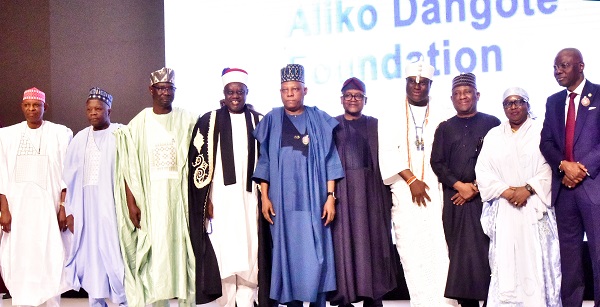
L–R: Kano State Governor, Abba Kabir Yusuf; Gombe State Governor, Muhammadu Inuwa Yahaya; Nasarawa State Governor, Abdullahi Sule; Chairman, ADF Scholarship Programme Steering Committee, Justice Sidi Bage, JSC; Vice President of the Federal Republic of Nigeria, Kashim Shettima; Chairman, Aliko Dangote Foundation, Aliko Dangote; Ooni of Ife, Oba Adeyeye Enitan Ogunwusi (Ojaja II); Chairman, BUA Group, Abdulsamad Rabiu; Deputy Governor of Kaduna State, Hadiza Balarabe; Lagos State Governor, Babajide Sanwo-Olu, at the launch of the Aliko Dangote Foundation (ADF) N100 Billion Annual Education Scholarship Initiative in Lagos on Thursday, December 11, 2025.
…Pledges 25% of personal wealth to Foundation
…FG lauds initiative as governors pledge support
…A population becomes a liability only when it is uneducated
Nigerian industrialist Aliko Dangote, on Thursday, announced a N100 billion annual education support initiative, describing it as a long-term investment aimed at reducing financial barriers that drive millions of young Nigerians out of school. The programme is expected to cost more than N1 trillion over the next decade.
The Presidency praised Dangote for unveiling what is now the largest private education support programme in Nigeria, describing the initiative as a major boost to the Federal Government’s human capital development agenda.
Speaking at the launch in Lagos, Dangote said the plan will support 45,000 new students every year from 2026, rising to 155,000 beneficiaries by the fourth year and remaining at that level for ten years. In total, the scheme is projected to reach 1.3 million students across all 774 local government areas.
The initiative comprises four programmes targeted at sectors where educational exclusion is most acute. Through the Aliko Dangote STEM Scholars, the programme will fund 30,000 undergraduate students annually in science, technology, engineering and mathematics (STEM) across Nigeria’s public universities and polytechnics. Beneficiaries will have their tuition aligned to actual institutional fees.
A total of 5,000 students in public technical and vocational institutions will receive support each year for tools, materials and essential training requirements through the Aliko Dangote Technical Scholars. This complements the Federal Government’s recent policy providing free tuition for TVET students.
The MHF Dangote Secondary School Girls Scholars, named after Dangote’s daughters — Mariya, Halima and Fatima — will support 20,000 public-school girls annually from JSS1 to SSS3, with continued support into tertiary education. The Foundation will prioritise states with the highest numbers of out-of-school girls.
Through the Dangote Teacher Training Programme, the Foundation will launch a large-scale teacher development scheme, beginning with 10,000 secondary-school STEM teachers in 39 government colleges attended by MHF scholars and expanding across all six geopolitical zones.
Dangote said the intervention is aimed at Nigeria’s most vulnerable learners, noting that financial hardship, not lack of talent, is the primary reason many drop out of school.
“This is not only charity. This is a strategic investment in Nigeria’s future. Every child we keep in school strengthens our economy. Every student we support reduces inequality. Every scholar we empower becomes a future contributor to national development,” he said. “Our young people are not asking for handouts. They are asking for opportunities. They are asking for a chance to learn, to grow, to compete and to succeed. And we believe they deserve that chance.”
Dangote noted that for more than three decades, the Aliko Dangote Foundation has invested heavily in health, nutrition, economic empowerment and humanitarian support across Nigeria. However, he said one guiding principle has remained unchanged: “no nation can rise above the quality of education it offers its young people.”
He described education as “the foundation on which every prosperous society is built”, calling it the most powerful equaliser and the strongest engine of social mobility. Despite this, he warned that many talented Nigerian students continue to face financial pressures that threaten to push them out of school. Their dreams, he said, are limited not by ability but by opportunity.
“We cannot allow financial hardship to silence the dreams of our young people — not when the future of our nation depends on their skills, resilience and leadership,” Dangote said.
Noting that this concern informed the Foundation’s new Education Support Initiative, Dangote stressed that the effort is intended as a starting point rather than a standalone solution. “A single organization cannot solve Nigeria’s education challenges alone,” he said. “Government has a role. The private sector has a role. Communities and families have a role. When we work together, we can transform education — and with it, transform Nigeria’s future.”
He added that Nigeria’s progress must not be judged by the number of children left behind, but by the millions empowered and prepared for leadership. He expressed hope that the new initiative would inspire broader action across sectors.
Addressing young Nigerians directly, Dangote said: “your dreams matter. Your education matters. Your future matters. We believe in you. We are investing in you. And we are committed to ensuring that you do not walk this journey alone.”
The Foundation, he said, will use a merit-based and fully digital system for verification, disbursement and monitoring, working in partnership with NELFUND, JAMB, NIMC, NUC, NBTE, WAEC and NECO. Dangote said the focus will be on measurable outcomes including retention, completion rates and post-school impact. He noted that the vision behind the initiative is to give every deserving child the chance to learn — unfettered by cost, free to dream, and equipped to achieve.
To oversee implementation, a Programme Steering Committee has been constituted, chaired by His Highness Justice Sidi Dauda Bage, Emir of Lafia. Other members include former vice-chancellors, senior education administrators, technical advisors and representatives of the Dangote family.
Dangote also disclosed that the programme’s long-term sustainability is tied to his formal commitment to allocate 25 per cent of his wealth to the Aliko Dangote Foundation, adding that the progress on the initiative will be reviewed in 2030 as part of Dangote Group’s Vision 2030 strategy.
He commended President Bola Ahmed Tinubu’s Renewed Hope agenda in the education sector, alongside the Federal Ministry of Education, SUBEBs and state governments, for “deliberate and steady efforts” to support learners amid economic pressures.
The initiative builds on the Foundation’s existing education investments, including university hostels across several states, the Mu Shuka Iri early-learning programme in Kano — which has reached more than 10,000 children — the Aliko Dangote School for Orphan Girls in Maiduguri with an annual N500 million commitment, and a N15 billion pledge over three years to upgrade the Aliko Dangote University of Science and Technology, Wudil.
Dangote said the new scheme marks only the first phase of expanded education interventions focused on quality of learning, teacher development and modern school environments.
Vice President Kashim Shettima said the intervention demonstrates the critical role of private-sector actors in national development. He noted that Nigeria’s demographic growth makes urgent investment in education indispensable, warning that “a population becomes a liability only when it is uneducated.”
“Alhaji Aliko Dangote, through his far-reaching philanthropy, has set in motion the single largest private-sector education support intervention in the history of this country,” Shettima said. “What he has done here today is a lesson to each of us. This is nation-building in its purest form.”
Shettima highlighted ongoing reforms under President Bola Ahmed Tinubu’s administration, including the Nigerian Education Loan Fund (NELFUND), strengthened basic education infrastructure through UBEC, expanded TETFUND interventions and accelerated technical and vocational programmes.
He said these reforms aim to improve Nigeria’s poor Human Capital Index ranking and prepare young people for a skills-driven global economy. Describing Dangote’s philanthropy as “structural and long term,” Shettima said the initiative aligns strongly with the government’s priority of expanding equitable access to education.
“No nation surpasses the aspirations of its most committed patriots,” he said. “The legacy of Alhaji Aliko Dangote reminds us that greatness is not measured by wealth but by the number of lives one lifts from the shadows into the light.”
The Vice President added that the Aliko Dangote Foundation programme will widen opportunities for thousands of learners and bolster the FG’s efforts to build a competitive workforce. He called for stronger collaboration between government, the private sector and development partners to address persistent gaps in the education system.
Education Minister Tunji Alausa described the initiative as “pure human capital development,” saying it aligns with the Tinubu administration’s education sector renewal plan of transforming Nigeria from resource-based economy to a knowledge-based economy and is significant because every local government area will benefit. He said that by the end of the first decade of the scholarship programme, an estimated 170,000 girls would have been enrolled in school through the MHF scholars alone, significantly helping to close the gender gap in education.
Lagos State Governor Babajide Sanwo-Olu, speaking on behalf of the 36 state governors, also commended the initiative and pledged the governors’ full support. He said Dangote continues to set the pace in philanthropy and national development.
“This is purposeful leadership. As a real partner in progress, he has choices, but he has chosen once again to lead with a bold and unprecedented initiative,” he said. “He has consistently shown what true philanthropy means and how wealth can become a catalyst for development. You are using your resources to lift millions, and Nigeria will remember this.”
Chairman of the Programme Steering Committee, His Highness Justice Sidi Dauda Bage, Emir of Lafia, said the scheme is unprecedented and praised Dangote’s patriotism in reinvesting his wealth to uplift other Nigerians. “This is a remarkable challenge Alhaji Aliko Dangote has taken upon himself — the largest ever undertaken by a single individual — committing his resources to support more than 1,325,000 Nigerian students over ten years at a cost exceeding N1 trillion. This is phenomenal, remarkable and truly commendable. Tens of millions of young Nigerians will feel the impact over the next decade and beyond. The multiplier effect on our human capital, social development indicators and overall economic prosperity will be absolutely unprecedented.”
The Ooni of Ife, Oba Adeyeye Enitan Ogunwusi, Ojaja II, said Dangote’s impact in driving private-sector transformation remains unmatched, describing the new initiative as both transformational and a strategic investment in Nigeria’s future.
He recalled how the ADF had come to the aid of his community during a devastating communal conflict that resulted in the destruction of several properties.
In her virtual remarks from the United States, the United Nations Deputy Secretary-General, Amina Mohammed, said the scholarship scheme would create an enabling environment for children to learn and for families to prosper.
Comment here