
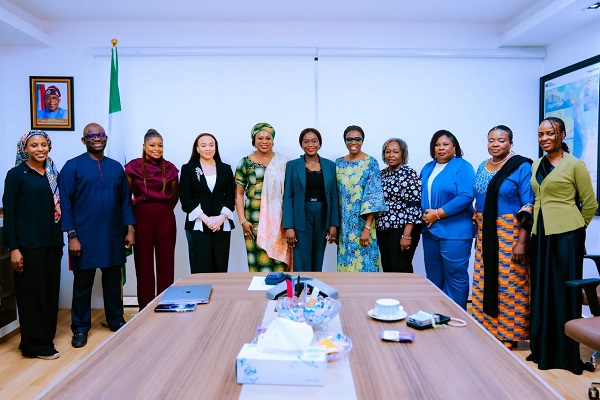
Olu Verheijen, Special Adviser to the President on Energy, Eyono Fatayi williams, President of WIEN, Bassey Adie – Director, Strategic Partnerships & Conferences, Rita Kwentoh, Director, sponsorship, Asanimo Omezi, Executive Secretary, Doyin Adelabu, member of BOT.
…Calls for Policy-Driven Reforms in Nigeria’s Energy Sector
The Women in Energy Network (WIEN) has highlighted structural barriers limiting women’s participation across Nigeria’s oil and gas value chain and called for deliberate, policy-driven reforms to expand inclusion and strengthen indigenous capacity.
During a policy engagement with the Senior Special Adviser to the President on Energy, WIEN presented sector data underscoring persistent participation gaps:
- Women account for 18.2% of Nigeria’s energy workforce and 25.6% of leadership roles.
- Despite over 35,000 companies registered on the Joint Qualification System (JQS), less than 2% are women-owned businesses.
- Women represent only 17% of current STEM enrolments, signaling long-term constraints within the technical and engineering pipeline.
WIEN noted that while a US$40 million Women in Energy Fund, supported by the Nigerian Content Development and Monitoring Board (NCDMB) and the Nigerian Export-Import Bank (NEXIM), is available to support women-led enterprises, utilization remains below optimal levels — largely due to limited access to bankable contract opportunities.
Without qualifying contracts, emerging firms are unable to unlock working capital financing under the facility. The Network emphasized that improving procurement visibility and structured contracting pathways would significantly enhance fund utilization and accelerate capacity development.
WIEN acknowledged that Nigeria’s energy sector is highly technical and capital-intensive, and that maintaining regulatory, safety, and operational standards is essential. However, the Network noted that capacity in such industries is built progressively.
Current procurement structures often require proof of full asset ownership and established technical track record at the bid stage. While appropriate for risk management, this sequencing can limit structured entry opportunities for emerging indigenous and women-led firms seeking to scale.
Referencing Nigeria’s Local Content success, WIEN noted that prior to 2010 indigenous participation was minimal, but has since expanded significantly due to intentional policy frameworks that created phased participation pathways, joint venture structures, and financing alignment.
“Capacity does not emerge by accident; it is engineered through opportunity,” the Network stated. “Nigeria cannot achieve its energy security objectives while half of its population remains underutilized.”
WIEN also stressed the importance of stronger board-level representation, noting that governance diversity strengthens capital allocation decisions, risk oversight, and long-term sector resilience.
In addition, the Network called for strengthened STEM pipelines through targeted internships, mentorship programmes, and industry-backed exposure initiatives to ensure young women are prepared for technical and leadership roles within the sector.
The Senior Special Adviser acknowledged the concerns raised and expressed commitment to promoting policies that ensure women are not structurally locked out of economic opportunities in the oil and gas industry before they are given the opportunity to grow.
WIEN reaffirmed that Diversity, Equity, and Inclusion (DEI) in Nigeria’s energy sector is not tokenism or entitlement, but a strategic imperative tied directly to capital formation, competitiveness, indigenous capacity expansion, and long-term energy security.
Comment here