
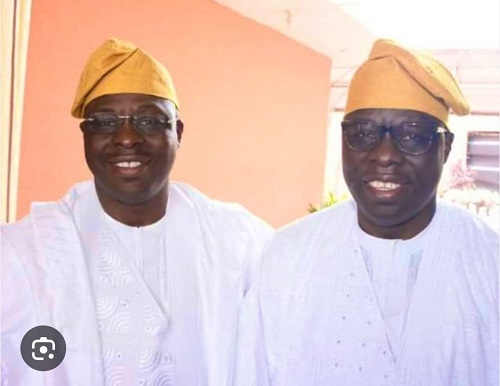
Gbite and Leye Falade
In the competitive corridors of West Africa’s oil and gas industry, a rare biological and professional phenomenon is unfolding. Gbite and Leye Falade are more than just contemporaries. They are identical twins whose lives have mirrored one another from their first days in Ibadan to the same engineering lecture halls. Today, that symmetry has reached the boardroom, as the 53-year-old brothers are poised to control the two most significant levers of Nigeria’s energy transition.
With Leye named the future head of the gas giant, Nigeria LNG (NLNG) and Gbite spearheading the rise of indigenous powerhouse, Aradel Holdings the “power twins” have completed a remarkable parallel ascent.
Emerging from the same Shell talent pipeline, they have moved from shared beginnings to the centre of the nation’s economic strategy one anchoring Nigeria’s global gas ambitions, the other leading the charge for indigenous oil independence.
They studied electrical and electronic engineering at the University of Ibadan and started their careers in the oil and gas industry at Shell Nigeria in 1996. They have worked across the upstream and midstream sectors in and outside Nigeria.
A 28-year veteran of the Shell Group, Leye Falade is the quintessential “company man” with a global footprint. His appointment as the incoming chief executive of NLNG, effective April 2026, marks a high-stakes homecoming for a leader who has spent several years mastering the world’s most complex energy frontiers.
He currently serves as the MD/CEO of Brunei LNG the world’s longest-running liquefaction plant, which is a joint venture between the Brunei government, Shell and Mitsubishi. His move to Brunei followed a strategic tenure as the country chairman for Shell in Namibia, where he sat at the core of one of the decade’s most significant offshore exploration booms.
For Leye, the return to NLNG is a move onto familiar turf. He previously spent over eight years at the company, serving in critical roles including general manager of production as well as operations manager. This deep institutional knowledge will be vital as he inherits NLNG’s most ambitious expansion to date: Train 7.
The $7bn project is designed to catapult Nigeria’s output from 22 million tonnes per annum (mtpa) to 30mtpa. When it comes online next year, Leye will be responsible for ensuring that this massive increase in capacity translates into the forex and energy security in Nigeria so desperately requires.
While his twin navigates the world of global majors, Gbite has emerged as a vanguard for Nigerian independent operators. Since taking the helm of Aradel Holdings, then known as Niger Delta Exploration and Petroleum (NDEP) in February 2021, he has transitioned the company from a quiet pioneer into a diversified energy powerhouse.
Under his stewardship, Aradel achieved a landmark listing on the Nigerian Exchange Group in October 2024, signalling a new era of transparency and scale for local firms.
His tenure has been defined by high value deal-making. He successfully led the acquisition of the Olo and Olo West Marginal Fields from the TotalEnergies-NNPC joint venture, but his magnum opus remains the $2.4bn acquisition of the Shell Petroleum Development Company onshore portfolio.
As a key architect within the Renaissance Energy Africa consortium, he secured a formidable 33.3% stake in the deal, comprised of a 12.5% direct stake for Aradel and 20.8% through its affiliate, ND Western. It is a poetic turn of events: the man who left Shell in 2009 is now buying back his former employer’s legacy assets.
His “indigenous-first” strategy is backed by a sophisticated operational pedigree, including senior executive roles at Oilserv Group and Oando, where he served as COO of Oando Energy Resources.
Having spent his early career as a petroleum economist for Shell EP Africa, Gbite combines technical rigour with the financial agility necessary to thrive in a post-international oil company landscape. He also assumed the chairmanship of the Independent Petroleum Producers Group in November.
Source: The Africa Report
Comment here