
…Establishes Mechanisms for Early Engagement
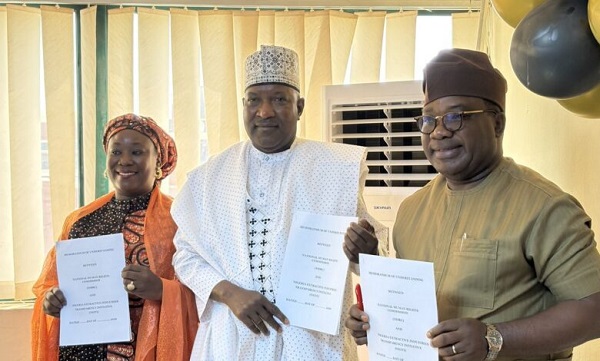
The Nigeria Extractive Industries Transparency Initiative (NEITI) has signed a Memorandum of Understanding (MoU) with the National Human Rights Commission (NHRC) for the protection of civic space, while deepening transparency and accountability in resource governance.
The agreement which was consummated on Friday at the NHRC’s Headquarters, Abuja, was intended to improve information sharing, enable coordinated advocacy and strengthen joint responses to issues at the intersection of extractive governance and human rights.
Speaking during the epoch-making event, the Executive Secretary of NEITI, Hon. Musa Sarkin Adar said, the ceremony was not a formality, but a deliberate step to strengthen an already productive relationship and to align the institutions around shared values of transparency, accountability, human rights protection and democratic governance.
Affirming that the NEITI and NHRC have long worked at intersecting points, Hon. Sarkin Adar said the NEITI’s mandate to promote transparency and accountability in the extractive sector complements NHRC’s mandate to safeguard human rights and civic freedoms.
Speaking further Adar said, “Over the years our collaboration has produced practical benefits. Today’s MoU simply formalises and structures that cooperation so it can deliver an even greater, measurable impact.”
While saying that the protection of the civic space was central to the NEITI, Hon. Adar explained that civil society is central to EITI implementation.
“It is a formal, indispensable part of the tripartite system (We call it the Magic triangle) alongside government and industry. That tripartite arrangement is the backbone of EITI’s credibility, balance and the ability to operate freely, independently and without fear,” he added.
According to him, the civil society organisations carry out advocacy, policy dialogues, analyse data, engage communities, disseminate findings, and hold actors to account at national and subnational levels.
“They translate complex extractive-sector information into public knowledge and ensure host communities’ interests are represented. NEITI’s effectiveness is therefore directly linked to the strength and freedom of civil society.
“By anchoring civic space protection in a formal partnership with the NHRC, NEITI is reinforcing its commitment to EITI principles and to an enabling environment for civil society participation.
Adar added that “The MoU establishes mechanisms for early engagement, joint response, and institutional support when civic space concerns arise in the extractive sector context.”
Highlighting the benefits of the MoU, the NEITI boss said, “This partnership therefore, will improve information sharing, enable coordinated advocacy and strengthen joint responses to issues at the intersection of extractive governance and human rights.
He expressed optimism that the agreement would be translated into concrete programmes- joint capacity-building, shared platforms for monitoring and reporting, rapid-response protocols for civic space violations and public outreaches that empower communities and civil society.
“Success will be measured by tangible outcomes which include safer civic space, clearer information flows and stronger protections for citizens affected by extractive activities.”
Comment here