
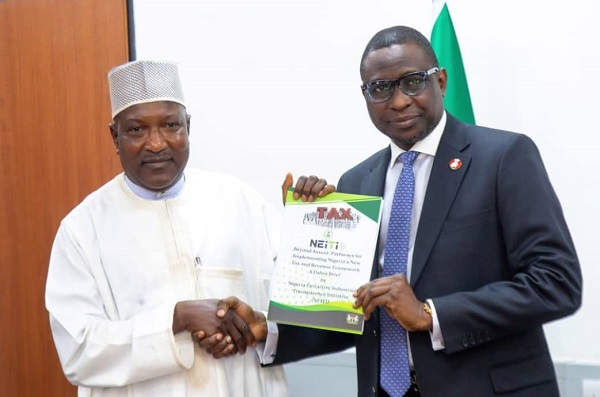
From Left: The Executive Secretary of NEITI, Hon Musa Sarkin Adar, presenting the policy brief titled “Beyond Assent: Pathways for Implementing Nigeria’s New Tax and Revenue Framework” to the Executive Chairman of the Economic and Financial Crimes Commission (EFCC), Mr. Ola Olukoyede, during the courtesy visit by NEITI to EFCC in Abuja.
The Nigeria Extractive Industries Transparency Initiative (NEITI) has reaffirmed its unwavering commitment to accountability in Nigeria’s oil, gas, and mining sectors by strengthening its partnership with the Economic and Financial Crimes Commission (EFCC) and the Independent Corrupt Practices and Other Related Offences Commission (ICPC).
During separate courtesy visits to the headquarters of both agencies, NEITI’s Executive Secretary, Hon. Musa Sarkin Adar, underscored the urgency of deepening collaboration to enforce transparency, remediate audit findings, and plug systemic revenue leakages in the extractive industries.
Hon. Adar emphasized that since assuming office, his priority has been to engage strategically with institutions whose statutory mandates align with NEITI’s mission. He described EFCC and ICPC as indispensable partners in ensuring that NEITI’s transparency disclosures translate into concrete enforcement outcomes.
“This partnership is not just about disclosure. It is about accountability, corrective actions, and measurable impact. As Nigeria prepares for the 2026 EITI Validation, our collective responsibility is to demonstrate that transparency leads to real change,” Adar stated.
The Executive Secretary highlighted that the forthcoming EITI Validation will assess Nigeria’s implementation of the 2023 EITI Standard across three critical pillars: Transparency, Stakeholder Engagement, and Outcomes & Impact. He stressed that the assessment is a test of Nigeria as a nation, not just NEITI as an institution.
NEITI formally sought the continued cooperation of EFCC and ICPC under the existing Memorandum of Understanding (MoU), calling for stronger joint action through information sharing, technical collaboration, and coordinated follow-up on cases arising from NEITI’s audit reports.
EFCC Chairman, Mr. Ola Olukoyede, described NEITI’s audit reports as “indispensable raw materials” for investigations, noting that the Commission has already established a dedicated Extractive Industry and Fraud Section to tackle sector-specific financial crimes. He pledged to review and strengthen the MoU with NEITI to enhance coordination and impact.
ICPC Chairman, Dr. Aliyu, SAN, hailed NEITI as a “critical vanguard” in the fight against systemic corruption. He highlighted the operationalization of ICPC’s Special Extractive Industry Desk, created specifically to act on NEITI’s audit findings.
According to Dr. Aliyu, “By combining NEITI’s forensic data with ICPC’s investigative and prosecutorial powers, we have moved beyond reporting infractions to rectifying them”.
He assured NEITI of ICPC’s continued partnership, stressing that Nigeria’s natural wealth must deliver tangible development outcomes and that public expectations for accountability remain high.
The partnership between NEITI, ICPC and the EFCC reflects a united front by NEITI and a shared mandate for accountability. The three agencies underscored the need for transparency to be matched with enforcement, adding that the effective management of Nigeria’s extractive resources depend on sustained inter-agency cooperation and collaboration.
The meetings, attended by senior management teams of the agencies, form part of NEITI’s ongoing sensitization visits to prepare stakeholders for their roles and responsibilities ahead of Nigeria’s 2026 EITI Validation.
Comment here