
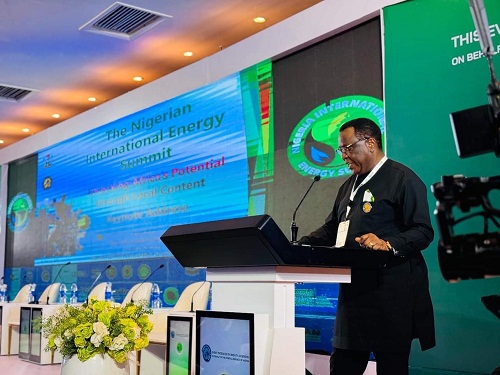
Engr. Felix Ogbe, ES NCDMB
…President’s Executive Order on local content coupled with Nigeria First policy was designed to boost local capacity and attract investments in the industry.
-Felix Douglas
During his keynote address at the Nigeria International Energy Summit (NIES), Executive Secretary (ES) of Nigerian Content Development and Monitoring Board (NCDMB), Felix Omatsola Ogbe, pointed out that the epoch event is a gathering that continues to shape the future of Africa’s energy narrative.
The ES said this year’s theme “Local Content Beyond Compliance: Building African Industrial Powerhouses”—is a call for Africa to move from consuming innovation to creating innovation.
To understand what is “beyond compliance” truly means, stakeholders must reflect on three pillars that determine the continent’s industrial destiny: Competence, Capacity Utilization and Collaboration.
He stated further that competence is building a strategic, indigenous supply chain that delivers service excellence without compromising standards. Capacity utilization is maximizing of domestic assets from fabrication yards to marine fleets—ensuring local content translates to local mastery and value retention.
On the aspect of collaboration, Ogbe said it aligns and galvanizes regional blocs and the private sector to implement a single Pan-African local content template.
NCDMB’s compliance trajectory has been to first develop regulations, systems and processes that enabled the development of indigenous technologies, strengthening domestic manufacturing, fostering research and innovation, and creating a resilient and globally competitive supply chain.
The ES spoke on the cable manufacturers that supplied an estimated 2 million meters of cables to NLNG train 7 also have the capacity to deliver quality cables to African markets in Cameroon, Angola, Ghana, Cote d’Ivoire and Algeria.
Local indigenous companies like Aveon, Beamco, Tranos have built fabrication and assembly yards capabilities of pressure vessels, pumps, valves, cable trays and similar oil field production platforms.
Ogbe emphasized further that Temile Nigeria owners of LNG carrier and Tamrose with fleet of vessels are testimonies of indigenous ownership of marine assets.
The ES spoke on Radial Circle, Weafri, Harybeat, Fairtex which are examples of indigenous companies that have expanded operations beyond the shores of Nigeria, with operations in Angola, Ghana, Uganda and Equatorial Guinea.
Trainers under the Oil and Gas Trainers Association are providing field development, infrastructure, facilities management, and deepwater linked trainings relevant for the African oil and gas labour market.
The NCDMB helmsman posited that Executive Order on local content issued by President Tinubu’s administration coupled with the “Nigeria First” policy, were designed to boost local capacity, attract investment in gas and deepwater projects and accelerate contract execution.
NCDMB has carried out a detailed revision of its guidelines to reduce contracting timelines, mitigate the transferability of NCEC.
According to Ogbe: “For Africa to be an industrial powerhouse, we must collectively and collaboratively embrace talent development, process excellence, research & development, modern manufacturing capabilities and cross border trade in goods and services.
He stated that competence is what gives investors’ confidence and capacity is what gives investors certainty. The country’s aspiration is to evolve from local participation to local mastery, where African companies lead EPC projects, fabricate complex components, and export specialized services.
Ogbe explained that one of the critical success factors for a sustainable local content program is access to competitive financing. He also spoke on the African Energy Bank which is now a reality, and the office will be handed over to African Petroleum Producers’ Organization (APPO). This quantum leap in access to project financing will enable companies to access cheaper financing to compete globally.
Notwithstanding, the tripod of compliance, capacity utilization and collaboration will unlock Africa’s industrialization powered by energy innovation, technology- powered infrastructure, sustainable operations, manufacturing clusters, AfCFTA-enabled globally competitive supply chains and a workforce prepared for complex high-tech operations.
Comment here