
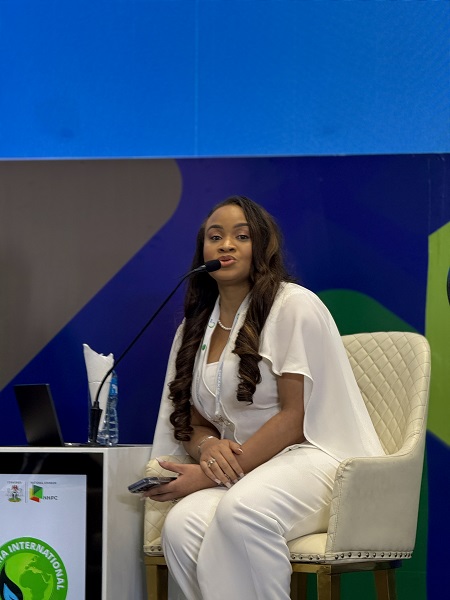
Bassey Adie, MD Loyz Marine Services Limited
Bassey Adie, Managing Director of Loyz Marine Services Limited and Director of Partnerships and Conferences at the Women in Energy Network (WIEN), delivered a policy-driven call for inclusive industrial reform at the Nigeria International Energy Summit (NIES) and the Sub-Saharan Africa International Petroleum Exhibition and Conference (SAIPEC).
Speaking across both platforms, Adie argued that Nigeria’s next phase of energy and maritime growth must be anchored in deliberate, inclusive policy architecture that strengthens indigenous ownership, expands structured participation, and reinforces long-term competitiveness.
Local Content as Proof of Policy Success
At NIES, Adie positioned Nigeria’s Local Content framework as clear evidence that intentional policy intervention can re-engineer an industry.
Prior to 2010, indigenous participation in Nigeria’s oil and gas sector was estimated at roughly 3%. Today, local content delivery has risen to nearly 70%, driven by structured contract allocation, joint venture frameworks, and access to aligned financing mechanisms.
“Policy is not theoretical. We have already seen how intentional frameworks can transform an entire industry. Local content is proof that when government intervenes deliberately, capacity follows,” she stated.
She emphasized that the same architectural discipline must now be applied to close participation gaps — particularly for women-owned enterprises and indigenous marine operators.
Structural Access, Not Capability
Nigeria’s Joint Qualification System (JQS) lists over 35,000 active NCDMB-registered companies competing across the energy value chain, with fewer than 5% identified as women-owned.
According to Adie, this disparity reflects structural access constraints rather than a lack of competence.
“Diversity is not a social gesture — it is a strategic imperative. Capacity does not appear by accident; it is engineered through opportunity,” she said.
At SAIPEC, where she spoke on a Diversity, Equity and Inclusion (DEI) panel, Adie reinforced that meaningful inclusion requires measurable systems, not rhetoric. She outlined practical reforms, including:
- Structured procurement pathways
- Predictable payment cycles
- Access to financing and contract guarantees
- Transparent participation frameworks
- Leadership accountability tied to measurable inclusion metrics
Strengthening Nigeria’s Blue Economy
Adie’s remarks also focused on indigenous vessel ownership, offshore logistics infrastructure, and financing structures that allow local operators to retain economic value within Nigeria.
She argued that Nigeria must move beyond extractive participation toward asset-backed industrial growth.
“A competitive blue economy is not built on access alone — it is built on ownership, infrastructure, and financing. If indigenous operators cannot scale assets, Nigeria exports value instead of retaining it.”
She highlighted persistent financing gaps, fragmented procurement structures, and policy-execution disconnects that continue to constrain indigenous marine capacity, calling for coordinated alignment between regulators, financial institutions, and private operators.
Inclusion as an Economic Strategy
Speaking through her leadership role at WIEN, which represents over 1,500 women professionals, more than 80 women-owned businesses, and approximately 30 corporate members, Adie reframed diversity as a structural economic issue.
“The biggest mistake organisations make is treating diversity as a social conversation instead of an economic strategy. Nigeria cannot compete globally while leaving half of its talent underutilised.”
She stressed that industrial growth and human capital inclusion must advance together if Nigeria is to achieve sustainable energy security and maritime competitiveness.
A Blueprint for the Next Phase
Across both platforms, Adie reinforced a central message: Nigeria already has a blueprint for industrial transformation. The Local Content framework demonstrates that when policy is deliberate and sustained, participation expands and capacity scales.
“The next step is ensuring that no capable segment of our industry is left outside the architecture of growth,” she concluded.
Comment here