
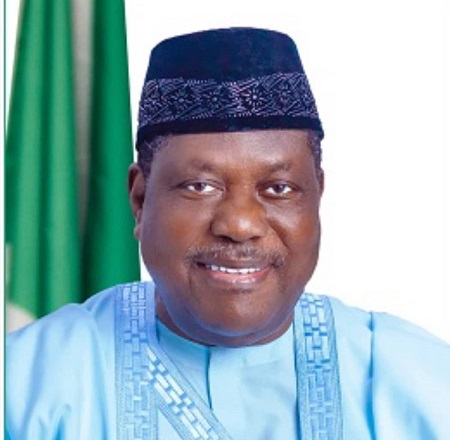
Senator George Akume
-Felix Douglas
The Secretary to the Federal Government Senator George Akume, commended and acknowledged roles of members of the civil society, partners and stakeholders in Advocacy Dialogue at the Extractive Industries Transparency Initiative (EITI) Validation Forum.
Akume was of the view that the presence these stakeholders underscores collective commitment to strengthening transparency, accountability, and governance in Nigeria’s extractive sector.
The Federal Government scribe congratulated the Executive Secretary of Nigeria Extractive Industries Transparency Initiative (NEITI), Hon. Musa Sarkin Adar, on his appointment and expressed confidence in his capacity to provide leadership as NEITI advances its transparency and accountability mandate.
He also commended the NEITI Secretariat, under his leadership for convening the timely dialogue.
Akume acknowledged the invaluable support of development partners, particularly the European Union- International Institute for Democracy and Electoral Assistance Programme and the EITI International Secretariat, whose continued collaboration has helped deepen Nigeria’s transparency reforms.
According to Akume: “this dialogue comes at a critical moment for Nigeria. As a nation, we are navigating complex economic reforms, fiscal pressures, and heightened public expectations for accountability in the management of Nigeria’s natural resources. The extractive sector remains central to Nigeria’s economic stability, revenue mobilisation, and long-term development aspirations. Yet, it is also a sector where governance gaps, inefficiencies, and lack of transparency have historically constrained its full potential.”
Akume stated further that the findings and recommendations of NEITI reports over the years have become part of the major tools driving the on-going reforms in oil, gas and mining sectors.
The 2023 EITI Standard assumes heightened relevance. The Standard challenges all implementing countries to not only disclose information but to ensure that transparency drives reform, strengthens institutions, and delivers tangible benefits to citizens. For Nigeria, this means going beyond compliance to using EITI as a reform tool that supports domestic revenue mobilisation, prudent fiscal management, and inclusive governance.
“As the Chairman of the NEITI NSWG, I am particularly encouraged that this dialogue focuses on Nigeria’s recent EITI Assessment, the Validation process, and the unveiling of a policy brief on “Beyond Assent: Pathways for Implementing Nigeria’s New Tax and Revenue Framework”. These discussions are not merely academic; they speak directly to how Nigeria can close revenue leakages, improve sector oversight, and align extractive sector governance with the country’s broader economic reform agenda.”
The Federal Government scribe said the strength of NEITI lies in its multi-stakeholder model. Government alone cannot deliver transparency. Civil society, the private sector, sub-national actors, the media, and development partners all have vital roles to play.
“This is why dialogues such as this are essential to create space for constructive engagement, honest reflection, and shared ownership of reforms.”
Comment here