
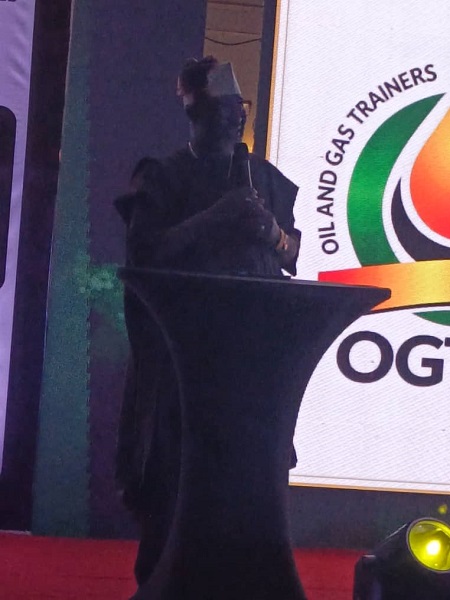
Sola Adebawo
…Trainers must reposition themselves as strategic partners capable of addressing operational challenges.
…Trainers to move from connections to collaboration, from collaboration to competence, from competence to contracts and from contracts to sustainable national value.
-Felix Douglas
Mr. Adesola Adebawo, Chief Executive Officer (CEO) at Hyphen Partners Limited has made it known that competence, institutional credibility and strategic collaboration are critical to winning contracts and strengthening Nigeria’s local training capacity.
He called on Nigerian oil and gas training institutions to move beyond conventional networking and embrace competence-driven collaboration as a strategy for securing commercial opportunities and strengthening local capacity in the energy industry.
Adebawo, who delivered the keynote address at the 5th Oil and Gas Trainers Association of Nigeria (OGTAN), Lagos Zone Dinner and Award Ceremony on Friday, November 27, 2026, said relationships could open doors to business opportunities, but only demonstrated competence, credibility and the capacity to deliver could translate those opportunities into sustainable contracts.
Speaking on the theme, “From Connections to Contracts: Creating Opportunities Through Collaboration in Nigeria’s Oil and Gas Training Sector,” he stressed that training providers must reposition themselves as strategic partners capable of addressing operational challenges rather than merely selling training programmes.
He noted that the oil and gas industry operates within a demanding environment characterised by capital-intensive projects, significant operational risks, stringent regulatory requirements and critical safety considerations, making technical competence and reliable service delivery essential.
According to him, operators cannot award critical training contracts solely on the strength of personal relationships but must be convinced that providers possess qualified instructors, appropriate facilities, credible methodologies and the capacity to deliver measurable results.
“A relationship may secure an introduction. It may earn us a meeting. It may even get our proposal considered. But it cannot, on its own, guarantee a contract,” he said.
Adebawo urged training institutions to understand the changing requirements of the industry, particularly in areas such as engineering, equipment maintenance, offshore operations, project management, safety, digital technologies, cybersecurity and artificial intelligence.
He argued that training providers must shift from offering generic courses to identifying and solving specific industry problems, explaining that commercial opportunities increasingly belong to institutions that understand operational requirements and can demonstrate how their interventions improve business performance.
On collaboration, the Hyphen Partners CEO was of the view that partnerships must go beyond meetings, memoranda of understanding and ceremonial exchanges, describing effective collaboration as the combination of complementary resources, expertise and institutional capabilities to achieve results that individual organisations may struggle to deliver independently.
He identified operators, service companies, regulators, training institutions, universities and technical organisations as important stakeholders whose capabilities must be aligned to address Nigeria’s human capacity-development needs.
He also encouraged training providers to form properly structured consortia to pursue larger and more technically demanding contracts, noting that such arrangements must clearly establish responsibilities, pricing, revenue sharing, intellectual property, confidentiality, quality assurance and accountability.
OGTAN to strengthen industry engagement
Adebawo identified OGTAN as a strategic platform capable of coordinating human capacity development across Nigeria’s oil, gas and energy industry, urging the association to translate its institutional positioning into greater commercial relevance.
The association’s network of more than 400 members represented considerable collective capacity, but argued that membership strength must be demonstrated through the ability to address industry requirements.
He proposed five strategic interventions through which OGTAN could strengthen its influence and create greater opportunities for members.
These include establishing an industry skills intelligence platform to identify emerging workforce requirements, developing a verified directory of members’ technical capabilities, promoting consortium-based business development, deepening engagement with operators and service companies, and strengthening quality assurance.
He said a credible industry-wide capability directory would enable operators to identify institutions with appropriate facilities, internationally recognised accreditation, qualified instructors and specialised training expertise.
He further urged OGTAN to establish regular engagement with the human resources, technical, procurement, operations and Nigerian content departments of industry companies to identify training requirements before opportunities are advertised.
On quality assurance, Adebawo highlighted the Nigerian Content Trainers’ Registration Certificate, launched by the Nigerian Content Development and Monitoring Board (NCDMB) in July 2026, as an important development towards improving standards among training providers.
He encouraged OGTAN members to embrace the registration framework as an opportunity to strengthen their competitiveness rather than treat it merely as a regulatory compliance requirement.
Training must translate into employment and productivity
The keynote speaker also stressed the need to connect human capacity development directly to employment creation, entrepreneurship and measurable industry outcomes.
He referenced NCDMB’s 60-20-20 Strategic Training Model, which applies to the Board’s direct-intervention human capacity-development programmes, allocating 60 per cent to employment creation and entrepreneurship development, 20 per cent to advanced training and certification, and 20 per cent to basic and entry-level training.
According to him, the model reinforces the principle that training should respond to actual industry requirements and create opportunities for beneficiaries to deploy their acquired competencies.
The Hyphen Partners CEO highlighted importance of project-based human capacity development, urging indigenous contractors and other industry players to identify workforce requirements during project planning and bidding rather than waiting until contract execution.
He maintained that training providers should participate earlier in the project value chain by engaging contractors and operators while workforce requirements and project execution strategies are being developed.
The opportunity is to move training from the margins of project execution into the architecture of project delivery,” he said.
Calls for improved competitiveness and technology adoption
Addressing the challenges confronting indigenous training providers, Adebawo acknowledged difficulties associated with procurement processes, payment cycles, accreditation costs, specialist equipment and investment in modern training facilities.
However, he challenged Nigerian institutions to critically assess their competitiveness, particularly their instructors’ experience, technical facilities, certifications, programme relevance, financial capacity and ability to deliver at the scale required by major industry projects.
He maintained that local content opportunities must be supported by growing indigenous competence, adding that Nigerian providers should aspire to meet international standards and eventually export their services across Africa.
He also called for increased investment in technology-driven training, identifying artificial intelligence, automation, robotics, digital twins, predictive analytics, cybersecurity and remote monitoring as emerging technologies reshaping workforce requirements across the energy value chain.
He advocated stronger partnerships with technology companies, original equipment manufacturers, international training institutions and research organisations to facilitate knowledge transfer, improve local infrastructure and develop Nigerian instructors.
He cautioned against international partnerships that create permanent dependence on foreign expertise, insisting that the objective should be to build sustainable indigenous knowledge and institutional capacity.
Looking ahead, Adebawo outlined a seven-point agenda for the association and its members over the next 12 months.
The proposals include an annual industry training demand and capability report, regular engagement between operators and training providers, development of strategic training consortia, stronger links between training and employment, international partnerships focused on knowledge transfer, improved commercial readiness of training institutions, and measurable assessment of commercial and developmental outcomes.
He said OGTAN should increasingly measure its performance by the business opportunities facilitated, contracts secured, professionals trained and employed, institutional standards improved and economic value retained within Nigeria.
Emphasising the importance of institutional credibility, he added that sustainable business relationships must be supported by integrity, transparency, consistent performance and adherence to commercial agreements.
He urged operators and service companies to give qualified Nigerian training institutions fair opportunities to compete, while encouraging local providers to continually improve their technical and operational capabilities.
Continuing, Adebawo said Nigeria’s energy future would depend not only on hydrocarbon reserves, production volumes and investment inflows but also on the quality of its workforce and the strength of institutions responsible for developing local capabilities.
He challenged OGTAN members to see themselves not merely as providers of training programmes but as critical contributors to developing the professionals who will explore, produce, process, transport, manage and regulate Nigeria’s energy resources.
“Let us move from connections to collaboration, from collaboration to competence, from competence to contracts and from contracts to sustainable national value,” he said.
He congratulated OGTAN Lagos Zone on the fifth edition of its dinner and award ceremony and commended the award recipients for their contributions to professional excellence and the development of Nigeria’s energy industry.
Comment here