
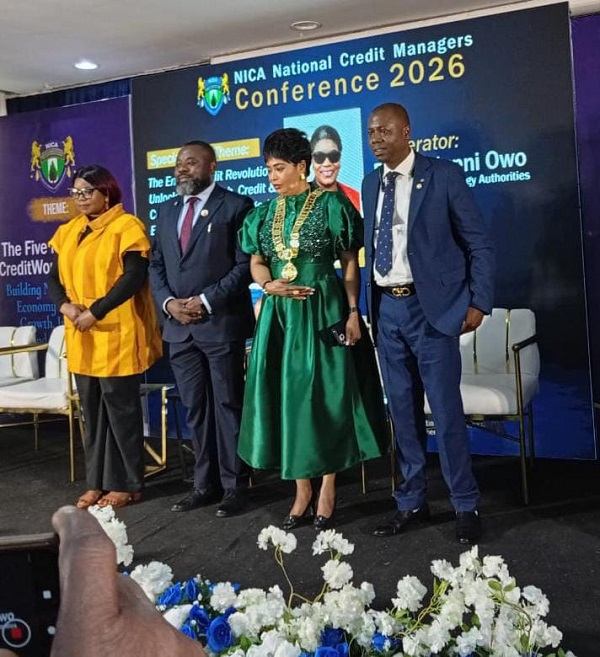
L-R: Dr. Oladunni Owo, CEO, BlackGold Energy Authorities, Mr Sheriff Adeeyo, GM, Emadeb Energy, Dr (Mrs) Markie Idowu, FICA, NICA President, and Mr. Felix Eribo, Executive Director, Masters Energy.
Oil and Gas operators have identify supply chain financing, transparency, payment discipline and trust as critical to improving access to funding across Nigeria’s energy value chain
At the just concluded National Institute of Credit Administrators (NICA) credit managers conference in Lagos yesterday stakeholders said that Nigeria’s energy industry requires a stronger and more credible credit management framework to unlock capital, improve liquidity and attract the investment needed to expand operations across the oil and gas value chain.
In one of the panel sessions, moderatored by Dr. Oladunni Owo, the Chief Executive officer and Managing Director (CEO/MD) of BlackGold Energy Limited, the speakers identified inadequate access to credit, trapped receivables, weak payment structures as huge gap to funding in the oil and gas industry. They raised concerns over the creditworthiness of operators as major obstacles to financing projects and expanding energy infrastructure in the country.
The panel session themed “The Energy, Oil and Gas Credit Revolution: Unlocking the Cash, Credit and Confidence to Power Nigeria’s Energy Future” is part of the planned summit on Energy credit next year.
Speaking at the session, Dr. Oladunni Owo, described credit as the missing link between Nigeria’s enormous energy resources and the economic benefits they should generate.
She said that although oil and gas remained critical to the country’s foreign exchange earnings, government revenue and industrial development, operators across the sector continued to struggle with access to working capital, while distributors battled trapped receivables and consumers faced rising energy costs.
According to her, Nigeria does not lack energy resources but an effective financial bridge to convert those resources into productive economic outcomes.
She warned that without a reliable credit management system, lenders would remain reluctant to finance projects, investors would hesitate to commit funds, and operators would find it difficult to expand their businesses.
Owo noted that the financing challenges facing the industry had implications beyond oil and gas companies, stressing that the availability of credit ultimately affected energy affordability, industrial productivity and the welfare of ordinary Nigerians.
She recalled spending about 15 years seeking funding for a refinery project before the emergence of the Dangote Refinery, observing that the country’s fuel supply situation could have been considerably worse without the huge investment secured for the facility.
She said the conference was a pilot initiative ahead of a much bigger national and international summit on energy, oil and gas credit management planned for 2027.
The proposed summit, she explained, would bring together more financial institutions, local and international lenders, oil and gas operators, regulators and investors to develop practical solutions to the industry’s financing challenges.
Speaking on how operators could improve payment cycles and restore liquidity, the Chief Operating Officer of Emadeb Energy Group, Mr. Sheriff Adeeyo, identified supply chain financing as one of the most effective mechanisms for unlocking capital within the industry.
Adeeyo explained that conventional funding arrangements had become increasingly difficult for some operators, forcing companies to explore alternative financing structures and depend more on internally generated resources to sustain and expand their businesses.
He cited supply chain financing initiatives involving major industry players, including Renaissance Africa Energy, as examples of how contractors and vendors could access financing through their contractual relationships with oil and gas companies.
According to him, such arrangements enable vendors and contractors to obtain funding from commercial banks and other financial institutions using verified contracts and business transactions as the basis for financing.
He stressed that transparency and proper documentation of contractual relationships between operators, creditors and contractors were essential to making such financing arrangements successful.
Adeeyo said lenders would be more willing to provide funding when they could independently establish the ownership of contracts, the credibility of the operating company and the viability of the underlying assets.
Also speaking, the Group Executive Director, Operations, Masters Energy Group, Mr. Felix Eribo, said the difficulty of accessing credit was not limited to the oil and gas industry but affected businesses across different sectors of the Nigerian economy.
Drawing from research he conducted involving 41 microfinance banks in Nigeria as part of his Doctor of Business Administration (DBA) thesis, Eribo said he encountered several promising business proposals that could not secure financing because the applicants were considered insufficiently creditworthy.
He noted that even established oil and gas companies could be denied facilities when their credit ratings failed to meet the requirements of financial institutions.
Eribo argued that strengthening credit assessment procedures and establishing reliable systems through which lenders could verify borrowers’ financial and business records would help address the challenge.
He said the development of efficient credit information and verification mechanisms would enable financial institutions to conduct necessary checks without depending entirely on physical interactions with prospective borrowers.
According to him, although banks must protect depositors’ funds and satisfy shareholders’ interests, some financial institutions and credit organisations remain willing to finance businesses with demonstrable integrity, strong transactional histories and proven repayment records.
Using his experience in the industry, he recalled how a company he was associated with successfully repaid a bank facility following the challenges that affected the sector in 2008.
He said the repayment subsequently earned the company a positive recommendation from the financial institution, helping to strengthen its relationship with lenders and improve access to further credit facilities.
Eribo emphasised that trust, repayment discipline and a demonstrable willingness to honour financial obligations were critical considerations in determining whether businesses could access credit, irrespective of their size.
He urged operators to recognise that building a credible credit history was as important as presenting viable business proposals when seeking financing.
The discussions highlighted the need for a more integrated credit ecosystem capable of connecting financial institutions with operators, contractors, distributors and other participants across the energy value chain.
Stakeholders maintained that improving access to finance would require more than the availability of funds, stressing that transparency, credible financial records, effective contract administration and timely repayment obligations must underpin lending relationships.
They expressed optimism that a strengthened credit management framework would improve confidence among lenders and investors, unlock funding for new oil and gas projects and support Nigeria’s ambition to expand energy production and infrastructure.
Comment here