
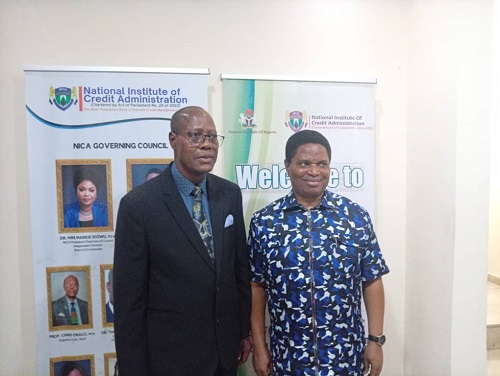
L-R: Prof. Chris Onalo, Founding Registrar/CEO, NICA and Dr. Felix Amieyeofori, MD/CEO, Entek Intergrated Resources Limited
…Nigeria’s oil and gas companies should strengthen corporate governance, uphold business integrity and adopt prompt payment practices.
-Felix Douglas
The National Institute of Credit Administration (NICA), Chartered, has warned that poor credit management, prolonged payment cycles and mounting receivables across Nigeria’s oil, gas and wider energy industry are threatening investment, project execution and sustainable sectoral growth.
The Institute said Nigeria’s energy development ambitions could remain constrained unless urgent measures were taken to address financial and commercial bottlenecks preventing the effective flow of credit and capital across the energy value chain.
NICA’s Founding Registrar and Chief Executive Officer, Prof. Chris Onalo, raised the concern on Monday during a press conference with energy journalists in Lagos, where he unveiled the objectives and significance of the forthcoming National Credit Managers Conference 2026.
Prof. Onalo explained that Nigeria’s energy industry was grappling with more than infrastructure and production challenges, noting that poor credit and receivables management had emerged as significant obstacles to business sustainability and investment.
He disclosed that contractors frequently finance project operations from their own resources while waiting for months to receive payments, with some service providers and vendors subjected to payment arrangements extending to 180 days.
He added that petroleum product marketers depend heavily on credit facilities to finance product purchases and distribution, while gas off-takers rely on commercial agreements that require consistent financial commitments from all parties.
According to him, when these credit relationships become unreliable, the effects spread across the industry, leading to delayed projects, restricted working capital, declining investor confidence and substantial receivables trapped in corporate balance sheets.
The NICA chief executive warned that businesses unable to convert outstanding payments into cash would struggle to sustain operations, meet contractual obligations and undertake fresh investments.
He argued that Nigeria’s enormous oil and gas reserves would not automatically translate into economic prosperity without adequate financing, investment, infrastructure and dependable commercial relationships.
“What is the value of oil in the ground if the credit required developing, processing, transporting and commercialising it cannot flow?” he queried.
Prof. Onalo maintained that unlocking Nigeria’s energy potential required more than increasing electricity generation capacity, stressing that the effective mobilisation of cash, credit and investor confidence was equally important.
He said these concerns informed the decision to dedicate a major session of the 2026 National Credit Managers Conference to the theme, “The Energy, Oil & Gas Credit Revolution: Unlocking the Cash, Credit and Confidence to Power Nigeria’s Energy Future.”
The conference, which will bring together government officials, regulators, financial institutions, energy operators, investors and credit management professionals, will also examine the broader theme, “The Five Pillars of a Creditworthy Nation.”
Prof. Onalo said the gathering would provide a platform for developing practical solutions to financing and credit challenges confronting Nigeria’s productive sectors, particularly the energy industry.
He identified credit guarantees, reliable credit reporting systems, collateral reforms and professional credit management as critical instruments for reducing investment risks and improving access to financing for energy projects.
The conference is also expected to examine strategies for unlocking trapped receivables, shortening payment cycles and restoring liquidity across the oil, gas and wider energy value chain.
According to him, the desired outcome is a practical roadmap for establishing an energy credit ecosystem where lenders, investors, operators, contractors and consumers can transact with greater confidence.
He envisaged an industry where contractors receive payments within agreed timelines, petroleum marketers secure financing more easily, gas supply agreements are honoured and vendors are protected from the financial pressures associated with prolonged payment cycles.
“Receivables must become cash, cash must become investment, investment must become projects, and projects must deliver reliable energy and economic prosperity,” he said.
Beyond the energy industry, Prof. Onalo was of the view that the conference would advance a homegrown credit economy framework anchored on five pillars: CreditReady Citizens, CreditWorthy Citizens, CreditManaged Citizens, CreditRules-Abiding Citizens and CreditSustainable Citizens.
He explained that the framework was designed to promote a national credit culture in which individuals and businesses could access responsible credit based on their credibility, financial history, capacity and repayment behaviour rather than depending exclusively on cash transactions or conventional collateral.
Highlighting the Institute’s regulatory responsibilities, Prof. Onalo referenced the National Institute of Credit Administration Act No. 26 of 2022, which empowers NICA to regulate, promote and develop the credit management profession in Nigeria.
He also disclosed that the Federal Government’s recognition of credit management as a national profession in October 2024 had strengthened the need for professionally trained and competent credit managers across public and private institutions.
On the Federal Government’s financial inclusion and capacity-building agenda, Prof. Onalo added that NICA had been called upon to contribute to the national initiative to train 10 million Nigerians, with priority attention to women, youths, graduates and micro, small and medium enterprises (MSMEs).
He disclosed that the Institute had signed a Memorandum of Understanding with five other professional bodies to establish a collaborative framework for delivering the training programme nationwide.
Additionally, NICA has launched an online learning platform offering 13 specialist credit management courses to expand access to professional education and develop the manpower required to support Nigeria’s emerging credit economy.
Onalo further announced that the Institute had established a professional relationship with the Africa Credit Rating Agency (AFCRA), launched in Mauritius on October 7, 2026, as part of efforts to strengthen credit management standards and advance Africa’s credit ecosystem.
Prof. Onalo emphasised on Nigeria’s oil and gas companies and urged them to strengthen corporate governance, uphold business integrity and adopt prompt payment practices to improve access to finance, protect smaller businesses and stimulate economic growth across the industry.
He stressed the need to address persistent delays in payments to vendors, contractors and service providers.
Prof. Onalo noted that despite the enormous financial resources circulating within the oil and gas industry, many operators and service providers continue to struggle financially because payments for services rendered and supplies delivered are often delayed.
According to him, the situation has created a difficult environment for businesses across the industry’s upstream, midstream and downstream segments, leaving smaller operators and vendors struggling to meet their financial obligations.
He explained that the proposed engagement would feature two panel discussions, with the first focusing on financing and the second examining broader industry challenges, particularly the relationship between corporate governance, business practices and access to credit.
He emphasised that the objective was not merely to discuss macroeconomic policies but to address institutional practices and business relationships that prevent funds from flowing effectively across the industry’s value chain.
Using the United Kingdom as an example, Prof. Onalo highlighted the introduction of a payment code by the Chartered Institute of Credit Management about 15 years ago to protect small businesses from unfair payment practices.
Under the framework, companies are expected to settle invoices submitted by small businesses within seven working days of the delivery of goods or services. Organisations that fail to comply risk reputational damage through public reporting.
He argued that Nigeria’s oil and gas industry could adopt a similar framework to promote responsible business conduct, improve payment discipline and ensure that smaller businesses are not disadvantaged by the practices of larger corporations.
He maintained that corporate governance must go beyond boardroom policies and regulatory compliance to include everyday business transactions, particularly how companies treat vendors and suppliers.
He further observed that stronger accountability in the industry would encourage job creation, wealth generation and the development of businesses that provide supporting services to oil and gas companies.
Prof. Onalo called on industry leaders and chief executives to recognise that failing to pay vendors for services delivered reflects poor management and weak corporate governance.
He stressed that opening up the industry, enforcing accountability and establishing a culture of respect for agreed procedures and payment obligations would strengthen business confidence and protect corporate reputations.
The proposed initiative, he added, seeks to bring stakeholders together to promote integrity, trust, responsibility and sustainable business relationships across Nigeria’s oil and gas industry.
Prof. Onalo also called on stakeholders across the oil, gas, power and renewable energy industries to participate actively in the conference, insisting that credit development and energy development could no longer be treated as separate national priorities.
The NICA chief also urged energy journalists to expand their coverage beyond infrastructure, production capacity and government expenditure to examine the financial structures, credit arrangements and payment obligations underpinning energy projects.
The National Credit Managers Conference 2026 is scheduled to hold at the Civic Centre, Victoria Island, Lagos, with proceedings commencing at 9:30 a.m.
The conference is expected to provide a platform for defining a Nigerian credit economy model and identifying practical measures to strengthen investment confidence, enterprise development, financial inclusion and sustainable energy growth.
Comment here