
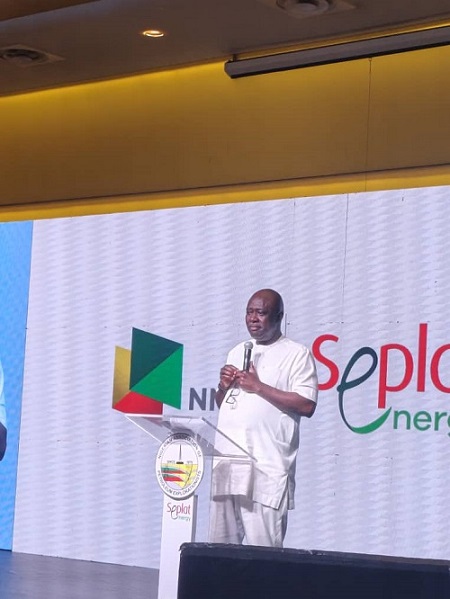
Mr. Heineken Lokpobiri, Minister of State for (Oil)
…Number of active drilling rigs in the country has increased from 10 to more than 60 currently, reflecting growing activities by operators across the industry.
…Nigeria’s GDP, oil and gas remain dominant contributors to the country’s foreign exchange earnings.
-Felix Douglas
The Minister of State for Petroleum Resources (Oil), Heineken Lokpobiri has said Nigeria’s crude oil production has increased from about one million barrels per day in August 2023 to more than 1.8 million barrels per day, attributing the improvement to increased drilling activities and ongoing government reforms in the petroleum industry.
The Minister disclosed this while addressing delegates at the 44th Annual International Conference and Exhibition of the Nigerian Association of Petroleum Explorationists (NAPE), where he highlighted the Federal Government’s efforts to boost production, attract investments and unlock the country’s untapped hydrocarbon resources.
Speaking on the conference theme, “Unlocking More Barrels: Driving Reserves Growth Through Exploration, Local Capabilities and Adaptive Technology,” he said the government’s priority was to expand Nigeria’s production capacity and ensure that the country translates its vast hydrocarbon resources into economic value.
He recalled that when he was appointed in August 2023, Nigeria’s crude oil production stood at approximately one million barrels per day, excluding condensates.
According to Lokpobiri, available industry records now indicate production of more than 1.8 million barrels per day, representing significant progress, although he acknowledged that the country had yet to reach its desired production level.
Speaking on the conference theme, “Unlocking More Barrels: Driving Reserves Growth Through Exploration, Local Capabilities and Adaptive Technology,” he said the government’s priority was to expand Nigeria’s production capacity and ensure that the country translates its vast hydrocarbon resources into economic value.
The Minister stressed that an additional 100,000 barrels per day represents substantial economic value, noting that some countries, including Nigeria’s neighbours, produce less than that volume.
He said the administration was laying the foundation for sustainable oil and gas production through increased drilling campaigns and renewed exploration activities.
Lokpobiri disclosed that the number of active drilling rigs in the country had increased from about 10 when the administration assumed office to more than 60 currently, reflecting growing activities by operators across the industry.
“If you don’t drill today, there will be nothing to unlock tomorrow,” he said, emphasising that sustained exploration and drilling were essential to securing Nigeria’s future production
The Minister also argued that reserves figures alone have little economic significance unless the resources are developed and brought to market.
Using Venezuela as an example, he noted that despite having more than 300 billion barrels of proven crude oil reserves, the country continues to face significant economic difficulties.
Lokpobiri maintained that Nigeria must move beyond celebrating its estimated 37 billion barrels of crude oil reserves and concentrate on the investments and activities required to commercialise its resources.
The minister further linked the performance of the petroleum industry to Nigeria’s foreign exchange position, citing Central Bank of Nigeria figures which he said showed that approximately 85 per cent of the country’s foreign reserves were generated from the oil and gas sector.
He argued that although the non-oil sector contributes significantly to Nigeria’s Gross Domestic Product (GDP), oil and gas remain the dominant contributors to the country’s foreign exchange earnings.
He expressed optimism that sustaining the current production growth trajectory over the next four to five years would significantly strengthen Nigeria’s foreign reserves.
He recalled that during his early years in Warri, he was familiar with an industry training institution that served as an incubation centre for young professionals, providing them with practical skills and exposure to real industry operations.
He expressed concern that the closure of such a training facility could create a manpower gap in the industry if urgent steps were not taken to revive similar initiatives.
Lokpobiri disclosed that NAPE had recently approached his office with a proposal to establish or support an industry-backed training initiative, assuring the association of government support.
According to him, petroleum engineering graduates must be exposed to real industry operations, while university lecturers should also benefit from practical experience to improve the quality of professional training.
He further called for increased frontier exploration, particularly in Nigeria’s underexplored sedimentary basins, noting that the country’s hydrocarbon potential extends beyond its established producing areas.
He identified the need to intensify exploration activities in basins such as Anambra, Chad and Benue Trough, among other frontier areas, to discover additional oil and gas resources.
The minister noted that the Petroleum Industry Act (PIA) had provided for a dedicated fund for frontier exploration, expressing confidence that sustained investment in these areas could significantly increase Nigeria’s reserves.
He also referred to the potential of deepwater exploration, arguing that the country’s offshore acreage could hold substantial additional resources that require further investigation and certification.
On attracting foreign investment, Lokpobiri disclosed that Nigeria had received encouraging investment interest from international financial groups following his recent visit to Abu Dhabi.
He said one investment group had indicated its willingness to mobilise about $15 billion for investment in Nigeria, citing the need for international investors to diversify their portfolios across different geographical locations.
The minister explained that his administration was also working to mobilise domestic and African capital to finance energy development, particularly amid challenges associated with access to international financing.
He described the weaponisation of access to capital against developing economies, particularly African countries, as one of the reasons behind the establishment of the African Energy Bank.
Providing an update on the institution, he announced that the African Energy Bank had formally been launched in Nigeria on October 31, 2026, following the completion of key requirements for its take-off.
He disclosed that the bank had appointed its president and board, adding that January 4, 2027, had been scheduled for the commencement of its formal operations.
According to him, the institution would help mobilise capital for Africa’s petroleum and energy industries while providing an alternative financing platform for projects across the continent.
He said discussions were ongoing with international investment groups to explore opportunities for partnership with the bank, whose headquarters is located in Nigeria.
Lokpobiri described Nigeria as strategically positioned to benefit from the changing global energy landscape, urging industry stakeholders to take advantage of emerging opportunities to attract investments, expand production and strengthen indigenous capabilities.
He assured NAPE of the government’s continued willingness to support initiatives that would advance exploration, professional development and sustainable growth in the petroleum industry.
He concluded by expressing appreciation for the contributions of speakers and industry experts at the conference, saying the government looked forward to receiving recommendations from the technical sessions and discussions.
He reaffirmed his commitment to supporting the association and the broader petroleum industry, even after the end of his tenure in office.
Comment here