
In the Niger Delta, the presence of oil has never been quite the same thing as the presence of opportunity. Beneath the creeks and across the region’s terrain, the industry has built the infrastructure, acquired the expertise, and committed the capital required to bring hydrocarbons to the surface. But the value of an extractive operation is not exhausted by what it takes out of the ground. It is measured equally by what it leaves behind: the technical skills it nurtures, the industrial capabilities it helps build, and the economic pathways that become possible because the enterprise is there. These outcomes do not emerge automatically from crude production. They require deliberate investment.
In a technically demanding environment, that investment must centre on the people tasked with sustaining operational integrity. Fluency in complex disciplines such as production engineering, process control, instrumentation, asset integrity, and industrial automation does not happen through casual observation. It is built through rigorous instruction, accredited curriculum standards, and direct exposure to the systems that govern active assets. Translating that operational reality into long-term practice depends on steady alignment between the operators who manage the fields and the statutory authorities charged with national content development.
That alignment was evident in 2025, when Ado Oseragbaje, Chief Executive Officer of Heritage Energy Operational Services Limited, led the OML 30 Joint Venture leadership, comprising representatives of NNPC Exploration and Production Limited and Shoreline Natural Resources Limited, to meet Felix Omatsola Ogbe, Executive Secretary of the Nigerian Content Development and Monitoring Board, where they restated their commitment to advancing the local content agenda across OML 30. Discussions focused on indigenous supplier development, research and development, and human capacity development.
At that Lagos meeting, Oseragbaje and the joint venture partners presented their long-term development strategy for OML 30, citing indigenous capability expansion as one of the pillars. He noted that sustainable asset growth depends on equipping Nigerian professionals and domestic service companies to take ownership of complex operations. Ogbe welcomed the joint venture’s approach and pledged the Board’s institutional support to advance these shared human capital objectives.
Execution across the joint venture continues to match those commitments. Going beyond the baseline requirements of statutory compliance, the partners have integrated human capital development into the operational life of the asset as a matter of institutional philosophy. The leadership team approaches local capability building as a deliberate stewardship responsibility. Over the past few years, the joint venture has, in collaboration with the Board and training services providers, graduated multiple cohorts in specialised disciplines, including gas lift compressor installation, project management, and subsea engineering, reflecting a self-driven commitment to the workforce that sustains the industry.
That institutional philosophy finds its direct expression in structured training programmes spanning multiple locations, from Delta State to Rivers and Lagos states. These initiatives run as intensive twelve-month programmes featuring rigorous selection processes designed to identify and cultivate top-tier domestic talent.
Speaking on the strategic value of this approach, Felix Usiwo, Nigerian Content Development Manager at Heritage Energy Operational Services Limited, highlights how building deep technical capability directly reinforces the broader industrial base.
“An asset is only as resilient as the domestic base supporting it. When we build deep technical capability in local engineering, contracting, and other specialised services, we are systematically stripping vulnerability out of our supply chain,” Usiwo said.
“When a pump trips, or when you have scheduled maintenance, you cannot afford to wait weeks for external intervention. What we are doing with Nigerian Content in our organisation is building that domestic backbone. We are developing the local technical depth that ensures faster turnaround, lower downtime, and absolute cost predictability to our operations.”
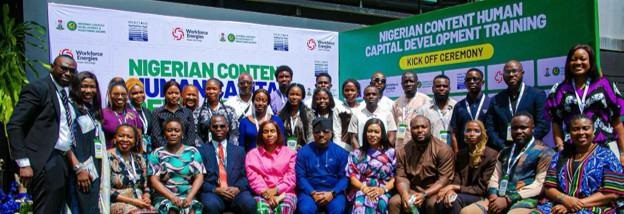
This domestic backbone is currently being reinforced in Lagos, where twenty-three professionals recently commenced a comprehensive twelve-month Digitalisation and Field Readiness training programme.
To bridge the gap between theory and execution, the curriculum is divided into two distinct phases: intensive classroom instruction followed by structured on-the-job (OJT) deployment. As upstream operations grow increasingly reliant on data analytics, automated process controls, and remote monitoring, local capability must evolve beyond traditional mechanical disciplines to encompass the software architectures that dictate modern asset efficiency. Slated for completion in October 2027, the programme is designed to embed advanced digital fluency directly into the domestic workforce.
The Lagos induction marks the ninth capacity-building initiative sponsored by the OML 30 joint venture in 2026, sustaining a continuous technical pipeline across the operational footprint. During the second and third quarters of the year, the preceding cohorts in Delta and Rivers states concluded their twelve-month programmes. Having met the requisite standards, these specialists have already transitioned into the broader Nigerian talent pool, directly fortifying the domestic service base that the upstream sector relies upon.
While the OML 30 joint venture provides the funding and platform alongside its local training partners, translating that investment into actual competence rests entirely with the trainees. Nigerian Content Advisor at Heritage Energy, Sanya Okebiorun, representing General Manager, Supply Chain and Business Services, Uzo Nwagwu, emphasised the role of individual accountability throughout the duration of the training.
“I strongly encourage you to approach this programme with utmost dedication, discipline, and a drive for excellence. Work closely and collaboratively with the facilitators to ensure you extract maximum value, transforming this opportunity into measurable skills and lasting professional growth.”
Ultimately, the return on these investments extends beyond the immediate operational requirements of OML 30. By converting statutory compliance into a core asset management strategy, the JV is engineering a self-sustaining industrial ecosystem. When these specialists deploy their expertise across flow stations, remote control rooms, and domestic contracting firms, they establish the technical authority required to manage Nigeria’s energy infrastructure independently. For Heritage Energy and its JV Partners, this is the definitive metric of sustainable asset development: ensuring that long after the hydrocarbons are recovered, the capacity to drive the sector remains firmly rooted in the domestic economy.*
Comment here