
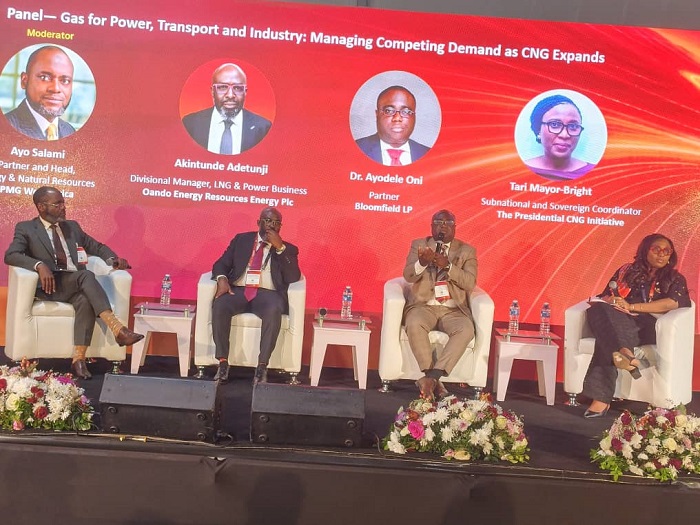
L-R: Ayo Salami, Partner and Head, Energy & Natural Resources, KPMG West Africa, Akintunde Adetunji, Divisional Manager, LNG & Power Business Oando Energy Resources Plc, Dr. Ayodele Oni, Partner Bloomfield LP; Tari Mayor-Bright, Subnational and Sovereign Coordinator, The Presidential CNG Initiative at a panel session during the Nigeria Energy Leadership Summit in Lagos.
-Felix Douglas
Industry experts have called for increased investment in gas infrastructure, improved regulatory coordination and consistent policy implementation to ensure Nigeria meets rising demand for gas across the power, transportation and industrial sectors without creating supply competition.
The stakeholders made the call during a panel session titled “Gas for Power, Transport and Industry: Managing the Competing Needs as CNG Expands,” where industry operators, legal practitioners and energy experts examined the challenges and opportunities associated with Nigeria’s growing gas market.
Speaking during the discussion, Tari Mayor-Bright of the Presidential Compressed Natural Gas Initiative (PCNGI), who also serves as Head of Gas Integration, said the expansion of the CNG programme was not competing with gas supply to the power sector but was creating additional demand and economic opportunities across the gas value chain.
She explained that the initiative, initially conceived as a palliative measure following the removal of fuel subsidy, was designed to provide Nigerians with alternative fuel options while developing an integrated gas value chain linking upstream producers, midstream infrastructure operators and downstream consumers.
According to Mayor-Bright, the growing adoption of CNG has increased awareness of natural gas and encouraged upstream producers who were previously reluctant to engage with the market to explore supply opportunities.
She noted that the programme had also stimulated the development of virtual gas distribution systems, enabling gas to reach commercial and industrial consumers beyond existing pipeline networks.
She maintained that the CNG mobility market was not taking gas volumes away from power generation, stressing that both sectors could grow together if the necessary infrastructure and commercial arrangements were established.
However, another panelist, Akintunde Adetunji, Divisional Manager, LNG & Power Business, Oando Energy Resources Plc, warned that although there was currently no significant competition between the CNG and power sectors, increasing demand could create pressure around shared infrastructure in the coming years.
He explained that CNG suppliers could attract higher commercial returns because their prices were benchmarked against transportation fuel, unlike the power sector, where affordability and strategic considerations limit the prices consumers can pay.
Adetunji cautioned that without adequate infrastructure and appropriate commercial frameworks, gas suppliers could increasingly favour CNG and industrial customers at the expense of power generation.
He therefore stressed the need for investments that would support growing demand across the different segments of the domestic gas market.
Also speaking, Dr. Ayodele Oni, Partner Bloomfield LP, identified policy implementation, regulatory coordination and commercial viability as critical factors for sustaining gas investments.
He referenced the Petroleum Industry Act (PIA), particularly its domestic gas delivery obligation, explaining that the shift from a supply obligation to a delivery obligation was intended to ensure that allocated gas actually reached the domestic market.
He, however, expressed concern over the reported gap between allocated and delivered volumes, noting that implementation remained a major challenge.
He also called for improvements in the administration of Import Duty Exemption Certificates (IDEC), which provide fiscal relief for eligible gas, CNG, LPG and electric vehicle investments.
According to him, delays in processing the certificates could undermine the benefits of government incentives, particularly when investors have already committed funds to equipment and other project requirements.
He further highlighted the role of the Midstream and Downstream Gas Infrastructure Fund (MDGIF) in financing gas projects, while calling for improved commercial arrangements, longer-term contracting considerations and better coordination among regulatory institutions.
He emphasised that gas projects must operate under commercially sustainable conditions to attract lenders and achieve financial close.
On the role of domestic manufacturing, Mayor-Bright identified local production and assembly of CNG equipment and components as a major policy priority.
She said Nigeria remained heavily dependent on imported components for CNG conversion kits, refueling stations and other equipment, resulting in high costs and long delivery timelines.
Using the conversion of diesel-powered trucks as an example, she disclosed that a single conversion kit could cost about N13 million, arguing that local manufacturing of selected components could reduce costs, create employment and strengthen domestic technical capacity.
She also advocated the establishment of local assembly lines for major CNG refueling station components, noting that some imported equipment could take between six and eight months to manufacture and deliver.
Mayor-Bright added that the initiative had encouraged local assembly of buses, citing manufacturers including Innoson, Nord and other Nigerian assemblers.
Providing an update on the programme, she said Nigeria had recorded approximately 250,000 vehicle conversions, combining government-supported and private-sector activities.
Mayor-Bright disclosed that the number of operational commercial conversion centres had increased to 375 while an average of 20,000 vehicles was being converted monthly.
She added that the initiative was working towards expanding conversion capacity and increasing the number of refueling stations to achieve the critical mass required for a sustainable CNG market.
On investment priorities, Dr. Ayodele said increasing domestic gas production remained the foundation for expanding the CNG market without diverting existing supplies from power and industrial consumers.
He urged regulators, particularly the Nigerian Upstream Petroleum Regulatory Commission (NUPRC), to accelerate approvals and consent processes required for upstream investments, including field development and other project activities.
He argued that timely regulatory approvals, alongside existing fiscal incentives and improved access to affordable financing, would encourage producers to invest in additional gas production.
He also maintained that CNG should be regarded as an additional domestic gas customer rather than a competitor for existing supply.
Addressing the domestic gas pricing framework, Adetunji said the market would eventually require greater price flexibility to reflect the different commercial realities of power generation, transportation and industrial consumption.
He explained that allowing prices to reflect costs would encourage investment while ensuring that suppliers could recover their investments across the value chain.
However, he stressed that such reforms must be supported by adequate infrastructure, contract certainty and appropriate government interventions to protect the sustainability of the power market.
In their concluding remarks, the panelists identified infrastructure expansion, stronger coordination between government agencies, faster regulatory approvals and improved policy implementation as essential to ensuring that Nigeria’s gas resources support multiple sectors.
They agreed that the success of the expanding CNG market would depend on developing an integrated gas value chain capable of meeting the needs of transportation, power generation and industry without undermining the commercial viability of any segment.
The discussion underscored the need for deliberate collaboration among government, regulators, gas producers, infrastructure operators and investors to translate Nigeria’s abundant gas resources into reliable energy supply, industrial growth and economic development.
Comment here