
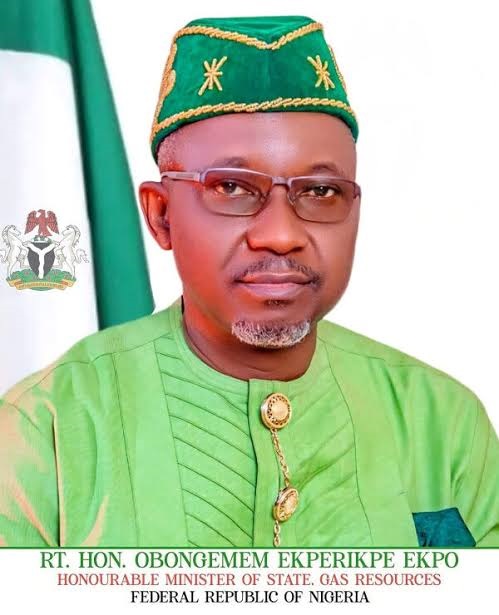
Rt. Hon. Ekperikpe Ekpo, Minister of State for Petroleum Resources (Gas)
…OGTAN Conference is a catalyst for industrialisation, investment and sustainable economic growth
…Human Capacity Development must therefore remain at the centre of the Decade of Gas.
-Felix Douglas
Speaking during his keynote address at the Oil and Gas Trainers Association of Nigeria (OGTAN) Human Capacity Development Conference, Minister of State for Petroleum Resources (Gas), Rt. Hon. Ekperikpe Ekpo, commended the Association for its sustained commitment to professional excellence and human capacity development across Nigeria’s oil and gas industry.
The Minister pointed that through OGTAN focus on competence, standards and continuous learning, the Association continues to play important roles in developing the skilled workforce required to sustain the growth and competitiveness of the petroleum sector.
He said the theme of the conference, “Empowering People, Driving Performance Shaping the Future of Oil & Gas,” is both timely and compelling. It aligns with the Federal Government’s determination, under the leadership of President Bola Ahmed Tinubu to reposition Nigeria’s energy sector as a catalyst for industrialisation, investment, job creation and sustainable economic growth.
“More importantly, the theme reinforces a fundamental truth: the future of our energy industry will be determined not only by the resources beneath our soil, but by the quality, competence and ingenuity of our people.”
Ekpo added that Nigeria is richly endowed with oil and gas resources, including one of Africa’s largest natural gas endowments and enormous opportunities across the petroleum value chain.
The Minister said resources alone do not create prosperity. “No refinery operates efficiently without skilled engineers and technicians. No gas processing facility succeeds without competent operators. No pipeline remains safe without trained personnel. And no investment delivers sustainable value without capable regulators, commercial experts, project managers, researchers and innovators.”
It is people who transform natural resources into national prosperity.
Ekpo cautioned that if Nigeria is to achieve greater investment, improved productivity, enhanced energy security and sustainable economic growth, the country must invest deliberately in the knowledge, competence and capabilities of its people.
He said the declaration of 2021–2030 as Nigeria’s Decade of Gas represents much more than a policy initiative. It is a national development strategy that recognises natural gas as a critical enabler of Nigeria’s industrial and economic transformation.
“Our ambition is to deepen domestic gas utilisation, improve power generation, expand cleaner cooking and transportation fuels, stimulate gas-based industries, create jobs, enhance energy access and strengthen Nigeria’s position in regional and global energy markets.”
However, infrastructure alone cannot deliver this ambition. As Nigeria expands gas processing facilities, pipelines, LNG projects, CNG infrastructure, LPG distribution networks, petrochemical facilities and other gas-based industries, the country must simultaneously develop the people who will design, finance, construct, operate and maintain these assets.
Infrastructure creates opportunity, but human capacity converts opportunity into sustainable value. Human Capacity Development must therefore remain at the centre of the Decade of Gas and Nigeria’s broader energy transformation.
The Minister told participants at the OGTAN conference that global energy landscape is evolving at unprecedented speed. Artificial Intelligence is transforming exploration and decision-making. Automation is redefining operations. Digital twins and data analytics are improving asset performance. Cybersecurity has become fundamental to critical energy infrastructure, while carbon management, emissions reduction and cleaner technologies increasingly influence investment decisions and market access.
Oil and gas workforce must be equipped not only with traditional technical competencies, but also with capabilities in Artificial Intelligence, digital technologies, data analytics, automation, cybersecurity, gas commercialisation, carbon and emissions management, project finance, contract negotiation, energy economics and strategic leadership.
Human capacity development must never be regarded merely as a compliance requirement or an annual organisational activity. It must be treated as a strategic investment in productivity, safety, innovation and competitiveness.
Ekpo made it known that the true measure of training is not the number of courses attended or certificates issued. It is the measurable improvement in competence, productivity, safety, operational efficiency, innovation and organisational performance.
“We must therefore move from training for training’s sake to training for performance and measurable impact.”
The Minister reiterated that Nigeria has made significant progress in developing indigenous capacity through the implementation of the Nigerian Oil and Gas Industry Content Development Act 2010.
He acknowledged the important work of the Nigerian Content Development and Monitoring Board (NCDMB) in promoting indigenous participation, skills development, technology transfer and the growth of Nigerian capacity across the oil and gas industry.
Through its Nigerian Content mandate and various human capacity development interventions, the NCDMB has contributed significantly to creating opportunities for Nigerians to acquire the technical, professional and entrepreneurial competencies required to participate meaningfully in increasingly complex oil and gas activities.
At present, Nigerian professionals and indigenous companies are playing increasingly important roles across the upstream, midstream and downstream segments of the petroleum industry. Local technical expertise continues to grow, and Nigerian professionals are demonstrating their capabilities on increasingly complex projects.
Ekpo told operators in the industry to create greater opportunities for young Nigerians and women to participate meaningfully across technical, commercial and leadership roles in the oil and gas value chain.
The Minister said through the Ministry of Petroleum Resources, Gas remains committed to supporting the development of a highly skilled, innovative and globally competitive petroleum-sector workforce.
He called for development of Nigerian professionals whose competence is respected and sought after anywhere in the world.
He said OGTAN has an important responsibility to continue evolving as a strategic human-capital development partner for Nigeria’s energy transformation—one that anticipates the skills of tomorrow and ensures that Nigerian professionals are prepared for the opportunities of the future.
“As we advance the Decade of Gas and position Nigeria as a leading gas-powered economy, let us place Human Capacity Development at the heart of our policies, investments and strategic decisions.
According to the Minister, government, industry, academia and professional organisations such as OGTAN must work together to build a workforce that is competent, innovative, adaptable, productive and globally competitive.
Comment here