
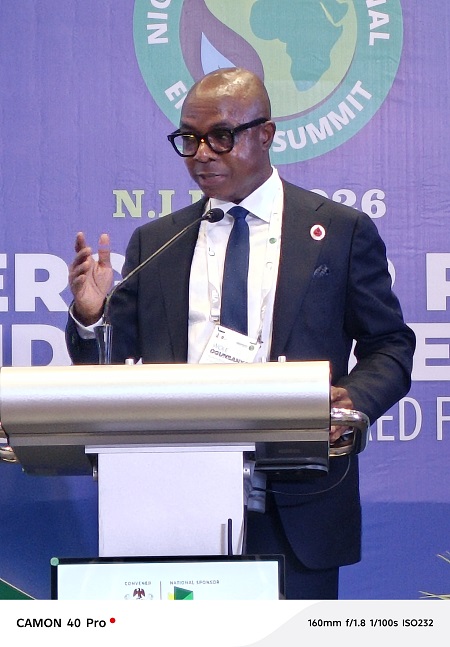
Engr. Wole Ogunsanya, Chairman of PETAN
The Petroleum Technology Association of Nigeria (PETAN) has said Nigeria’s oil and gas industry does not have a talent problem, but a talent pipeline problem, with critical mid-career professionals increasingly being recruited by international markets just as they reach peak value to Nigerian operators.
Engr. Wole Ogunsanya, Chairman of PETAN, disclosed this in his opening panel speaking notes during the first panel session of the OGTAN 2026 Human Capital Development (HCD) Conference in Warri, Delta State.
Ogunsanya, who was represented on the panel by Dr. Joan Faluyi, CEO of Offshore Dimensions and PETAN’s Publicity Secretary, said the talent pipeline is structurally fractured at three critical points: the mid-career workforce, hands-on technical competency and readiness for emerging technologies.
He said Nigerian universities continue to produce capable graduates, while the country retains a strong pool of experienced, world-class senior professionals.
“The problem lies in what happens in between,” he said.
According to PETAN, Nigeria is steadily losing experienced mid-tier professionals, including 10-to-15-year drilling engineers, completions specialists, ROV supervisors, and metering and instrumentation leads, to international markets.
“We develop them, and global markets recruit them,” Ogunsanya said.
He described the trend as one of the sharpest operational constraints facing PETAN members, noting that companies can secure contracts but still struggle to find specialist personnel to execute them.
Beyond the mid-career talent drain, PETAN identified a widening gap between formal qualifications and demonstrated hands-on competence.
The association said the challenge is not necessarily a lack of classroom knowledge, but limited access within Nigeria to simulator time, supervised field experience and Original Equipment Manufacturer (OEM) training.
Where such training is unavailable locally, indigenous companies are forced to send personnel abroad, increasing costs and potentially putting Nigerian-trained crews at a disadvantage when assessed against international peers.
Ogunsanya said the gap could be addressed locally through stronger collaboration among educational institutions, operators, OEMs and indigenous service companies.
On emerging technologies, PETAN said the next cycle of oil and gas contracts would increasingly be shaped by digital systems, automation and artificial intelligence, stressing that Nigeria’s challenge is not a lack of innovation.
He cited a Nigerian AI-enabled subsurface solution that recently won the NCDMB Tech-Innovation Challenge in Yenagoa as evidence of the country’s capacity to develop innovative technologies.
The bigger challenge, he said, is building a sufficient pool of professionals capable of safely deploying, validating and scaling such technologies in live operations.
Without addressing the three gaps simultaneously, Ogunsanya warned that Nigeria risks “localising yesterday’s services while importing tomorrow’s.”
PETAN Seeks Greater Role in Industry Training
Ogunsanya reaffirmed PETAN’s commitment to moving from “consumers” to “partners” in human capital development, saying its members have already begun providing industry-based training but require formal recognition, accreditation and scale.
He disclosed that the association is working with industry partners on structured graduate placements within live service-company operations, with additional proposals before international and indigenous operators.
He said the priority is to move the initiative from pilot programmes to a systematic, industry-wide model.
According to PETAN, indigenous service companies provide a natural platform for practical training because “the best classroom in the industry is a live project.”
A graduate embedded in an indigenous service company for 12 months, the association said, can gain exposure to real equipment, procedures, clients, safety requirements, documentation and performance expectations — turning academic knowledge into practical competence.
To formalise this approach, PETAN proposed three measures.
The first is recognition of workplace learning, with operators encouraged to recognise structured placements in qualified service companies as certifiable workplace training that can be counted, credited and funded.
The second is greater funding access for indigenous-led training programmes. PETAN called for a transparent and measurable share of Nigerian Content-funded HCD resources to be competitively allocated to accredited indigenous training programmes, alongside specialist international training where necessary.
The third is a joint accreditation pathway with OGTAN.
Ogunsanya said PETAN is proposing an accreditation framework jointly developed with OGTAN, combining OGTAN’s training and quality standards with the field expertise, facilities and worksites available across PETAN member companies.
“OGTAN brings the standards. PETAN members bring the worksites. Put those together, and Nigeria can train more of its own people at home,” he said.
Ogunsanya stressed that the proposal is not a request for lower standards or preferential treatment, but for formal recognition of industry-based training under clearly defined standards that PETAN members are prepared to meet.
Comment here