
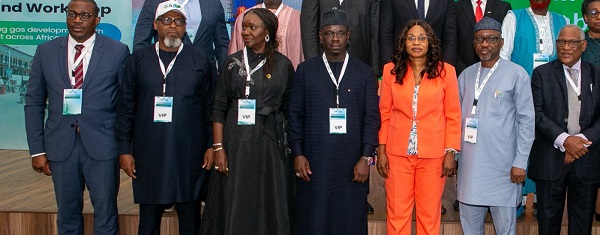
L-R: World Bank Country Director for Nigeria, Mathew represented by Justin Beleoken, Coordinating Director of the Decade of Gas Secretariat, Mr. Ed Ubong, Commission Chief Executive, NUPRC, Mrs. Oritsemeyiwa Eyesan, Honorable Minister of Energy, Petroleum and Mines, Senegal – Birame Soulèye Diop, Permanent Secretary Ministry of Petroleum Resources – Mrs Patience Oyekunle, Minister of State for Petroleum Resources (Gas), Ekperikpe Ekpo and Nigerian Midstream and Downstream Petroleum Regulatory Authority (NMDPRA) ,Authority Chief Executive (ACE) , Engr. Saidu A. Mohammed at the Decade of Gas/World Bank Ministerial Roundtable and Workshop in Abuja.
…As the country drives African gas unity for shared prosperity
By UGO AMADI
For decades, Africa has been defined by a painful paradox: a continent sitting on over 600 trillion cubic feet (tcf) of proven natural gas reserves, yet home to 600 million people living in the dark. At the Decade of Gas and World Bank Ministerial Roundtable and workshop, Nigeria sent a clear message to the continent: the era of “stranded resources” must end.
This comes at a time when the Nigerian Upstream Petroleum Regulatory Commission (NUPRC) is tasked with accelerating gas production, streamlining licensing, and enforcing technical standards to move 210+ trillion cubic feet of reserves to market. NUPRC recently revealed that Nigeria’s total oil and condensate reserves stand at 37.01 billion barrels, while total gas reserves rose to 215.19 trillion cubic feet—a strong indication that the “Decade of Gas” is on track.
Invariably, this shows that NUPRC is strategically focused on strengthening the performance of the upstream sector, boosting the expansion of oil and gas reserves, and maintaining steady production levels for collective economic benefit.
According to energy pundits, this progress is driven by the full implementation of the Petroleum Industry Act (PIA) 2021, alongside the execution of the Commission’s core strategic priorities.
As the “Decade of Gas” initiative gains velocity, Nigeria is pivoting from internal restructuring to regional leadership. Speaking at a high-level Ministerial Roundtable, the Minister of State for Petroleum Resources (Gas), Ekperikpe Ekpo, made an urgent case for unity.
“The future of Africa’s energy lies not in isolated pipelines, but in connected systems, shared markets, and collective ambition,” Ekpo told a room of ministers, investors, and development partners.
Ekpo described natural gas as a critical pathway to Africa’s self-reliance, capable of driving industrialisation, expanding energy access, and strengthening economic resilience.
He emphasised that no single country can unlock this potential alone, underscoring regional cooperation as the cornerstone of sustainable development.
With over 210 trillion cubic feet of gas reserves, Nigeria is advancing its “Decade of Gas” initiative to position itself as a regional hub through partnerships with other African nations.
Ekpo cited key cross-border projects already demonstrating the benefits of collaboration, including the West African Gas Pipeline, Trans-Sahara Gas Pipeline, Nigeria–Equatorial Guinea Gas Pipeline, and the Nigeria–Morocco Gas Pipeline.
To scale up impact across the continent, Ekpo outlined four priority areas for deepened cooperation. These include the development of regional gas supply and market frameworks, shifting from fragmented national systems to integrated markets featuring transparent pricing, aggregated demand, and efficient cross-border trade.
The Minister also emphasised the need to expand gas-to-power and clean cooking initiatives to ensure that gas development translates into tangible benefits, such as reliable electricity and improved living standards for citizens. On financing, he called for innovative, climate-aligned funding models, including blended finance structures, increased private sector participation, and stronger collaboration with international partners like the World Bank.
Ekpo further stressed the importance of harmonising policy and regulatory frameworks across countries to reduce investment risks and accelerate project delivery, pointing to Nigeria’s Petroleum Industry Act as a reference model. He described natural gas as Africa’s “transition fuel,” serving as a practical bridge for expanding energy access and supporting industrial growth while ensuring a just and inclusive energy transition.
The Minister urged the Abuja roundtable to move beyond discussions to deliver concrete outcomes, including clearly defined areas of cooperation, the identification of bankable cross-border projects, and the establishment of institutional mechanisms to drive implementation.
Reaffirming Nigeria’s commitment, Ekpo said the country stands ready to collaborate, invest, and provide leadership in building an integrated African gas market. He concluded that aligning visions and coordinating actions would enable Africa to transform from a continent of stranded gas resources into one of integrated energy prosperity.
The Momentum of the “Decade”
Nigeria isn’t just talking; it’s producing. Mr. Ed Ubong, Coordinating Director of the Decade of Gas Secretariat, revealed that the country’s gas production climbed from 6.8 billion cubic feet per day (bcf/d) in 2023 to 7.5 bcf/d in 2025. He attributed this growth to strong collaboration among government institutions, regulators, investors, and industry players.
Nigeria has reaffirmed its ambition to significantly scale up gas production, with a target of delivering up to 12 billion cubic feet (bcf) of gas per day into the market by 2030.
Ubong acknowledged the presence of African leaders and stakeholders, including representatives from South Africa, the South East African Council, and the World Bank.
He also recognised key regulators such as the Nigerian Midstream and Downstream Petroleum Regulatory Authority (NMDPRA) and the NUPRC, as well as the Chairman of the PiCNG ( Presidential Initiative on CNG)). These stakeholders are expected to play a pivotal role in advancing funding discussions to accelerate gas infrastructure projects across Africa.
Under President Bola Ahmed Tinubu’s vision of “Gas for Nigeria’s Prosperity,” the government has established a dedicated Secretariat to bridge the gap between upstream production and downstream demand. By tracking over 215 specific gas projects, the Secretariat ensures that Final Investment Decisions (FIDs) translate into actual molecules moving through pipes.
Ubong identified gas-to-power and the expansion of domestic liquefied petroleum gas (LPG) usage as priority areas. The gas-to-power initiative aims to improve electricity supply, while increased LPG adoption seeks to replace firewood and charcoal, improving public health and environmental sustainability.
Beyond the Pipe: Power and Clean Cooking
The push for gas is about more than industrial exports; it’s a humanitarian mission. The roundtable focused heavily on solving the continent’s electricity deficit and expanding LPG access. For millions of African women currently relying on wood and charcoal, the transition to LPG—championed by the Electric Cooking Nigeria Campaign—is a matter of public health and environmental survival.
Financing the Future
Unlocking 600 tcf of gas requires more than political will; it requires “bankable” projects. With the World Bank at the table, the Abuja talks shifted toward innovative funding models. Ed Ubong noted that over 60 project sponsors are currently engaging with global consultants like McKinsey to refine strategies that attract private capital.
Looking beyond Nigeria, he said the country is positioning itself as a catalyst for a regional gas ecosystem across West Africa. He stressed that achieving this vision would require alignment among countries on supply strategies, demand projections, and infrastructure development.
He highlighted the need for gas pipelines capable of bidirectional flow to enhance flexibility and reliability, noting that projects such as the African Atlantic Gas Pipeline would play a transformative role in connecting regional markets.
On infrastructure, Ubong disclosed that Nigeria has identified 16 critical pipeline projects requiring an estimated $22 billion in investment, emphasising the need for robust public-private partnerships to deliver them.
He also reiterated Nigeria’s commitment to environmental sustainability, noting that efforts are underway to curb gas flaring as production increases, in line with global environmental standards.
The power sector, he said, remains central to the gas agenda, requiring close coordination among key ministries, including Power and Finance, as well as industry operators to ensure a reliable electricity supply.
On domestic consumption, Ubong said Nigeria plans to increase LPG usage from 1.8 million tonnes per annum to 3 million tonnes by 2030. As part of this strategy, over five million gas cylinders are expected to be distributed nationwide to encourage the transition to cleaner cooking energy.
He concluded that while significant progress has been made over the past three years, sustained collaboration remains critical to achieving Nigeria’s gas ambitions and broader energy security goals.
“This platform provides an opportunity to deepen partnerships, strengthen regional cooperation, and accelerate delivery,” Ubong said. “Africa’s energy future depends on our ability to work together across borders, institutions, and value chains to achieve shared prosperity.”
Unity: The Key to Africa’s Energy Sovereignty
Senegal’s Minister of Energy, Petroleum and Mines, Birame Soulèye Diop, also emphasized the need for stronger collaboration between Francophone and Anglophone countries to achieve energy security and sustainable development in Africa.
He stressed that African countries must work together to translate their vast resource endowments into energy sovereignty. “We have sufficient natural resources, but we haven’t exploited them enough to ensure our sovereignty,” Diop stated. “This is crucial for a country to progress; it’s important that the results are felt at the national level. But we are part of an African community where each country shares the same objectives.”
However, the push for gas is about more than industrial exports; it’s a humanitarian mission.
The roundtable focused heavily on gas-to-power to solve the continent’s electricity deficit and the expansion of Liquefied Petroleum Gas (LPG).
As the roundtable concluded, the sentiment was one of a “just transition.” For Nigeria and its neighbors, gas is the “bridge fuel”—the practical pathway to industrialize the continent while gradually lowering emissions.
Nigeria has laid its cards on the table: it is ready to lead, invest, and connect. The goal is no longer just to be a gas-rich nation, but to be the heartbeat of an energy-secure Africa.
UGO AMADI is an energy analyst and Editor of Champion Newspapers
Comment here