
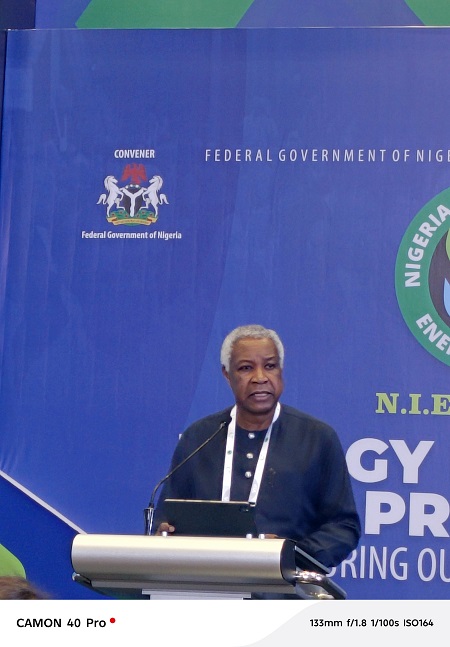
Mr. Osteen Olorunsola, Chairman of Aradel Holdings Plc and Energy Institute
…There has to be cooperation between NUPRC and NMDPRA not to work at cross purposes
Speaking at the 2026 Nigerian International Energy Summit, NIES, Chairman of the Energy Institute and Aradel Holdings Plc, Osteen Olorunsola submitted that despite differences in geography, politics and resource endowment, African countries share common structural challenges that continue to shape energy policy and investment decisions across the continent.
The Aradel Chairman called for stronger regional collaboration and regulatory coordination as the foundation for forging a unified African energy voice.
He identified persistent electricity deficits, weak and unstable transmission infrastructure, heavy dependence on petroleum revenues, limited access to energy, financing constraints, energy transition pressures and untapped mineral and renewable resources as shared realities confronting African economies.
According to him, these similarities should encourage cooperation, yet energy policies and regulations often end at national borders, with little cross-border alignment or collaboration.
He noted that the lack of shared learning, both from successes and failures, has slowed Africa’s progress towards energy security and sustainable growth.
Olorunsola described energy access as a critical driver of economic growth and resilience, stressing that continental initiatives such as the African Continental Free Trade Area, AfCFTA, offer an important platform for aligning energy policies and strengthening cooperation across Africa.
However, he cautioned that large pan-African frameworks can sometimes be too broad and complex to implement simultaneously across the continent.
He advocated a more practical, bottom-up approach that begins at the regional level.
Africa, he said, should leverage its five regional blocs; North, West, East, Central and Southern Africa, as starting points for coordinated energy planning and implementation, before consolidating these efforts into a continent-wide framework.
“This approach will facilitate joined-up thinking with industry participation and help develop a sustainable, unified energy voice for Africa,” he said.
The energy executive also urged stakeholders to critically assess why previous cross-border energy initiatives failed to deliver expected outcomes, citing weak political will, lack of trust, poor governance, limited institutional capacity and insufficient infrastructure cooperation as major obstacles.
Olorunsola said effective collaboration must begin at home. While acknowledging the Petroleum Industry Act, PIA, as a major reform that has improved the business environment, he stressed the need for stronger inter-agency collaboration to achieve implementation excellence.
He specifically called for closer cooperation between the Nigerian Upstream Petroleum Regulatory Commission, NUPRC, and the Nigerian Midstream and Downstream Petroleum Regulatory Authority, NMDPRA, warning that silo mentalities undermine regulatory efficiency and industry growth.
According to him, regulation should focus on enabling industry performance rather than creating bureaucratic bottlenecks through fragmented oversight.
He spoke on successful local collaboration would provide the credibility and momentum needed to drive regional and continental energy cooperation.
The Aradel Chairman emphasised that true collaboration must be built on shared goals, transparency, accountability, trust and a long-term strategic outlook and expressed confidence that with intentional and disciplined cooperation, Africa can develop a unified energy voice capable of delivering sustainable growth and prosperity.
Comment here