
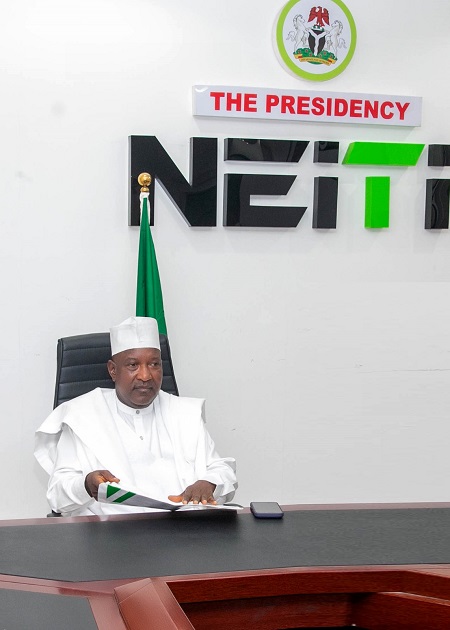
Hon. Musa Sarkin Adar, Executive Secretary of NEITI
-Felix Douglas
Speaking at the Advocacy Dialogue for stakeholders on the implementation of global Extractive Industries Transparency Initiative (EITI), the Executive Secretary (ES) of Nigeria Extractive Industries Transparency Initiative (NEITI), Hon. Musa Sarkin Adar made it know that the dialogue will unpack Nigeria’s preparedness and journey to validation by the global EITI.
“This is one of the series of engagements that NEITI has scheduled for its esteem stakeholders. Your presence today, signifies a shared commitment to transparency and accountability in a sector that is the lifeblood of our nation’s economy.”
Adar added that the meeting is critical because Nigeria’s implementation of the EITI will be benchmarked against the EITI 2023 standard having scored 72 out of 100 points in its last assessment in 2023, “we are determined to achieve a better outcome this time.”
The ES disclosed that EITI is no longer just a narrow checklist. It has evolved into an outcome-oriented credibility test that demands demonstrable reform, meaningful stakeholder engagement, and tangible impact on national governance. The 2023 Standard specifically emphasizes robust, independent participation from civil society, the media, and sub-national actors. It requires not just representation, but genuine influence on policy and governance outcomes.
According to Hon. Adar, Nigeria’s 2023 Validation identified specific gaps that demand immediate action. These are, strengthening its multi-stakeholder engagement mechanisms, providing a more structured, predictable and safe space for civil society participation, improving the accessibility and utility of extractive sector data and explicitly demonstrating how the EITI process contributes to real, impactful policy and extractive reforms across the country.
NEITI has taken these findings with the utmost seriousness, initiating comprehensive reforms. However, the EITI process is fundamentally built on an indispensable tripartite foundation of government, companies, and civil society.
“As we approach the next validation with urgency, our message is simple that Nigeria will be ready. However, this readiness is a shared responsibility and a collective national outcome.
You are central and foundational pillars in interrogating data, asking difficult questions, and holding institutions accountable. This is a mandatory requirement of the EITI Standard itself.”
NEITI’s objectives are to provide clarity and shared ownership regarding corrective actions identified in Nigeria’s 2023 Validation report, review the progress made, identify remaining gaps, jointly develop an implementable framework to address the identified challenges and elevate the essential role of non-state and sub-national actors in advancing Nigeria’s broader reform agenda.
Adar said Civil society and the media have critical roles to play in tracking the implementation of these new laws to ensure reforms genuinely translate into improved public value and citizen welfare.
The ES commended the European Union and International Institute for Democracy and Electoral Assistance (EU-IIDEA) for providing essential support for the program.
The partnership with NEITI underscores a global recognition of the importance of sound governance in galvanizing shared prosperity for citizens.
Comment here