
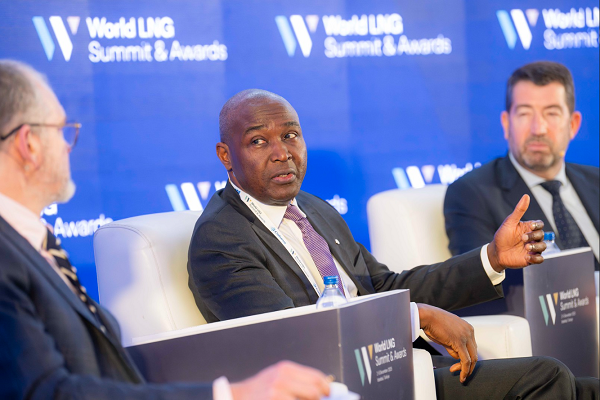
Philip Mshelbila, NLNG’s MD/CEO, speaking on the panel “Energy Expansion in a Challenging Global Trade Environment” at the 25th World LNG Summit in Istanbul, Turkey.
NLNG has called for a new era of global collaboration to strengthen LNG supply, improve affordability for emerging markets, and safeguard energy expansion in a world increasingly shaped by geopolitical fragmentation and trade uncertainty.
Managing Director and Chief Executive Officer of NLNG, Philip Mshelbila, made this call while speaking at the panel titled “Energy Expansion in a Challenging Global Trade Environment” at the World LNG Summit & Awards holding in Istanbul, Turkey.
Mshelbila emphasised that only coordinated effort across the LNG value chain can prevent a widening energy divide and keep natural gas central to a balanced, lower-carbon global future.
In his words: “In order to safeguard global energy security from the risks of geopolitics and unilateral (national and regional) policies and sanctions, LNG contracts must evolve from merely defining volume and price to actively managing sovereign risk, through diversification of supply sources, delivery routes and contract terms.”
He stated that global energy expansion will stall unless structural bottlenecks in LNG supply, pricing, financing, and decarbonisation are urgently addressed and warned of the negative implications of retaining the status quo.
While speaking on shifting trade dynamics in the industry, Mshelbila noted that the LNG market had moved from a period dominated by short-term contracting to heightened interest in long-term commitments after the 2022 supply shock, emphasising that both contract types are now in strong demand, driven by elevated global risk and uncertainty.
Addressing the broader question of how LNG can continue to meet rising global energy demand, Mshelbila stated that several foundational elements like availability, affordability, and decarbonisation must be in place.
He explained that while many still regard natural gas as a transition fuel, its relevance will extend well beyond the next few decades. For this to be realised, he said the industry must secure more supply, ensure improved affordability, and accelerate decarbonisation across the entire natural gas and LNG value chains.
Mshelbila referenced major capacity expansions in the United States and Qatar, alongside NLNG’s own Train 7 development, which will add eight million tonnes per annum of new production as examples of the supply growth needed to meet future global demand. However, he cautioned that affordability remains the most challenging dimension of LNG’s future, noting that high prices have repeatedly pushed developing markets back to coal and other cheaper but environmentally dirtier alternatives.
The World LNG Summit, now in its 25th edition, continues to serve as the industry’s foremost global gathering, bringing together policymakers, producers, buyers, financiers, and innovators to shape the future of LNG.
Comment here